Note
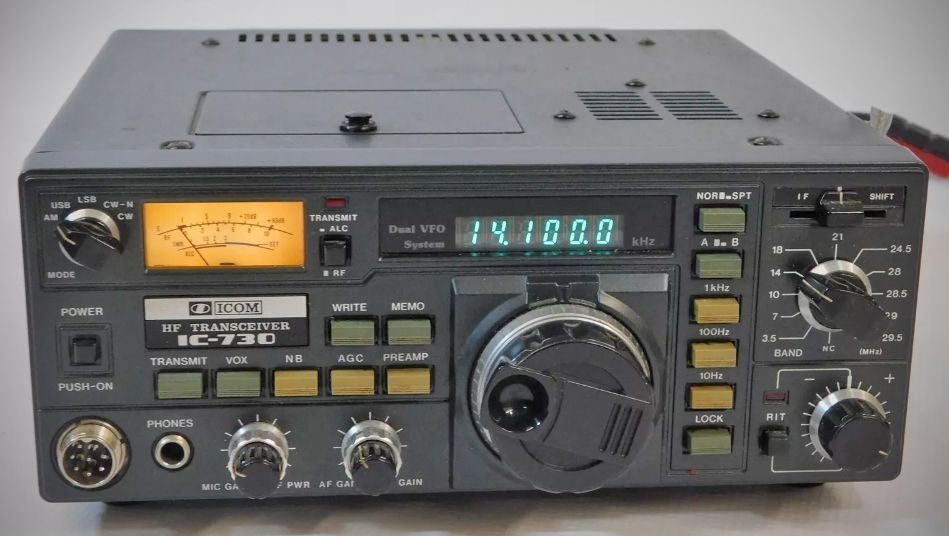
The IC-730 can be considered a high-performance, compact, and versatile HF transceiver for its era, effectively serving as an intermediate to advanced grade product. At the time, it was positioned as a high-value, compact alternative to larger "flagship" base stations, making it a popular choice for both mobile operation and as a primary rig for many operators.
The integration of low-pass and band-pass filters switched electronically by the CPU created a "no tune-up" system for ease of operation.
WARC Bands
The IC-730 hit the market right on the heels of the 1979 World Administrative Radio Conference (WARC), which allocated those new frequency bands to amateurs.
Because hams weren't legally allowed to transmit on them yet—the regulatory rollout was phased in over several years throughout the 80s—manufacturers like Icom had to comply by locking out the transmit capabilities. They gave operators the receiver so they could listen to the new frequencies, but hard-locked the PA from engaging.
The "Unofficial" Factory Fix
Because Icom knew those bands would eventually open up for legal use, they designed the radio to be easily unlocked when the time came. Since this was before the era of firmware updates or hidden digital menus, the lockout was purely physical.
To enable WARC transmit on an IC-730, the standard procedure involves popping off the case, locating the RF unit on the left side of the chassis, and snipping a single, specific green wire (sometimes along with a single resistor, depending on the exact production run). Once clipped, the rig transmits on the WARC bands as if it had been designed to do so all along.
Features
– Solid-State Design: It is a completely solid-state unit, providing approximately 100 watts of output power across the standard bands, but is *receive-only* on the then-new 10MHz, 18MHz, and 24MHz WARC bands. (See note above.)
– Receiver System: The IC-730 utilizes a quadruple conversion superheterodyne system. It features ICOM's "Direct Feed Mixer" (DFM) and an up-conversion system to enhance sensitivity, dynamic range, and spurious response rejection.
– Frequency Control: It employs a CPU-based dual digital VFO system with selectable tuning steps of 10Hz, 100Hz, and 1KHz, allowing for high precision.
– Pass-Band Shift Control: A built-in system allows for continuous adjustment of the IF pass-band center frequency to eliminate interference from nearby signals.
– The unit comes standard with features often found in higher-tier rigs, such as a Noise Blanker, VOX, CW Monitor, and an SWR meter.
– Filter Options: While it includes high-quality third-overtone crystal filters, it also supports optional crystal and AF filters to further improve selectivity in SSB and CW modes.
General Specifications
– Frequency Coverage:
3.5 MHz – 4.0 MHz
7.0 MHz – 7.3 MHz
10.0 MHz – 10.5 MHz (see notes above)
14.0 MHz – 14.35 MHz
18.0 MHz – 18.5 MHz (see notes above)
21.0 MHz – 21.45 MHz
24.5 MHz – 25.0 MHz (see notes above)
28.0 MHz – 29.7 MHz
– Frequency Control: CPU-based 10 Hz step pre-mixed synthesizer with independent transmit-receive frequencies available on the same band.
– Frequency Readout: 6-digit 100 Hz readout.
– Frequency Stability: Less than 500 Hz drift from 1 to 60 minutes after switching on; less than 100 Hz after one hour.
– Antenna Impedance: 50 ohms unbalanced.
Transmitter
– RF Power Input:
– SSB (A3J): 200 Watts PEP input.
– CW (A1): 200 Watts input.
– AM (A3): 40 Watts output.
– Adjustable Output Power: Continuously adjustable from 10 Watts to maximum.
– Carrier Suppression: More than 50 dB below peak power output.
– Unwanted Sideband: More than 55 dB down at 1000 Hz AF input.
– Microphone Impedance: 1300 ohms.
Receiver
– Receiving System: Quadruple conversion superheterodyne featuring continuous Pass-Band Shift Control.
– Sensitivity: SSB/CW: Less than 0.3 microvolts for 10 dB S+N/N; AM: Less than 0.6 microvolts for 10 dB S+N/N.
– Selectivity: SSB/CW: 2.4 KHz at -6 dB; 4.8 KHz at -60 dB; AM: 6.0 KHz at -6 dB; 18.0 KHz at -60 dB.
– Spurious Response Rejection Ratio: More than 60 dB.
– Audio Output: More than 2 Watts at 8 ohms impedanc
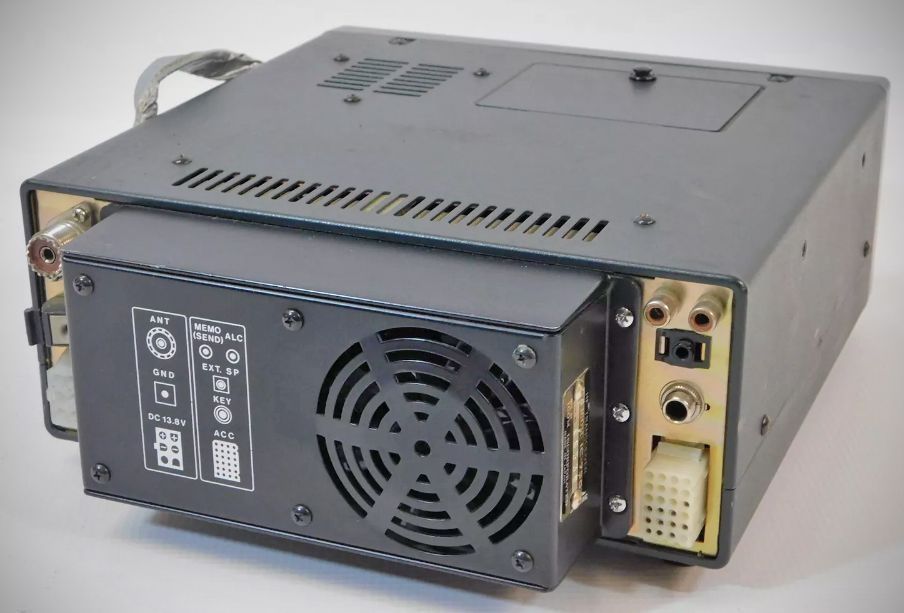
Power Supply Requirements: DC 13.8V ±15% (negative ground) with a maximum current drain of 20A at 200W input.