Note
One of those rare rigs that sets the ether on fire.
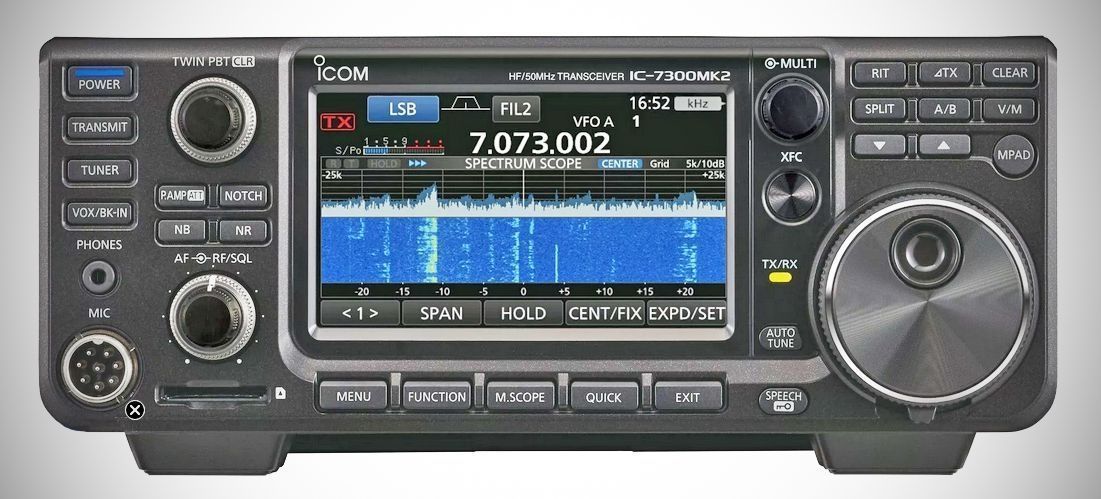
The Icom IC-7300 is a high-performance HF/50 MHz transceiver featuring a pioneering RF direct sampling system and a real-time spectrum scope. It integrates advanced digital signal processing (DSP) into a compact, user-friendly unit with a large color touch-screen interface.
The Icom IC-7300 is widely regarded as a game-changer in the world of amateur radio, often credited with bringing high-end software defined radio (SDR) technology to the masses. Since its debut in late 2015, it has become arguably the most popular HF transceiver of its decade, with global sales exceeding 100,000 units.
The IC-7300 didn't just sell well; it effectively shifted the entire industry toward SDR architectures, forcing competitors to rethink their entry-level and mid-range offerings to keep up with the "7300 standard."
Its immense popularity stems from several key factors that disrupted the market:
The "SDR for Everyone" Movement
Before the IC-7300, high-performance SDRs typically required a tethered computer and complex software to operate. Icom successfully integrated a powerful RF direct sampling system into a standalone "black box" with a traditional physical VFO knob and a built-in screen. This allowed hams to enjoy the benefits of digital signal processing without needing a PC in the shack.
The Visual Revolution (The Waterfall)
One of its biggest selling points is the high-resolution real-time spectrum scope and waterfall display. While waterfall displays existed on more expensive rigs, the IC-7300 made it a standard feature at a sub-$1,500 price point. This changed how people operate; instead of "tuning around" blindly, operators could see active signals and "pounce" on them instantly.
Price-to-Performance Ratio
The radio offered a Reciprocal Mixing Dynamic Range (RMDR) of about 97 dB, which rivaled radios costing twice as much at the time of its release. It provided a clear, quiet receiver and 100 watts of power in a compact frame, making it the "gold standard" recommendation for both new hams and seasoned operators looking for a reliable backup or portable rig.
Ease of Digital Modes
With the rise of FT8 and other digital modes, the IC-7300’s single-cable USB interface (carrying both CAT control and audio) made setup incredibly simple. This "plug-and-play" nature helped it dominate the digital-heavy landscape of modern amateur radio.
Massive Community Support
Because so many units were sold, a massive ecosystem of YouTube tutorials, third-party accessories (like panadapter kits and cooling fans), and forum support developed. If an operator has a question about a setting, a dozen videos or articles usually exist to explain it.
Features
– RF Direct Sampling System: Converts RF signals directly to digital data for processing in an FPGA, reducing noise and improving clarity.
– Real-Time Spectrum Scope: Offers class-leading resolution, sweep speed, and dynamic range with a "Waterfall" display to see signal history.
– 4.3-inch Color TFT Touch LCD: Provides intuitive operation for changing settings, entering frequencies, and navigating menus.
– Built-in Automatic Antenna Tuner: Automatically matches the transceiver to the antenna system across HF and 50 MHz bands.
– IP+ Function: Improves 3rd order intercept point (IP3) performance to better receive weak signals in the presence of strong interference.
– Enhanced RMDR and Phase Noise: Achieves a Reciprocal Mixing Dynamic Range (RMDR) of approximately 97dB and significantly reduced phase noise compared to previous models.
– Multi-Function Control: A dedicated knob and menu system for quick access to various settings.
– SD Card Slot: Used for saving radio settings, recording QSO audio (receive and transmit), and updating firmware.
– Voice Recorder Functions: Allows for quick or basic recording of communications directly to an SD card.
– Digital Modes Support: Includes a built-in RTTY decode and log function, and supports AFSK modes like FT8, PSK31, and JT65 via USB connection.
– USB Port: Supports CI-V remote control, audio input/output for digital modes, and RTTY decoding to a PC.
Specifications
Frequency Coverage
Receiver: 0.030–74.800 MHz
Transmitter: 1.8, 3.5, 5.3, 7, 10, 14, 18, 21, 24, 28, and 50 MHz
– Operating Modes: SSB, CW, RTTY, AM, FM
– RF System: Direct Sampling Superheterodyne
– Intermediate Frequency: 36 kHz
Receiver Sensitivity
SSB/CW (2.4 kHz BW, 10 dB S/N):
< –123 dBm (0.16 μV) for 1.8–29.9 MHz;
< –125 dBm (0.13 μV) for 50 MHz
– Antenna Impedance: 50 Ω (unbalanced)
– Audio Output: > 2.5 W at 10% distortion into an 8 Ω load
Receiver Selectivity
The Icom IC-7300 features a highly customizable digital intermediate frequency (IF) filter system. Because it uses an RF direct sampling architecture, the selectivity is managed by the FPGA and Digital Signal Processing (DSP), allowing for "sharp" or "soft" filter shapes that can be adjusted on the fly to combat interference.
Filter Settings and Shape Factor
The transceiver provides three independent filter presets (FIL1, FIL2, FIL3) for each operating mode. You can adjust the passband width and the "Sharp" or "Soft" shape factor for each.
– Sharp: Designed for maximum signal-to-noise ratio and rejecting adjacent signals. It has a very steep "skirt" (the slope of the filter).
– Soft: Provides a more natural audio quality and rounded filter edges, which can be more comfortable for long periods of listening or when signals are very clear.
Selectivity Specifications (Standard Passband)
The following table shows the default selectivity values. The radio is designed to maintain more than 60 dB of rejection outside the specified bandwidth.
Mode Passband Width (Typical) Rejection (More than)
SSB (BW: 2.4 kHz) 2.4 kHz / –6 dB 3.6 kHz / –60 dB
CW (BW: 500 Hz) 500 Hz / –6 dB 700 Hz / –60 dB
RTTY (BW: 500 Hz) 500 Hz / –6 dB 700 Hz / –60 dB
AM (BW: 6.0 kHz) 6.0 kHz / –6 dB 15.0 kHz / –60 dB
FM (BW: 15.0 kHz) 12.0 kHz / –6 dB 20.0 kHz / –60 dB
Additional Selectivity Tools
Beyond the primary IF filters, the IC-7300 uses several DSP-driven features to further refine selectivity in crowded band conditions:
– win PBT (Passband Tuning): This allows you to electronically narrow the IF passband by shifting the upper and lower limits independently. This is particularly effective for "clamping down" on a signal to eliminate interference from a station bleeding over from an adjacent frequency.
– Notch Filter:
– Auto Notch: Automatically tracks and eliminates multiple heterodyne signals (whistles/tones).
– Manual Notch: A 70 dB deep filter used to manually zero in on and remove a specific interfering carrier without affecting the rest of the audio.
– Digital Noise Reduction (NR): Uses 16 different algorithms to pull weak signals out of the background noise floor.
– Noise Blanker (NB): Specifically designed to suppress pulse-type noise, such as engine ignition or power line interference
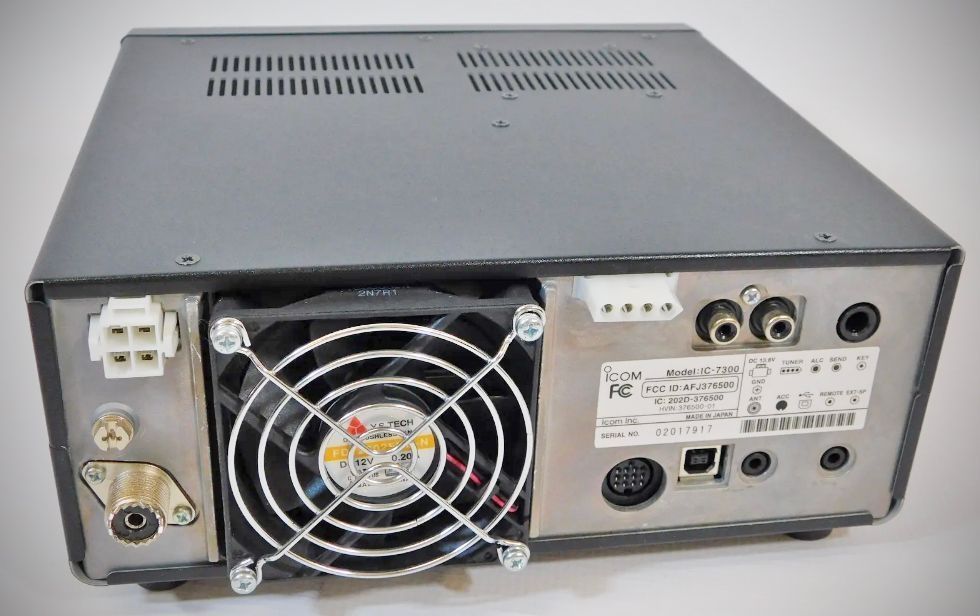
Connectors (Rear)
ANT (PL-259)
DC Power, Ground
USB (B-type)
ACC (13-pin)
REMOTE (CI-V)
EXT-SP (1/8")
KEY (1/4")
SEND
ALC
Connectors (Front)
PHONES (3.5 mm stereo), MIC (8-pin)
Noise Reduction: DSP-based with 16 adjustable levels (0–15)
Selectivity: Adjustable filter widths (Wide, Mid, Narrow) for all modes
Power Requirements
13.8 V DC (±15%) at a minimum of 21 Amps