Note
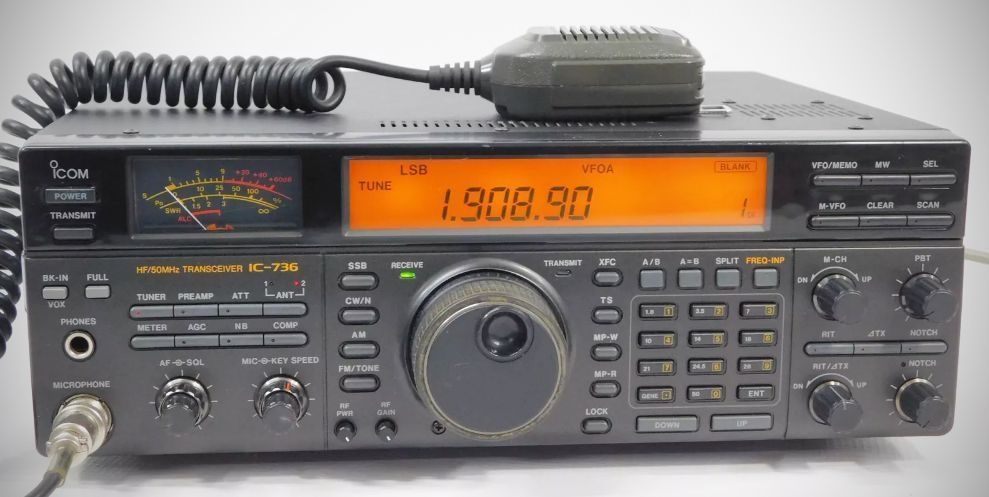
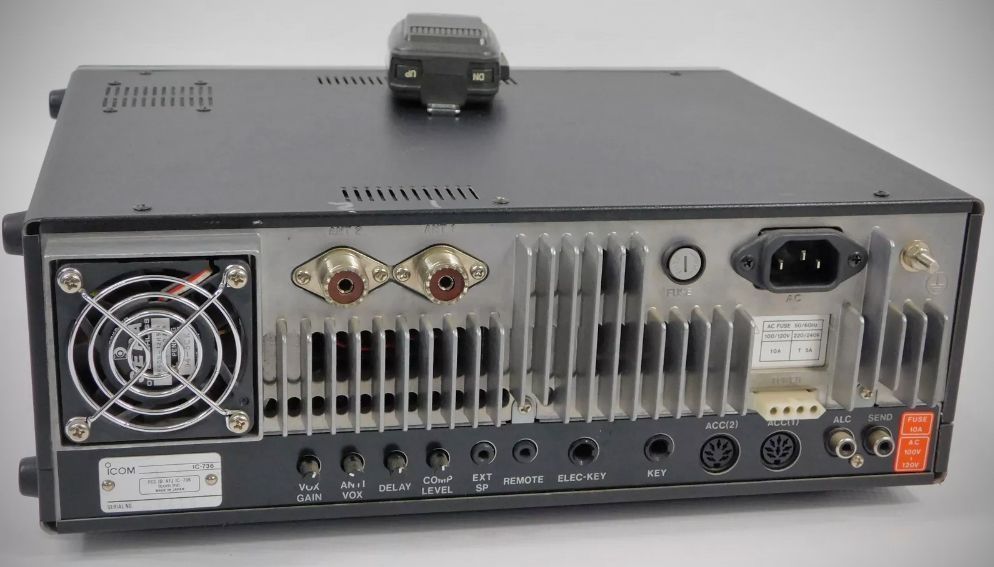
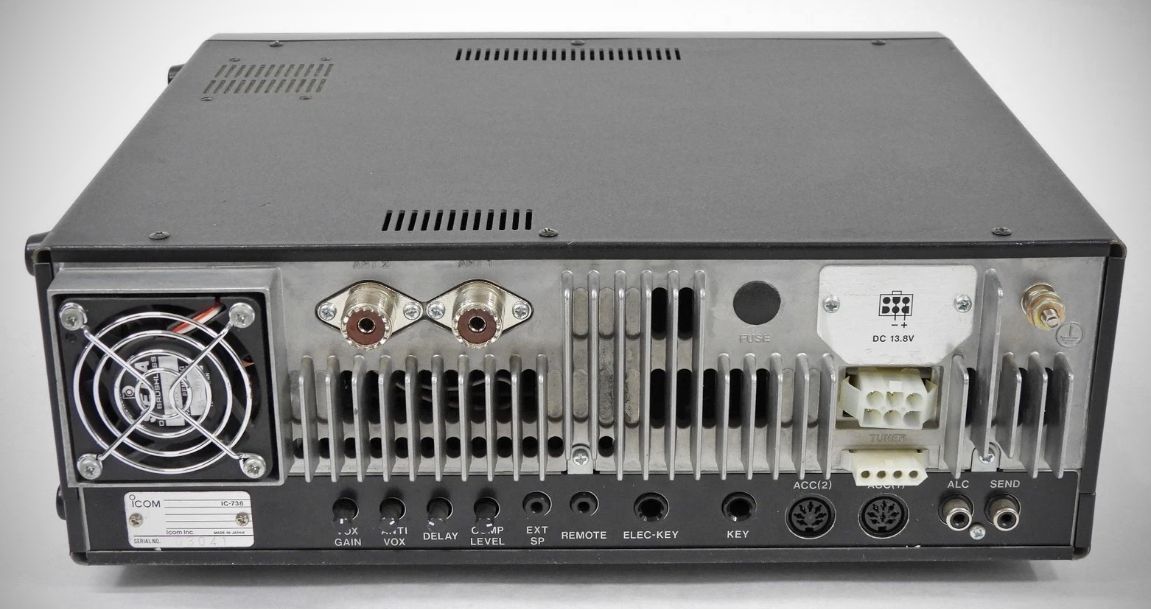
While the IC-736 and 738 are visually identical there are two major differences:
1) The IC-736 is an HF/50 MHz transceiver. The IC-738 is an HF-only transceiver and does not include the 6-meter band.
2) The IC-736 has a built-in AC power supply, whereas the 738 requires an external DC power source.
These transceivers feature solid-state construction and support both semi and full break-in (QSK) CW operations. The units are engineered to operate in environments with temperatures ranging from -10°C to +60°C.
Features
– Operating Modes: Both transceivers are equipped to operate in SSB, CW (with an optional Narrow setting), AM, and FM/TONE modes.
– VFOs and Split Operation: The units utilize VFO A and VFO B modes, which allow for split frequency operation.
– Memo Pads: A built-in memo pad function automatically stores the 5 most recent frequencies and operating modes for quick recall, which can be expanded to a capacity of 10 within the transceiver's set mode.
– Antenna Tuner: Both models include an antenna tuner switch that allows you to manually tune the connected antenna or bypass the tuning circuit. The tuning circuit will automatically bypass after 20 seconds of attempted tuning if it cannot match the antenna.
– CW Keying: An internal electronic CW keyer is integrated into the design, offering adjustable speeds from a minimum of 7 wpm to a maximum of 41 wpm.
– Interference Rejection: A notch control is included to adjust the filtering frequency and reject unwanted signals.
– Audio and Transmit Enhancements: A built-in speech compressor compresses the transmitter audio input to increase the average audio output level and talk power.
– Fine Tuning: Receiver Incremental Tuning (RIT) and Transmit Frequency (ΔTX) controls allow the operator to shift frequencies up to ±9.999 kHz.
– Split Frequency Operation: Supports split frequency functions with a dedicated "Quick Split" feature and a Transmit Frequency Check (XFC) switch to monitor the transmit frequency.
– Passband Tuning (PBT) and a Notch Filter for interference rejection.
– Noise Blanker (NB) to reduce pulse-type noise like ignition interference.
– 20 dB Attenuator and a Preamplifier to handle varying signal strengths.
– Built-in Keyer: Includes a built-in electronic keyer with adjustable speed (7 to 41 wpm) and supports both full and semi break-in operation.
– Features 101 memory channels and a Memo Pad function that stores the 5 (expandable to 10) most recent frequencies and modes.
– Supports multiple scan types, including programmed and memory scans.
– Dual Antenna Selection: Includes an internal antenna switch to toggle between two connected antennas.
Specifications
– RF Output Power (SSB, CW, FM): Continuously adjustable from a minimum of 5 W for QRP operation up to a maximum of 100 W.
– RF Output Power (AM): Adjustable from a minimum of 4 W up to a maximum of 40 W.
– Headphone Impedance: The front panel headphone jack is compatible with equipment rated between 4 and 16 Ω
AC Power (IC-736): The 100-120 V versions require a 10 A FGMB fuse, while the 220-240 V versions require a 5 A high breaking capacity fuse.
DC Power (IC-738): Powered via a 13.8 V DC socket on the rear panel. The input voltage must never exceed 16 V DC.