Note
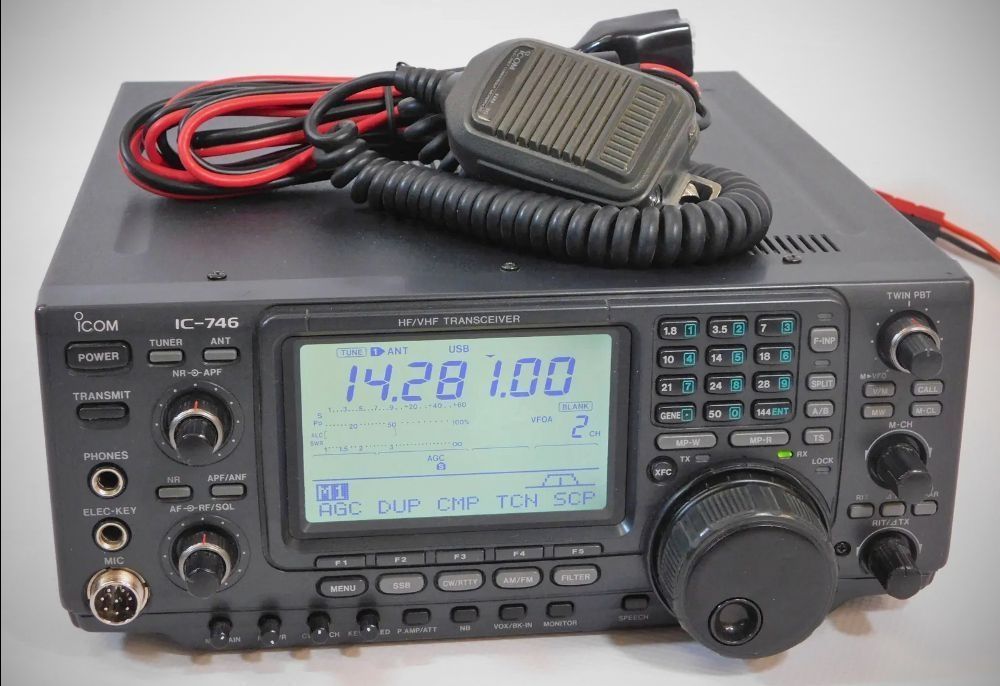
The Icom IC-746 is a versatile, "all-mode" transceiver that carved out a significant niche in the amateur radio world upon its release in the late 1990s. It is particularly well-regarded for being one of the first rigs to offer high-performance coverage across HF, 6 meters, and 2 meters in a single package. The 746 and 746 PRO are visually identical. The 746 was introduced in 1998, and the PRO version in 2002.
The primary difference between the 746 and 746 PRO is the DSP:
– IC-746: Uses a hybrid of analog filters and IF-DSP.
– IC-746 Pro: Uses a 32-bit floating-point DSP and 24-bit AD/DA converters, meaning all filtering is done digitally (no need to buy optional crystal filters)
There are a few other differences as well:
– Modulation: The PRO model includes all-mode digital modulation and demodulation.
– Noise Reduction: The IC-746PRO's noise reduction is a specific component of its 32-bit DSP system
– RTTY Capabilities: The IC-746PRO includes a built-in RTTY demodulator.
– Audio Customization: The PRO model adds a microphone equalizer and a Tone Control set mode that allows for ±5dB adjustment of received audio equalization.
– SSB/CW Synchronous Tuning
– Selectable Transmit Filter Width: Users can select the transmit filter width on the PRO version.
– Triple Band Stacking Register: The PRO model uses this to memorize the last three frequencies, modes, filters, and AGC settings used on a band.
– SWR Plotting: While both have SWR meters, the IC-746PRO has the ability to perform plot measurements of SWR.
Base Features
– Frequency Coverage: 160m through 2m (1.8 MHz to 144 MHz).
– Power Output: 100 Watts on all bands (HF, 50 MHz, and 144 MHz).
– Receiver System: Triple-conversion superheterodyne.
– Display: Large, multi-function LCD that provides a simple band scope and digital S-meter.
– Internal Antenna Tuner: It includes a high-speed automatic antenna tuner for HF and 6 meters (though not for 2 meters).
– CW Specialties: Features a 4-channel memory keyer, adjustable CW pitch (300 to 900 Hz), and electronic keyer speed control from 6 to 60 wpm. Full QSK.
– Filtering: The radio has three optional filter slots, allowing users to install high-quality 455 kHz and 9 MHz crystal filters for improved selectivity in crowded band conditions.
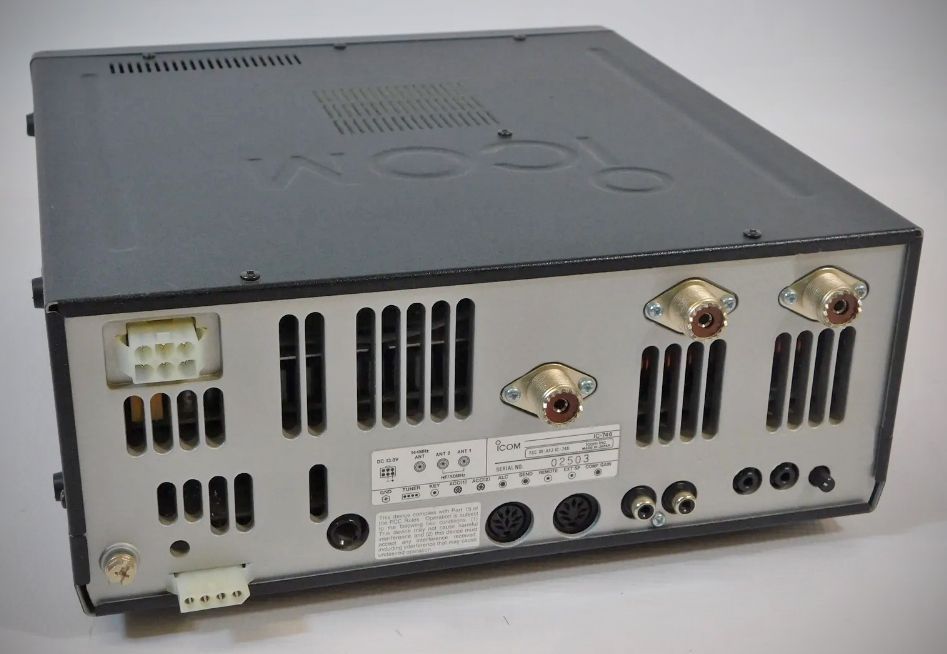
– Antenna Management: Features a built-in internal antenna tuner and an antenna selector switch to toggle between HF/50 MHz and 144 MHz connectors.
– Advanced Receiving Tools: Equipped with a simple band scope for visual signal checking, twin Passband Tuning (PBT) to electronically narrow IF passband widths, and a pulse-type noise blanker.
– Memory Capabilities: Includes 102 memory channels (99 regular, 2 scan edges, and 1 call channel) with the ability to assign alphanumeric names to each.
– Voice Operations: Provides VOX (Voice Operated Relay) for hands-free transmission in SSB, AM, and FM modes, as well as a speech compressor to increase average talk power.
Specifications
– Frequency Coverage (Receive): 0.030–60.000 MHz and 108.000–174.000 MHz
– Frequency Coverage (Transmit)
1.800–1.999 MHz, 3.500–3.999 MHz, 7.000–7.300 MHz, 10.100–10.150 MHz, 14.000–14.350 MHz, 18.068–18.168 MHz, 21.000–21.450 MHz, 24.890–24.990 MHz, 28.000–29.700 MHz, 50.000–54.000 MHz, and 144.000–148.000 MHz
– RF Output Power: 5–100 W for most modes; 2–40 W for AM
– Frequency Stability: Less than ±7 ppm (1–60 min after power ON); less than ±1 ppm/hr thereafter at +25°C (+77°F)
– Antenna Impedance… 50 Ω (SO-239 connectors × 3)
– Operating Temperature: –10°C to 60°C (14°F to 140°F)
– Frequency Resolution: 1 Hz
Power Supply Requirement: 13.8 V DC ±15% (negative ground)
Current Drain: 20.0 A max