Note
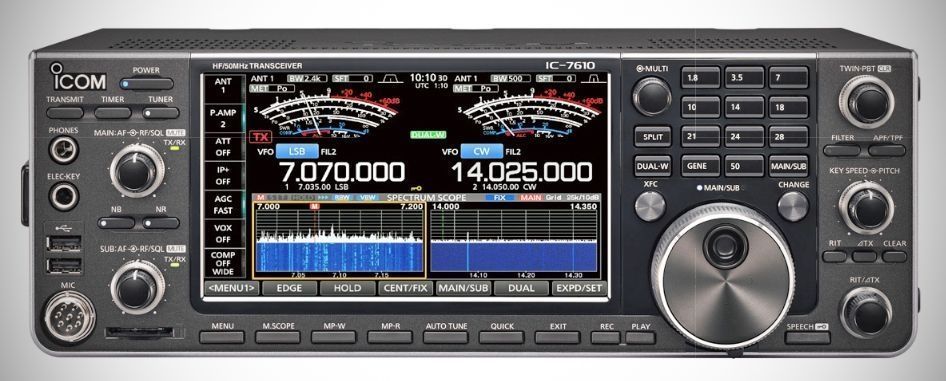
The Icom IC-7610 is an HF/50 MHz transceiver designed with state-of-the-art technology and craftsmanship. It utilizes an RF Direct Sampling System to provide high-level performance.
The Icom IC-7610 was officially announced in March 2017 and began shipping to customers later that year. It was first unveiled as a prototype in December 2016 at the Icom Amateur Radio Festival in Japan. Positioned as the successor to the IC-7600.
Features
– RF Direct Sampling System: RF signals are directly converted to digital data and processed in the FPGA (Field-Programmable Gate Array).
– Dual Identical Receivers: The transceiver features two independent and identical receiver circuits for the Main and Sub bands.
– Built-in DIGI-SEL Unit: Both the Main and Sub receivers include digital preselector units that reject interfering signals.
– Real-Time Spectrum Scope: This provides a 100 dB dynamic range with class-leading resolution and sweep speed, displaying conditions for both Main and Sub bands.
– Large Color Touch Screen: Equipped with a 7-inch touch screen color display for intuitive control and setting adjustments.
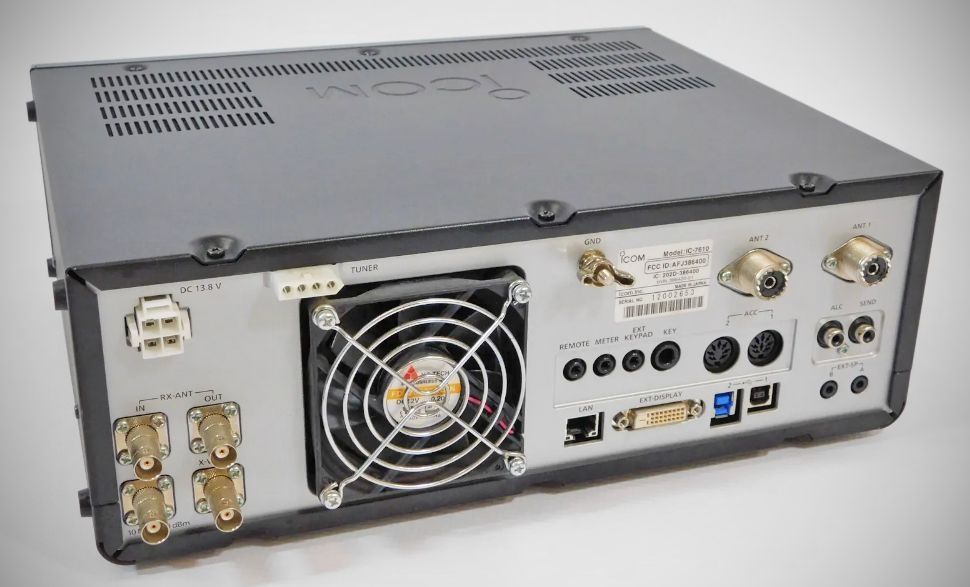
– Antenna Management: Includes a built-in automatic antenna tuner and BNC type RX IN/OUT connectors.
– External Connectivity: Features a DVI-D port for connecting an external monitor.
– Advanced Performance: Offers class-leading RMDR (Reciprocal Mixing Dynamic Range) and Phase Noise characteristics.
– Remote Capability: Supports IP remote control via the optional RS-BA1 software and the RC-28 remote encoder.
– Operating Modes: Supports Dualwatch operation, allowing simultaneous monitoring of two different bands.
Specifications
General
– Frequency Coverage (Receiver): 0.030000 ~ 60.000000 MHz.
– Frequency Coverage (Transmitter): 160 – 6 meters
– Operating Modes: USB, LSB, CW, RTTY, PSK, AM, and FM.
– Memory Channels: 101 channels (including 2 scan edges).
– Antenna Impedance: 50 Ω unbalanced (via two SO-239 connectors).
– Operating Temperature Range: 0°C to +50°C (32°F to 122°F).
Transmitter
– Transmit Output Power:
SSB/CW/RTTY/PSK/FM: 1 to 100 W.
AM: 1 to 25 W.
– Modulation System:
SSB: P.S.N. modulation.
AM: Low power modulation.
FM: Reactance modulation.
– Spurious Emissions:
HF bands: Less than –50 dB.
50 MHz band: Less than –63 dB.
– Carrier Suppression: More than 50 dB.
– Unwanted Sideband: More than 50 dB.
– Microphone Impedance: 600
– Frequency Coverage
1.800000 – 1.999999 MHz.
3.500000 – 3.999999 MHz.
5.255000 – 5.405000 MHz
7.000000 – 7.300000 MHz.
10.100000 – 10.150000 MHz.
14.000000 – 14.350000 MHz.
18.068000 – 18.168000 MHz.
21.000000 – 21.450000 MHz.
24.890000 – 24.990000 MHz.
28.000000 – 29.700000 MHz.
50.000000 – 54.000000 MHz.
Receiver
– Receive System: Direct sampling superheterodyne.
– Intermediate Frequency: 12 kHz.
– Sensitivity (SSB/CW at 10 dB S/N):
1.8 ~ 29.999999 MHz: 0.16 μV typical (with P.AMP1 ON).
50 MHz band: 0.13 μV typical (with P.AMP2 ON).
– Sensitivity (AM at 10 dB S/N):
1.8 ~ 29.999999 MHz: 2.0 μV typical (with P.AMP1 ON).
50 MHz band: 1.0 μV typical (with P.AMP2 ON).
– Sensitivity (FM at 12 dB SINAD):
28.0 ~ 29.7 MHz: 0.5 μV typical (with P.AMP1 ON).
50 MHz band: 0.32 μV typical (with P.AMP2 ON).–
– RIT Variable Range: ±9.999 kHz.
Antenna Tuner
– Tunable Impedance Range: 16.7 ~ 150 Ω unbalanced (less than 3:1 VSWR).
– Tuning Accuracy: Less than 1.5:1 VSWR.
– Tuning Time: 2 ~ 3 seconds on average; 15 seconds maximum.
Power Supply Requirement: 13.8 V DC (±15%)
Transmit (Maximum power): 23.0 A
Receive (Maximum audio): 3.5 A
Receive Standby: 3.0 A