Note
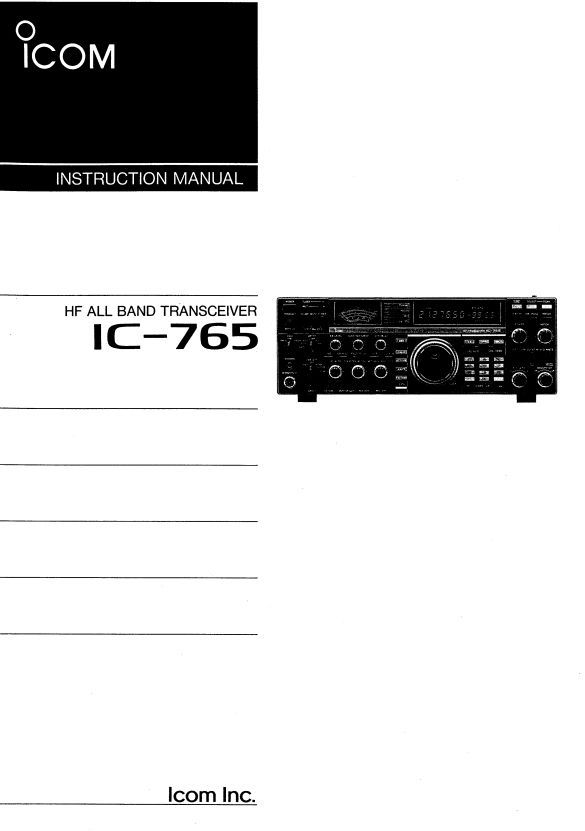
The IC-765 was designed to provide high-precision, sophisticated radio communications. It utilizes Icom's Direct Feed Mixer (DFM) system to achieve a high dynamic range and incorporates a Direct Digital Synthesizer (DDS) for rapid phase-locked loop (PLL) lock-up times. The unit features a large fluorescent display capable of showing operating frequencies down to a 10 Hz digit.
Discontinued in 1995. Replaced by the IC-775(DSP).
Features
– Automatic Antenna Tuner: Includes a newly developed, high-speed fully automatic antenna tuner that memorizes matched conditions for each band to accelerate subsequent tuning.
– CW Optimization: Offers full break-in capability, a built-in electronic keyer, CW pitch control, and an integrated 500 Hz narrow filter to reduce interference on crowded bands.
– Advanced Memory System: Features 99 memory channels, including split memory on channels 90 through 99. Each band also memorizes the last used frequency, mode, and IF filter setting, effectively providing 18 VFOs (2 per band).
– Signal Processing: Equipped with IF shift, a notch filter, an RF-type speech compressor, and a multi-mode noise blanker.
– Scanning Options: Supports programmed scan, memory scan, and selected memory scan.
– Power and Cooling: Contains a low-distortion 100 W power amplifier supported by a large heatsink and a dedicated cooling fan.
General
– Frequency Coverage: HF all-band transceiver.
– Operating Modes: SSB, CW, RTTY, AM, and FM.
– Frequency Display: 7-digit fluorescent display showing the operating frequency down to the 10 Hz digit.
– Memory Channels: 99-channel memory capacity.
– Antenna Tuner: Built-in, fully automatic high-speed tuner with a memory function for each band.
– Operating Temperature Range: −10∘C to +60∘C (+14∘F to +140∘F).
– Frequency Stability: High stability is supported by the DDS (Direct Digital Synthesizer) system.
Transmitter
– RF Output Power: 100 W from a low-distortion power amplifier.
– Modulation Systems:
SSB: Balanced modulation.
AM: Low power modulation.
FM: Variable reactance frequency modulation.
– Spurious Emissions: Less than −50 dB.
– Carrier Suppression: More than 40 dB.
– Unwanted Sideband: More than 50 dB.
– Microphone Connector: 8-pin connector, 600 Ω.
– CW Keying: Built-in electronic keyer with full break-in capability.
Receiver Specifications
– Receive System: Triple conversion superheterodyne.
– Intermediate Frequencies (IF):
1st: 69.0115 MHz.
2nd: 9.0115 MHz.
3rd: 455 kHz.
– Sensitivity:
SSB/CW/RTTY: 0.15 μV (10 dB S/N).
AM: 2.0 μV (10 dB S/N).
FM: 0.5 μV (12 dB SINAD).
– Selectivity:
SSB/CW/RTTY: 2.2 kHz/−6 dB; 4.2 kHz/−60 dB.
CW-N (Built-in): 500 Hz/−6 dB; 1.0 kHz/−60 dB.
AM: 6.0 kHz/−6 dB; 18.0 kHz/−50 dB.
FM: 15.0 kHz/−6 dB; 30.0 kHz/−60 dB.
– Spurious and Image Rejection: More than 70 dB.
– Dynamic Range: 105 dB (utilizing the Direct Feed Mixer system).
– RIT/ΔTX Range: ±9.99 kHz.
Mechanical & Physical Specifications
Power Requirements
120 VAC Type: Requires a 10 A fuse for the AC line.
220–240 VAC Type: Requires a 5 A fuse for the AC line.
DC Output: The transceiver features a 13.8 V DC output jack on the rear panel, which can provide a maximum of 2 A.