Note
The Icom IC-781 was manufactured from 1987 to 1993.
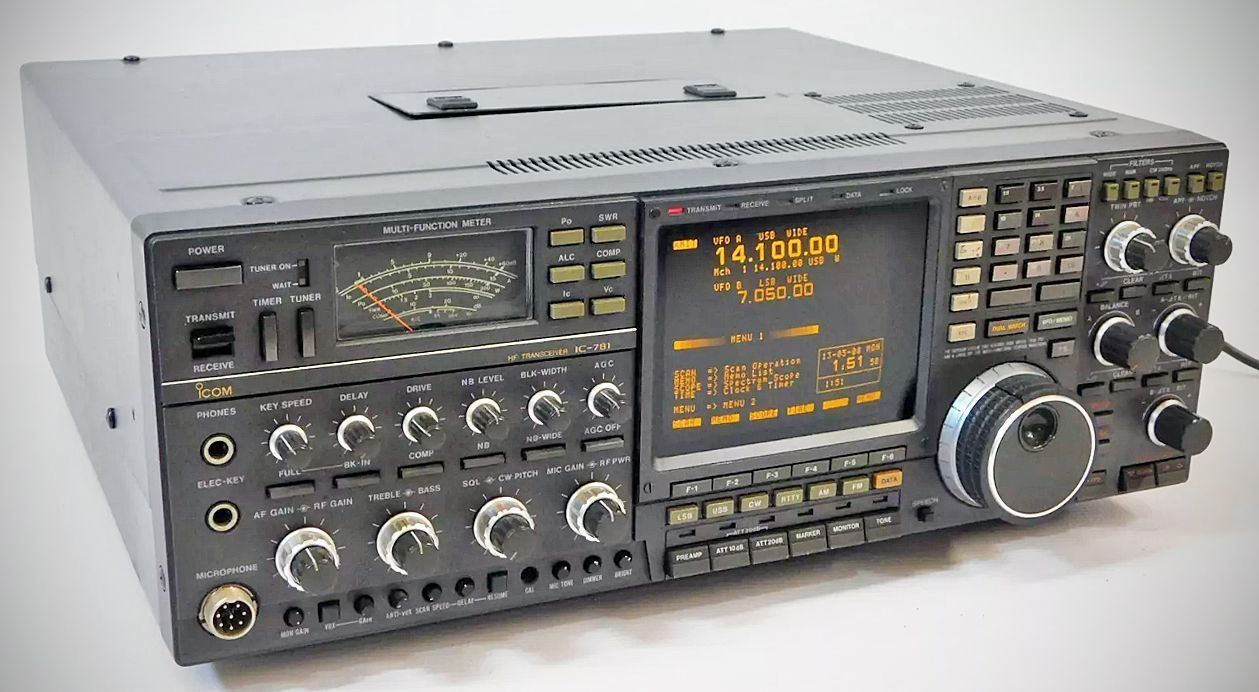
It was introduced as Icom's top-of-the-line "dream rig," notable for being the first amateur transceiver to feature a built-in 5-inch CRT display with a spectrum scope.
This "super-station" had an introductory price of between $5,995.00 and $6,149.00, though depending on the vendor and year, it was often cited closer to $8,000.00 with various options.
Though it was discontinued in 1993, it remained Icom's flagship HF radio until the release of the IC-756 in 1996.
Features
– Dynamic Range: Offers a high 105dB dynamic range for clear reception of faint and strong signals.
– Direct Digital Synthesizer (DDS): A newly developed frequency synthesizer system that provides rapid transmit/receive switching times, making it suitable for PACKET and AMTOR communications.
– Built-in Automatic Antenna Tuner: A preset/auto-tuning tuner that matches the transceiver to antennas with an SWR of less than 3:1.
Visual & Monitoring Capabilities
– Multi-functional 5-inch CRT Display: The first amateur radio transceiver with a built-in CRT. It displays frequencies for VFO A and B, memory contents, two menu screens, and seventeen operational screens.
– Built-in Spectrum Scope: Displays the relative strength of signals around a center frequency with selectable spans of 50kHz, 100kHz, and 200kHz.
– Terminal Monitor: Displays ASCII (RS-232C level) code data directly on the CRT, allowing for RTTY, PACKET, and AMTOR monitoring.
– Multi-Function Meter: A dedicated analog meter for monitoring relative output power (Po), ALC level, collector current (Ic), SWR, compression level (COMP), and collector voltage (Vc).
Receiver & Audio Tools
– Twin Passband Tuning (PBT): Allows for independent or tandem adjustment of the 455kHz and 9MHz IF filters to clear heavy interference.
– Dual Watch: Features two PLL circuits to monitor two separate frequencies simultaneously.
- Audio Peak Filter (APF): Attenuates unwanted audio in CW mode, allowing a specific frequency between 500Hz and 1000Hz to be isolated.
– Noise Blanker: Includes a noise-trigger type blanker with a maximum 15msec blank-width to remove pulse-type noise like engine ignition or "woodpecker" interference.
– Notch Filter: A dedicated control to eliminate specific interfering tones.
Operational Features
– Memory Management: Contains 99 memory channels, each capable of storing a frequency, mode, and a 10-character note.
– Band Stacking Register: Enables the storage of a frequency on one band while switching to another, with the ability to return instantly to the stored frequency.
– Scanning Modes: Includes Programmed Scan, AF Scan, Memory Scan, and a "Fine Scan" that slowly tunes through signals without stopping .
– Timers and Clocks: Features two built-in clocks (local and UTC) along with five Daily Timers and Sleep Timers that can automate the transceiver's power status.
– CW Specialties: Supports full or semi break-in operation and includes a CW pitch control that adjusts the audio pitch without changing the operating frequency.
Specifications
– Frequency Coverage: Receive: 100 kHz – 30.0000 MHz
–Transmit:
1.8000 – 1.9999 MHz
3.5000 – 4.0999 MHz
7.0000 – 7.3000 MHz
10.1000 – 10.1500 MHz
14.0000 – 14.3500 MHz
18.0680 – 18.1680 MHz
21.0000 – 21.4500 MHz
24.8900 – 24.9900 MHz
28.0000 – 29.7000 MHz
– Modes: SSB (LSB/USB), CW, AM, FM, RTTY
– Number of Memory Channels: 99 plus P1 and P2 (Scan Edge memories)
– Antenna Impedance: 50 Ω nominal
– Power Supply Requirement: 100 – 120 V AC or 220 – 240 V AC
– Operating Temperature Range: −10∘C to +60∘C (14∘F to 140∘F)
– Frequency Stability: Less than ±10 Hz from −10∘C to +60∘C after a 1-hour warmup
Transmitter
– Output Power:
SSB, CW, RTTY, FM: 10 – 150 W (continuously adjustable)
AM: 10 – 75 W (continuously adjustable)
– Modulation System:
SSB: Balanced modulation
AM: Low level modulation
FM: Variable reactance frequency modulation
– Spurious Emissions: Less than −60 dB
– Carrier Suppression: More than 40 dB
– Unwanted Sideband: More than 55 dB (at 1 kHz)
– Microphone Impedance: 600 Ω
Receiver
– Sensitivity (10 dB S/N for SSB/CW/RTTY; 10 dB S/N for AM; 12 dB SINAD for FM):
0.1 – 0.5 MHz: SSB/CW/RTTY: 0.5 μV; AM: 3.2 μV
0.5 – 1.8 MHz: SSB/CW/RTTY: 0.25 μV; AM: 2.0 μV
1.8 – 30 MHz: SSB/CW/RTTY: 0.16 μV; AM: 1.0 μV; FM: 0.32 μV (above 28 MHz)
– Selectivity:
SSB, CW (Wide), RTTY (Wide): More than 2.4 kHz/−6 dB; Less than 3.8 kHz/−60 dB
CW (Narrow), RTTY (Narrow): More than 500 Hz/−6 dB; Less than 1.0 kHz/−60 dB
AM: More than 6.0 kHz/−6 dB; Less than 18.0 kHz/−50 dB
FM: More than 15.0 kHz/−6 dB; Less than 30.0 kHz/−60 dB
– Spurious and Image Rejection: More than 80 dB
– Audio Output Power: More than 2.6 W at 10% distortion with an 8 Ω load
Antenna Tuner
– Matching Range: 16.7 Ω to 150 Ω (unbalanced; SWR less than 3:1)
– Tuning Accuracy: Less than SWR 1.2:1
– Insertion Loss: Less than 0.5 dB (after tuning)