Note
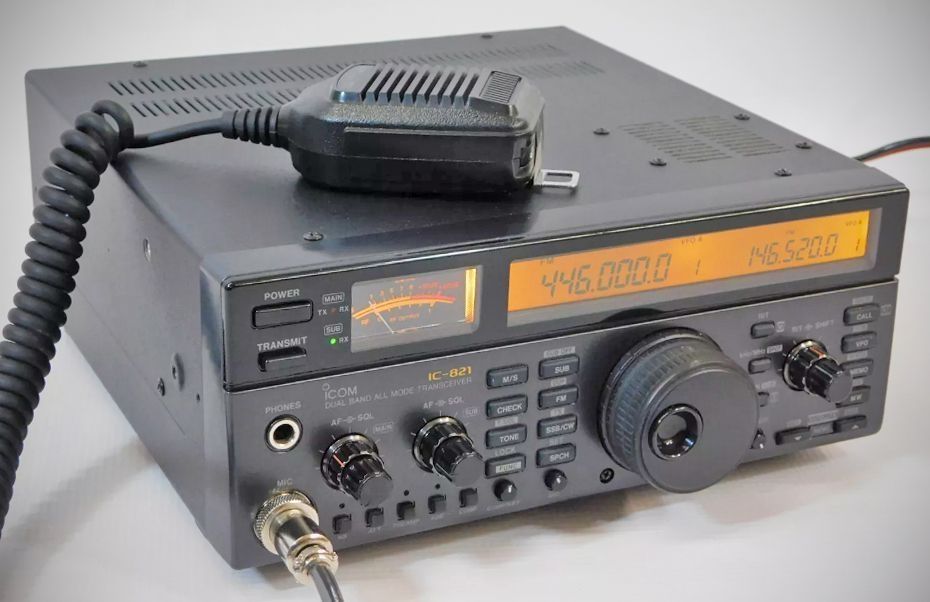
The IC-821H was introduced in 1996 as the successor to the IC-820H (which debuted in 1994). It remained a flagship VHF/UHF all-mode satellite transceiver for several years before being discontinued and eventually replaced by the Icom IC-910H
The 821H is equipped with an extensive range of technical and operational features designed for advanced VHF/UHF amateur radio activities, including satellite communications.
Core Features (Receiver)
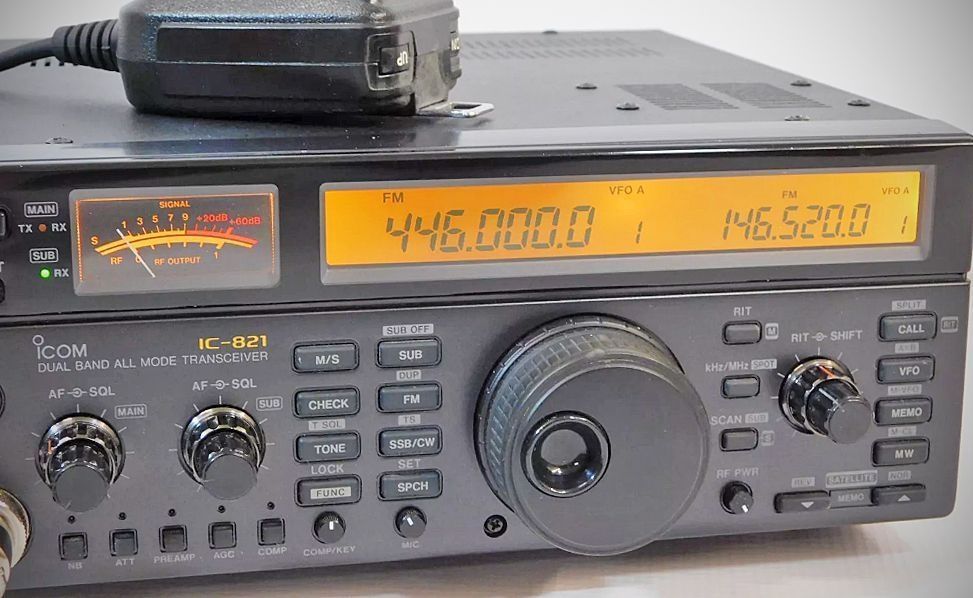
– Dual-Band Watch: Features independent "Main" and "Sub" bands with dedicated audio and squelch controls, allowing for simultaneous monitoring of two different frequencies.
– RIT (Receiver Incremental Tuning): Shifts the receive frequency by up to ±1.0 kHz (SSB/CW) or ±5.0 kHz (FM) without affecting the transmit frequency.
– IF Shift: Electronically adjusts the IF passband by ±1.2 kHz to reject nearby interference; this is highly effective in SSB and CW modes.
– Noise Blanker (NB): Reduces pulse-type noise, such as vehicle ignition interference, across both bands simultaneously.
– RF Attenuator: Provides 15 dB of attenuation to prevent signal distortion when operating near very strong transmitters.
– AGC (Automatic Gain Control): Features selectable "Fast" or "Slow" time constants for the main band to maintain constant audio output during signal fading.
Core Features (Transmitter)
– Speech Compressor: Increases the average audio output level in SSB mode to improve "talk power" during long-distance or poor propagation conditions.
– Adjustable RF Power: Allows for continuous adjustment of output power using a dedicated front-panel control.
– ALC (Automatic Level Control): Automatically limits RF output power to prevent signal distortion in SSB and CW modes.
– Internal Electronic Keyer: Built-in CW keyer with adjustable speed control (shared with the speech compressor knob).
– FM Repeater Tools: Includes a subaudible tone encoder for repeater access and an auto-repeater function that automatically sets the proper offset.
Satellite Operation Features
– Dedicated Satellite Mode: Features "Normal" (SATL-N) and "Reverse" (SATL-R) tracking to manage the relationship between uplink and downlink frequencies.
– Doppler Shift Compensation: Allows the user to cancel tracking temporarily to adjust for Doppler shift on one band without affecting the other.
– Satellite Memory: Includes specialized memory channels for storing satellite-specific frequency pairs and tracking configurations.
Control & Interface Features
– Sub Band Access: A dedicated "SUB" switch allows the tuning dial and most buttons to control the sub band while the main band remains on standby.
– Dial Lock: Prevents accidental frequency changes by electronically locking the main tuning dial.
– Memory Management: Features 100 regular memory channels, plus specialized channels for scan edges and call frequencies.
– Scan Functions: Supports programmed scan, memory scan, and mode-select memory scan to automatically find active frequencies.
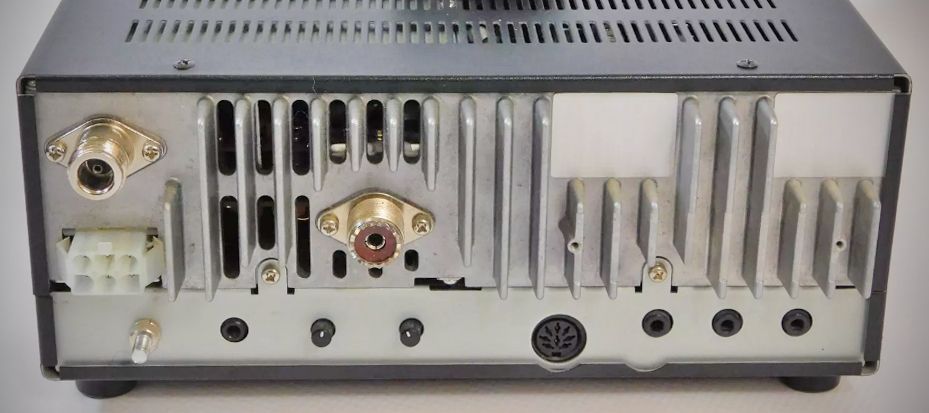
– CI-V Remote Control: Includes a remote jack for computer-controlled operation and data exchange.
– Sub Tuning Dial: The RIT and IF Shift controls can be reassigned via "Set Mode" to act as a secondary tuning dial for the sub band.
General Specifications
– Operating Modes: SSB (USB, LSB), CW, FM.
– Frequency Resolution: 1 Hz.
– Frequency Stability: Within ±3 ppm (at −10∘C to +60∘C).
– Antenna Impedance: 50 Ω (unbalanced).
Transmitter Specifications
– Output Power (continuously adjustable):
144 MHz Band: 6–45 W (SSB/CW/FM).
430 MHz Band: 6–40 W (FM/CW), 6–30 W (SSB).
– Modulation System:
SSB: Balanced modulation.
FM: Variable reactance modulation.
– Spurious Emissions: Less than −60 dB.
– Carrier Suppression: More than 40 dB.
– Unwanted Sideband: More than 40 dB.
– Microphone Impedance: 600 Ω.
Receiver Specifications
– Receive System:
SSB/CW: Triple conversion superheterodyne.
FM: Quadruple conversion superheterodyne.
– Sensitivity:
SSB/CW (at 10 dB S/N): Less than 0.11 μV.
FM (at 12 dB SINAD): Less than 0.18 μV.
– Squelch Sensitivity:
SSB/CW: Less than 1.0 μV.
FM: Less than 0.1 μV.
– Selectivity:
SSB/CW: More than 2.3 kHz/−6 dB; Less than 4.2 kHz/−60 dB.
FM: More than 12.0 kHz/−6 dB; Less than 30.0 kHz/−60 dB.
– Spurious and Image Rejection: More than 60 dB.
– Audio Output Power: More than 2.0 W at 10% distortion with an 8 Ω load.
– RIT/IF Shift Variable Range:
– RIT (SSB/CW): ±1.0 kHz.
– RIT (FM): ±5.0 kHz.
– IF Shift: ±1.2 kHz.
Power Supply Requirement: 13.8 V DC ±15% (negative ground).
Current Drain (at 13.8 V DC):
Transmit (High Power): 16.0 A.
Receive (Max Audio): 2.0 A.
Receive (Standby): 1.2 A.