Note
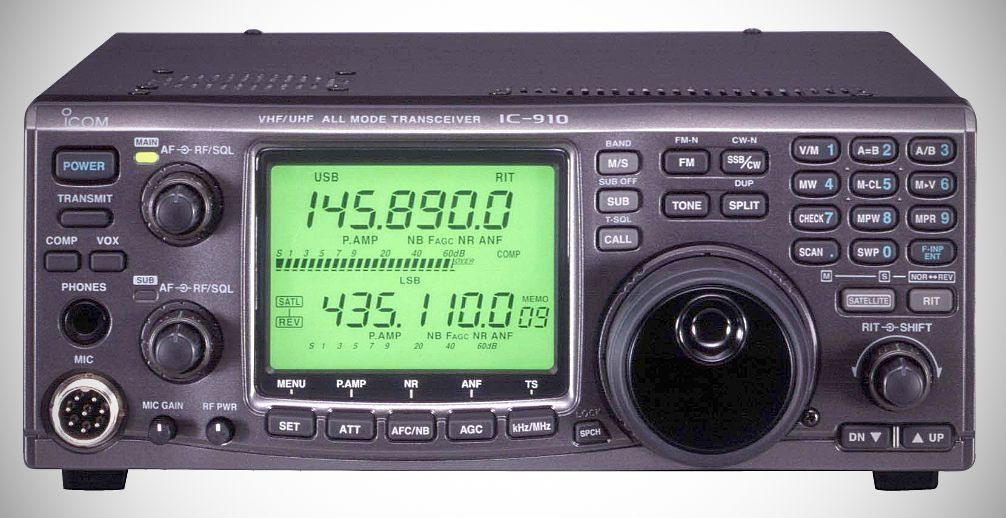
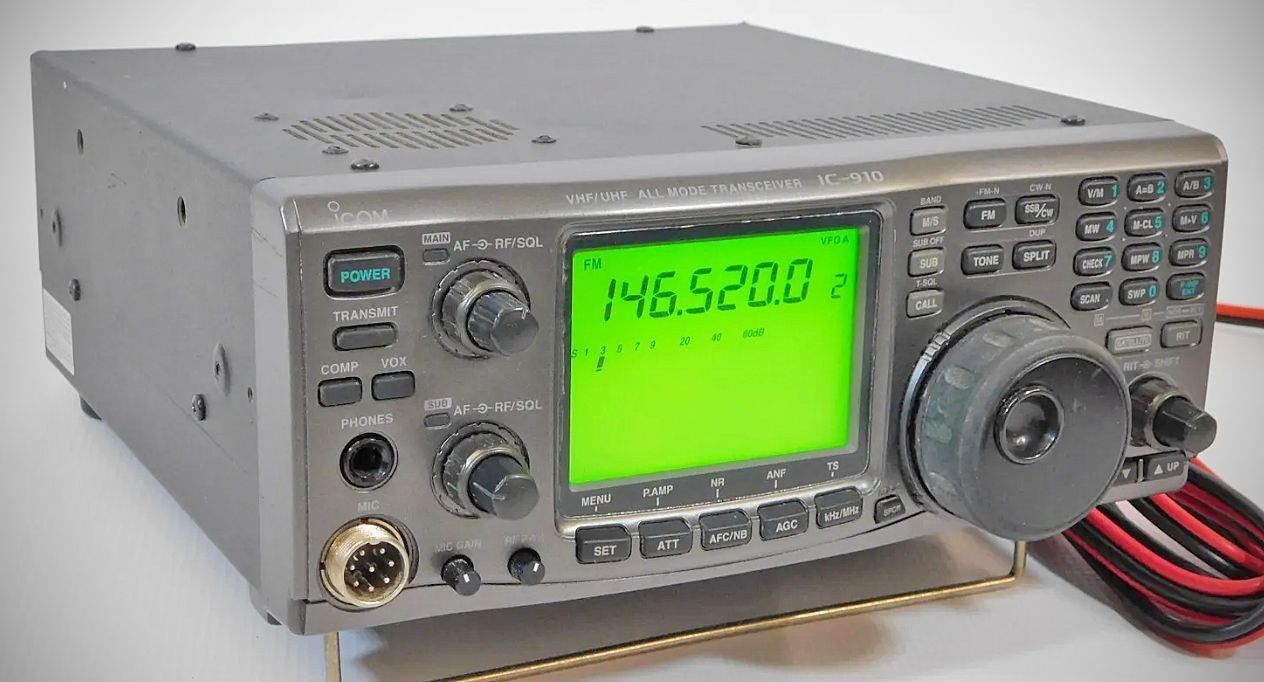
The Icom IC-910H is a high-performance VHF/UHF All Mode Transceiver. It is primarily used for communication on the 144 MHz (2m) and 430(440) MHz (70cm) bands, with an optional capability for the 1200 MHz (23cm) band through the installation of an internal UX-910 unit.
The 910H was introduced in 2000, and was a staple in the Icom lineup for nearly a decade. It was eventually replaced by the Icom IC-9100, which expanded on its capabilities by adding the HF and 50 MHz bands.
Core Operating Features
– Dual-Band Capability: Standard coverage for the 144 MHz and 430(440) MHz bands.
– All-Mode Operation: Supports SSB (USB/LSB), CW, and FM modes.
– Main and Sub Band System: Features independent MAIN and SUB bands for simultaneous reception.
MAIN Band: Used for both transmitting and receiving.
SUB Band: Used for receiving only (except in satellite mode where it handles transmission).
Satellite and Data Communication
– Satellite Mode: Specialized mode for satellite communications, including 10 dedicated satellite memory channels that store both uplink and downlink frequencies and modes.
– Tracking Functions: Includes tracking selection for easier frequency management during satellite operation.
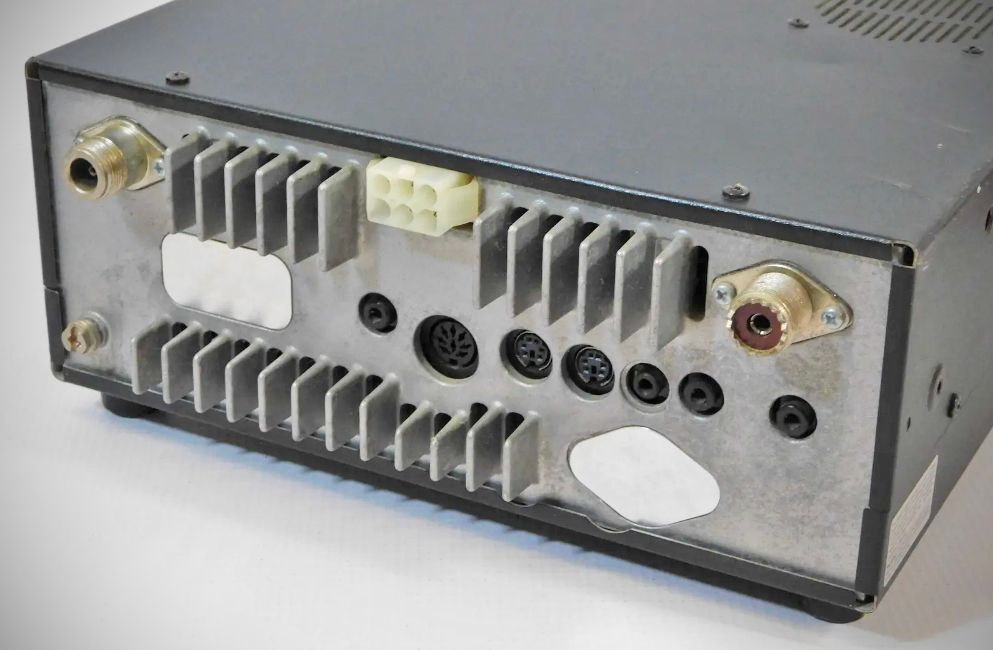
– Data Terminal Support: Equipped with [DATA] sockets on the rear panel for AFSK operations at 1200 bps or 9600 bps.
– Full Duplex: Capable of full-duplex operation, essential for monitoring your own signal via a satellite.
Signal Processing and Interference Rejection
– Speech Compressor: A built-in, low-distortion circuit that increases average RF output power to improve signal readability in SSB.
– RIT (Receiver Incremental Tuning): Allows for fine-tuning the receive frequency without changing the transmit frequency.
– IF Shift: Helps reject interference by shifting the IF passband (SSB/CW modes).
– Noise Blanker (NB): Reduces pulse-type noise, such as ignition interference.
– Electronic Keyer: Built-in for CW operation with adjustable keying speed and weight.
– Optional DSP (Digital Signal Processing): Supports the UT-106 DSP unit for noise reduction and auto notch filter capabilities.
Memory and Scanning
– Extensive Memory: 106 memory channels per band, including 99 regular channels, 6 scan edges, and 1 call channel.
– Memo Pads: Temporary memory storage (default 5 pads, expandable to 10) for quick frequency and mode "scribbling".
– Advanced Scanning:
Programmed Scan: Scans between two specified frequencies.
Memory Scan: Scans all programmed memory channels.
Mode Select Scan: Scans only channels with a specific operating mode.
Physical and User Interface
– Large LCD Display: Shows dual-frequency readouts, S-meters, and various status indicators.
– Adjustable Tuning Steps: Offers several steps from 1 Hz (SSB/CW) up to 100 kHz (FM).
– Optional Voice Synthesizer: Supports the UT-102 for audible frequency and signal strength announcements
Specifications
– Frequency Coverage (Unit: MHz):
144 MHz Band: 144.0–148.0 MHz (Guaranteed range).
430(440) MHz Band: 430.0–450.0 MHz (Guaranteed range).
1200 MHz Band (Optional UX-910): 1240.0–1300.0 MHz (Guaranteed range).
– Operating Modes: USB, LSB, CW, FM, and FM-N (Note: FM-N is not available in the 1200 MHz band).
– Number of Memory Channels: A total of 212 channels, which includes 99 regular, 6 scan edges, and 1 call channel for each band, plus 10 satellite memories.
– Antenna Connector: SO-239 (50 Ω) for the 144 MHz band and Type-N (50 Ω) for the 430(440) and 1200 MHz bands.
– Operating Temperature Range: −10∘C to +60∘C (+14∘F to +140∘F).
– Frequency Stability: Less than ±3 ppm (−10∘C to +60∘C).
Transmitter Specifications
– Output Power (Continuously Adjustable):
144 MHz: 5 to 100 W.
430(440) MHz: 5 to 75 W.
1200 MHz (Optional): 1 to 10 W with the UX-910 unit.
– Modulation Systems:
SSB: Balanced modulation.
FM: Variable reactance modulation.
– Spurious Emissions: Less than -60 dB (144/430 MHz) or -50 dB (1200 MHz).
– Carrier Suppression: More than 40 dB.
– Unwanted Sideband: More than 40 dB.
– Microphone Connector: 8-pin connector (600 Ω).
Receiver Specifications
– Receive System: Double conversion superheterodyne.
– Sensitivity (Typical):
SSB/CW (10 dB S/N): Less than 0.11 µV.
FM (12 dB SINAD): Less than 0.18 µV.
– Squelch Sensitivity (Threshold):
SSB/CW: Less than 1.0 µV.
FM: Less than 0.1 µV.
– Selectivity:
SSB/CW: More than 2.3 kHz/–6 dB; Less than 4.2 kHz/–60 dB.
FM: More than 15.0 kHz/–6 dB; Less than 30.0 kHz/–60 dB.
– Spurious and Image Rejection: More than 60 dB (144/430 MHz) or 50 dB (1200 MHz).
– Audio Output Power: More than 2.0 W at 10% distortion with an 8 Ω load.
– RIT Variable Range: ±1.0 kHz (SSB/CW/FM) or ±5.0 kHz (SSB/CW/FM in some modes).
Power Supply Requirement: 13.8 V DC (±15%) negative ground.
Current Drain (at 13.8 V DC):
Transmit (at max power): 23.0 A.
Receive (Standby/Max Audio): 2.0 A / 3.5 A.