Note
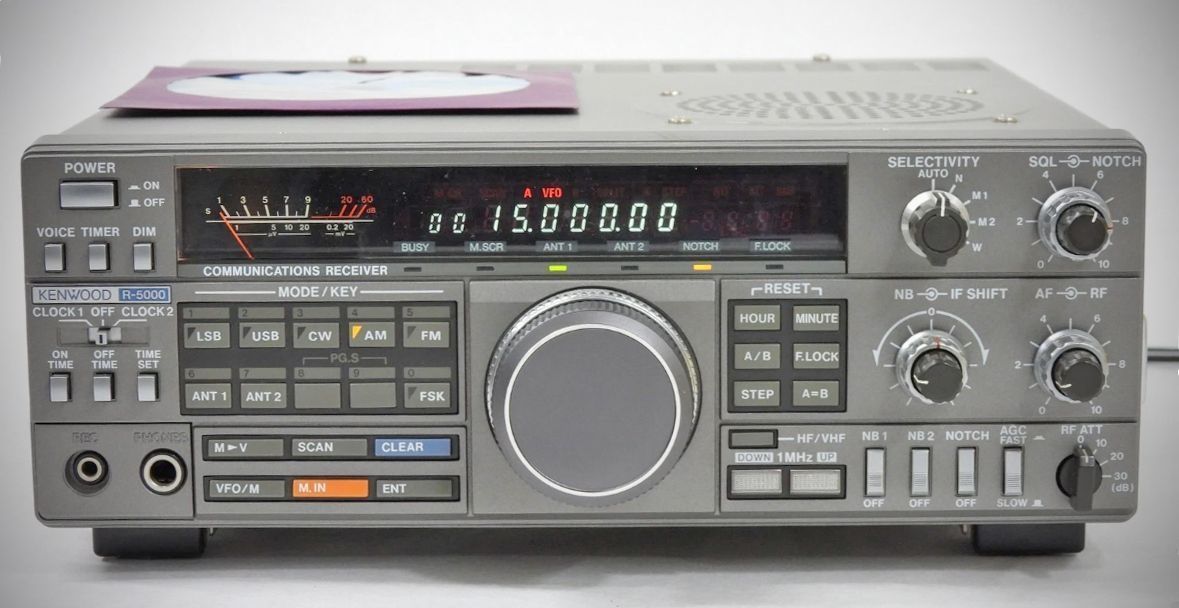
The Kenwood R-5000 is regarded as one of the last great dedicated tabletop HF communications receivers before the industry shifted toward software-defined radios and transceivers. Produced from the 1986 through the 1997.
The main tuning knob is heavy and smooth, providing a tactile high-end feel. The receiver uses a vacuum fluorescent digital, easy to read from a distance.
The R-5000 was designed to handle the crowded RF environments of the late 20th century, and its front-end filtering holds up remarkably well today.
Features
– Dual VFOs: Allows for seamless switching between frequencies or monitoring split-frequency operations.
– IF Shift & Notch Filter: Highly effective tools for cutting out adjacent channel interference (slop) and heterodynes.
– Programmable Scanning: Advanced for its time, featuring memory scan, band scan, and group scan options.
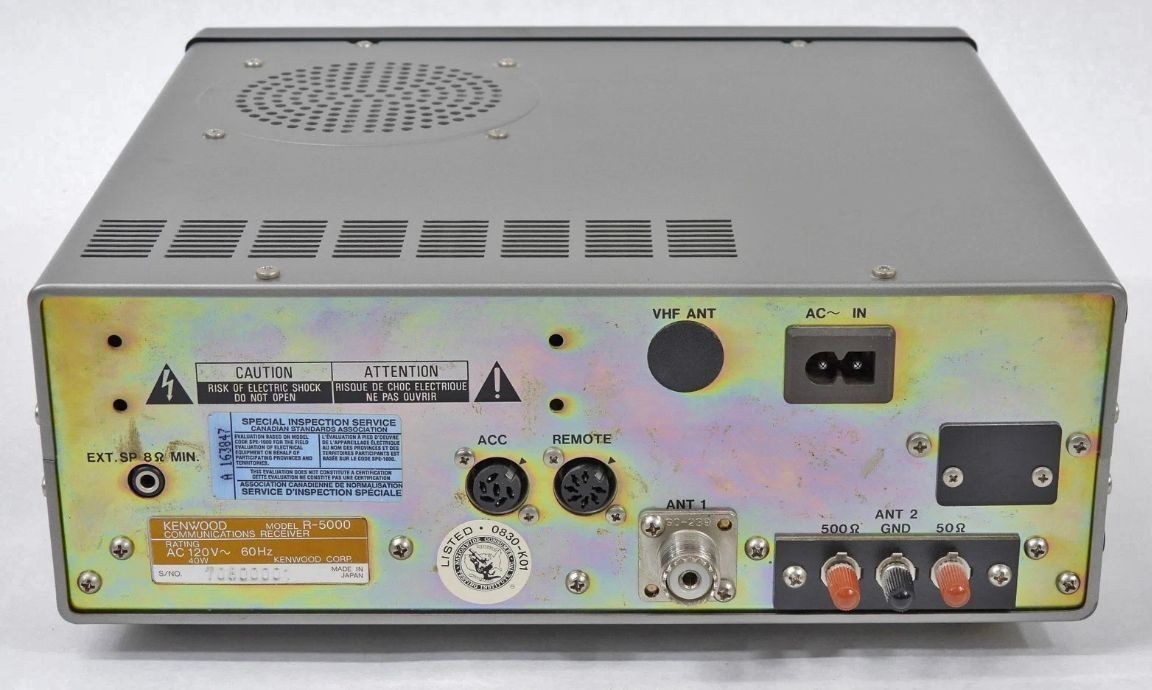
– VHF Expansion: The internal bay allows for the VC-20 converter, which adds 108–174 MHz coverage, making it a capable tool for monitoring aircraft and 2-meter ham bands.
– Noise Blanker: Includes two levels (NB1/NB2) to tackle different types of pulse noise, such as ignition interference or the "woodpecker" over-the-horizon radar common during its era.
Specifications
– Frequency Range: 100 kHz to 30 MHz (expandable to 108–174 MHz with optional VC-20)
– Modes: AM, SSB (USB/LSB), CW, FSK, FM
– Frequency Stability: ± 10 ppm (or better with optional TCXO)
– Sensitivity (SSB): < 0.25 µV (1.8–30 MHz)
– Selectivity (SSB): 2.4 kHz / -6 dB
– Memories: 100 Channels
Power Requirements: 120/220/240V AC (Internal) or 13.8V DC