Note
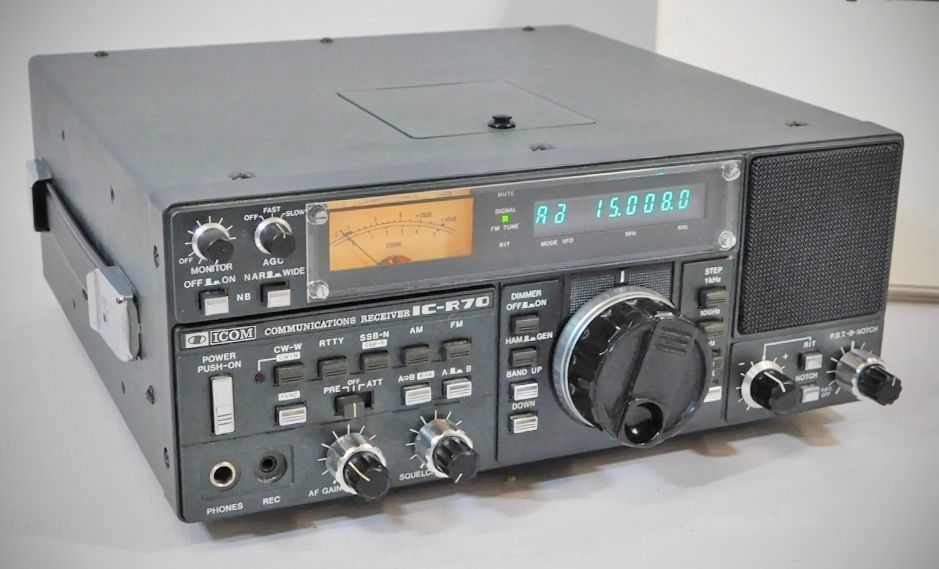
The Icom IC-R70 is a communications receiver designed for both amateur radio and general coverage listeners. It combines advanced digital frequency control with a sophisticated analog receiving system to provide wide dynamic range and clear reception across the 100KHz to 30MHz spectrum.
The IC-R70 was Icom’s first entry into the high-end HF communications receiver market and was replaced in late 1984 by the IC-R71A, which addressed some of the "IF hiss" issues present in the R70's audio and added features like a keypad for direct frequency entry.
Due to its high build quality and advanced features (for the time) (like the Pass-Band Tuning and IF Notch filter), it was used not only by hobbyists but also by government agencies such as the NSA and FCC.
Features
– General Coverage Capability: Offers full coverage from 0.1MHz to 30MHz, divided into thirty 1MHz segments.
– Dual Digital VFO: Features a CPU-based 10Hz step digital PLL synthesizer with two independent VFOs (A and B) that can be used on any desired band.
– Triple Tuning Rates: Provides selectable tuning resolutions of 10Hz, 100Hz, and 1KHz steps for precise or rapid frequency adjustments.
– Pass-Band Tuning (PBT): A built-in system that allows continuous adjustment of the IF pass-band to eliminate interference from nearby signals.
– Advanced Noise Blanker: Includes a noise blanker with selectable "NORMAL" and "WIDE" timing to combat different types of pulse noise, such as ignition interference.
– Adjustable Selectivity: Features multiple IF filters for different modes, including narrow CW and RTTY filters.
– Flexible RF Handling: Equipped with a preamplifier for weak signals and a 20dB attenuator for handling very strong or interfering signals.
– Notch Filter: Includes a tunable notch filter to reduce specific interfering tones within the pass-band.
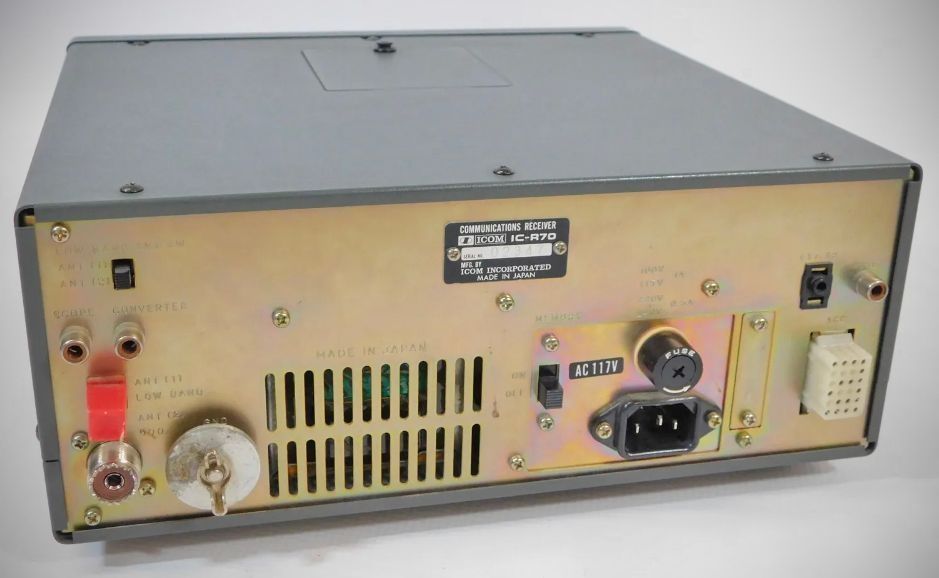
– Frequency Memory: A rear-panel memory switch allows the CPU to retain VFO frequencies and modes even when the main power is turned off.
Specifications
– Frequency Range: 0.1MHz to 30.0MHz
– Modes: A1 (CW), A3J (USB, LSB), F1 (RTTY), A3 (AM), and optional F3 (FM).
– Frequency Stability: Less than 250Hz drift between 1 and 60 minutes after switch-on; less than 50Hz drift after 1 hour.
– Antenna Impedance: 50 ohms unbalanced; a single wire terminal is available for 0.1–1.6MHz.
– Receiving System: Quadruple Conversion Superheterodyne (Triple conversion for FM).
– Intermediate Frequencies (IF):
1st: 70.4515MHz
2nd: 9.0115MHz
3rd: 455KHz
4th: 9.0115MHz (except FM)
– Sensitivity (with Preamp ON):
SSB/CW/RTTY: Less than 0.15 μV for 10dB S+N/N (1.6–30MHz).
AM: Less than 0.5 μV for 10dB S+N/N (1.6–30MHz).
FM (Optional): Less than 0.3 μV for 12dB SINAD (1.6–30MHz).
– Selectivity:
SSB/CW/RTTY: 2.3KHz at -6dB (Adjustable to 500Hz min with PBT).
CW-N/RTTY-N: 500Hz at -6dB.
AM: 6KHz at -6dB (Adjustable to 2.7KHz min with PBT).
– Spurious Response Rejection: Better than 60dB.
– Audio Output: More than 2 Watts into 8 ohms.
Power Requirements: 117V or 235V AC ±10%, 50–60Hz (internally modifiable for 100V, 200V, or 220V).