Note
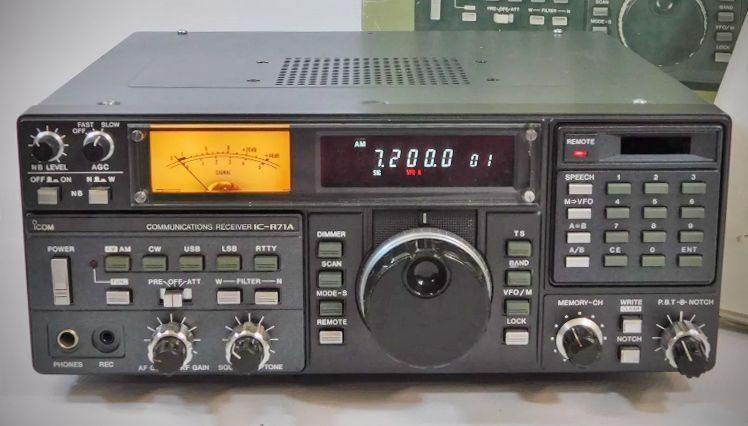
The Icom IC-R71A is a communications receiver designed to cover the 0.1 MHz to 30 MHz frequency range. It utilizes an up-conversion system with a high-side intermediate frequency and a microcomputer control system to achieve general coverage across thirty 1 MHz segments. The receiver is engineered for performance, featuring a 105dB dynamic range through an Icom-developed J-FET double balanced mixer.
The IC-R71A was released in 1984 to replace the IC-R70, and quickly became a benchmark for tabletop shortwave receivers. In 1989, due to a patent conflict, the Pass-Band Tuning (PBT) feature was removed and replaced with a technically different "IF Shift" system in units manufactured after March that same year.
Begining the early 1990s, the series was gradually phased out and succeeded by the IC-R72.
The R-71A included several improvements over the R-70. These included:
– Direct Frequency Entry: The R-71A features a 10-key keypad, allowing users to type in a specific frequency for immediate access.
– Expanded Memory: While the R-70 relied on a dual VFO system with a basic memory switch to retain the last frequency, the R-71A includes 32 tunable memories that store both mode and frequency data.
– Automatic Tuning Intelligence: The R-71A introduced an automatic tuning rate adjustment, which shifts from 10Hz to 50Hz increments if the tuning knob is rotated quickly. In contrast, the R-70 requires manual switching between 10Hz, 100Hz, and 1KHz steps.
– Advanced Scanning: The R-71A offers comprehensive scanning of frequencies, memories, and bands, including a "Mode-S" feature that only scans memories matching a specific operating mode. These scanning functions were not present in the R-70's core feature set.
– Computer Control & Voice Readout: The R-71A added support for optional digital interfaces for computer control and a synthesized voice frequency readout in English.
Other Features
– General Coverage Capability: Receives signals from 100KHz to 30MHz with a no-tune-up system using electronically selected low-pass and band-pass filters.
– Dual 10Hz Step Digital VFO: Employs a dual-looped Phase-Locked-Loop (PLL) and microcomputer control for precise tuning in 10Hz increments.
– Pass-Band Tuning (PBT): Enables continuous adjustment of the IF pass-band to eliminate interference from nearby signals.
– Deep IF Notch Filter: Provides adjustable rejection of interfering tones.
– Noise Blanker with Adjustable Level: Includes a noise blanker that can be adjusted for timing (Normal/Wide) and threshold level to eliminate pulse-type noise like automobile ignition or "woodpecker" interference.
– Selectable AGC Timing: Features a switch to change the Automatic Gain Control time-constant (Slow/Fast) or turn it off entirely.
Specifications
– Frequency Coverage: 0.1MHz to 30.0MHz.
– Frequency Control: CPU-based 10Hz step Digital PLL synthesizer with a dual VFO system.
– Frequency Readout: 6-digit display with 100Hz resolution.
– Frequency Stability: Less than 200Hz drift between 1 and 60 minutes after power-on; less than 30Hz drift after 1 hour.
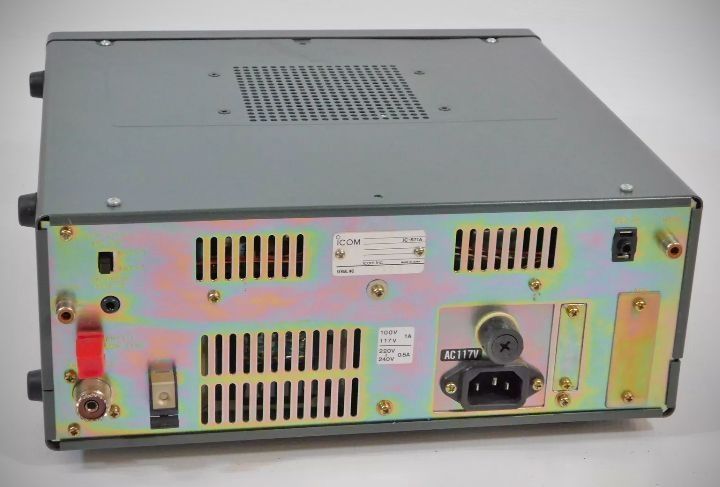
– Antenna Impedance: 50 ohms unbalanced; a single wire can be used for the 0.1MHz to 1.6MHz range.
– Receiving System: Quadruple Conversion Superheterodyne with continuous bandwidth control.
– Receiving Modes: A1 (CW), A3J (USB, LSB), F1 (FSK), A3 (AM), and optional F3 (FM).
– Intermediate Frequencies (IF):
1st: 70.4515MHz.
2nd: 9.0115MHz
3rd: 455KHz.
4th: 9.0115MHz (except for FM mode).
– Sensitivity (with Preamplifier ON):
SSB/CW/RTTY: Less than 0.15 μV for 10dB S+N/N (1.6–30MHz).
AM: Less than 0.5 μV for 10dB S+N/N (1.6–30MHz).
– Selectivity:
SSB/CW/RTTY: 2.3KHz at -6dB (Adjustable down to 500Hz min).
CW-N/RTTY-N: 500Hz at -6dB.
AM: 6KHz at -6dB (Adjustable down to 2.7KHz min).
– Spurious Response Rejection: More than 60dB.
– Audio Output: More than 3 Watts into an 8-ohm impedance
Power Supply: 117V or 235V AC ±10% (50–60Hz).