Note
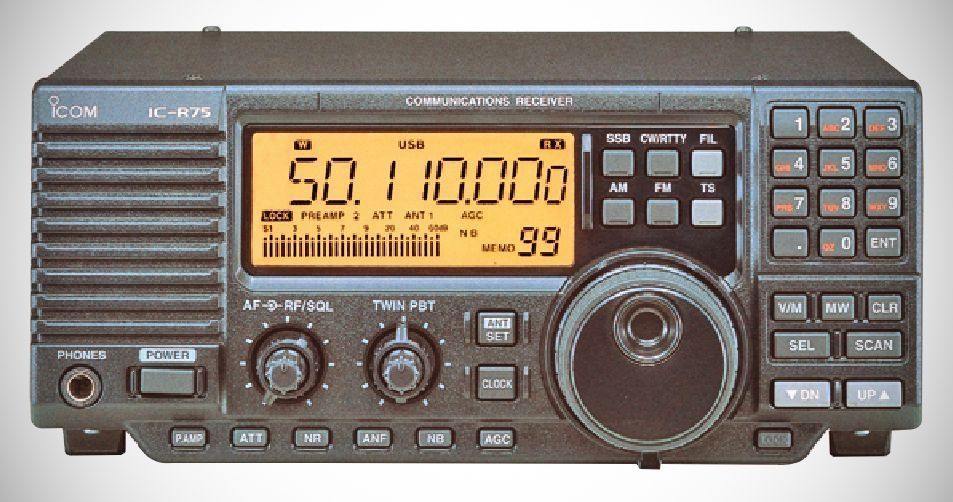
The Icom IC-R75 is a wide-coverage communications receiver designed for desktop or mobile use. It features a triple-conversion superheterodyne system (quadruple-conversion for FM) and a user-friendly interface with a clear function display and direct keypad entry.
Because it was in production for nearly 17 years, there are several distinct "eras" of the R75:
1999–2004: Early production units. These typically did not include the UT-106 DSP unit as a standard feature (it was a $100+ option).
Late 2004–2006: Icom began including the UT-106 Digital Signal Processing (DSP) unit as a standard, factory-installed item.
2007–2016: Later production models. These units are notable because they lack the Synchronous AM Detection (S-AM) feature. The Motorola chip required for this feature was discontinued, and rather than redesigning the circuit, Icom continued production without it.
2009: A minor update occurred where the standard linear power supply was replaced with a more efficient switching-type AC adapter for the North American market.
Icom officially announced the discontinuation of the IC-R75 in March 2016.
Features
– Wide Frequency Coverage: Receives signals from 0.03 MHz to 60.00 MHz, covering a broad spectrum of shortwave, AM, and amateur radio bands.
– Operating Modes: Supports USB, LSB, CW, RTTY, AM, and FM modes.
– Twin Passband Tuning (PBT): Allows for the independent adjustment of two IF passbands (455 kHz and 9 kHz) to narrow the bandwidth and eliminate adjacent-channel interference.
– 101 Memory Channels: Includes 99 regular memory channels and 2 scan edge channels, all capable of storing frequency and mode data.
– Multiple Scanning Options: Features Programmed Scan, Memory Scan, Select Memory Scan, Priority Watch, and Auto Memory Write Scan for efficient signal searching.
– Direct Keypad Entry: A 10-key keypad on the front panel allows for the immediate entry of a specific frequency or memory channel.
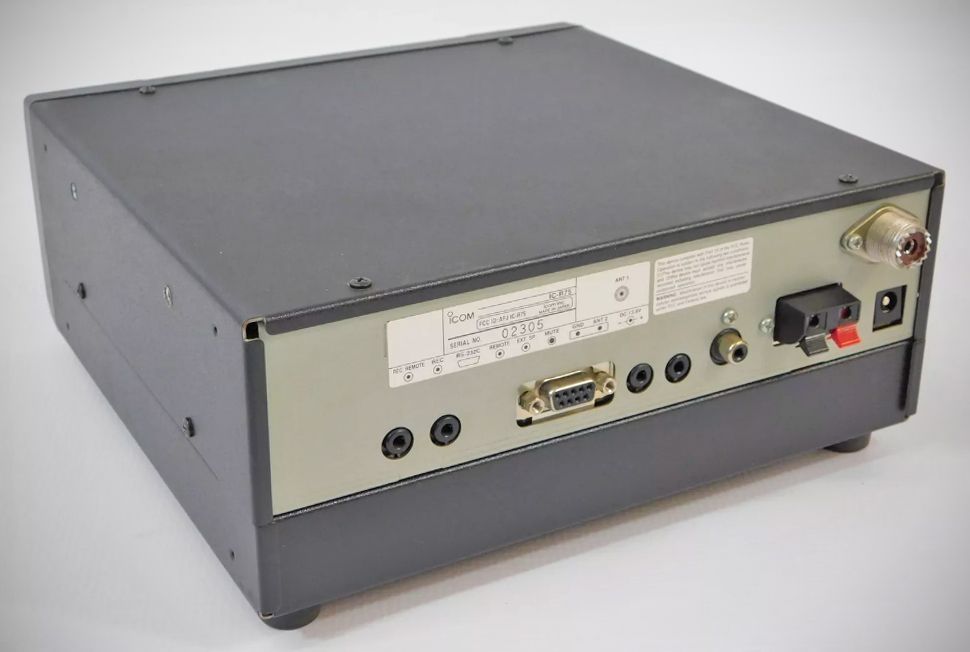
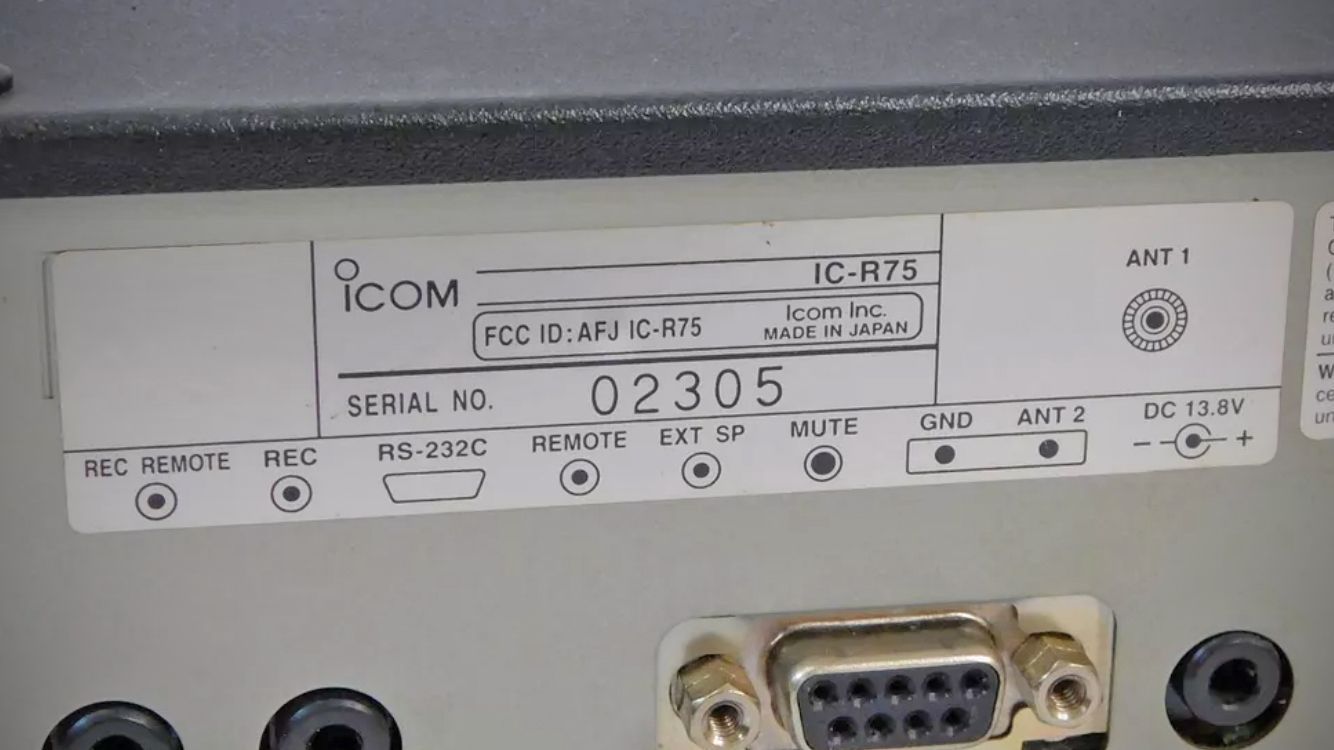
– Dual Antenna Connectors: Includes an SO-239 (50 Ω) connector for standard antennas and a push-terminal (500 Ω) for long-wire antennas.
– PC Interface: Equipped with an RS-232C connector and Icom's CI-V interface for computer control and data management.
– Clock and Timer Functions: Includes a built-in clock with programmable power-on, power-off, and sleep timers.
– Expandable Capabilities: Supports optional units such as the UT-106 DSP for digital noise reduction and auto-notch, and the UT-102 for voice frequency announcement.
Specifications
– Frequency Coverage: 0.03–60.000000 MHz (guaranteed performance from 0.1–29.99 MHz and 50–54 MHz).
– Mode: USB, LSB, CW, RTTY, AM, FM.
– Frequency Stability: Less than ±7 ppm from 1 to 60 minutes after power-on; less than ±1 ppm/hr thereafter at 25∘C.
– Antenna Impedance: SO-239 (50 Ω) and push connection terminal (500 Ω).
– Receiving System: Triple-conversion superheterodyne (Quadruple for FM).
– Sensitivity (1.8–28 MHz with preamp ON):
SSB/CW/RTTY: 0.16 μV (10 dB S/N).
AM: 1.6 μV (10 dB S/N).
– Squelch Sensitivity (1.8–28 MHz): Less than 5.6 μV (SSB) or 0.32 μV (FM).
– Spurious Response Rejection: More than 70 dB (except IF through in HF bands).
– Intermediate Frequencies (IF):
1st: 69.0115 MHz.
2nd: 9.0115 MHz.
3rd: 455 kHz.
Power Supply Requirement: 13.8 V DC ±15% (negative ground).
Current Drain: 0.9 A (Standby); 1.1 A (Maximum audio).