Note
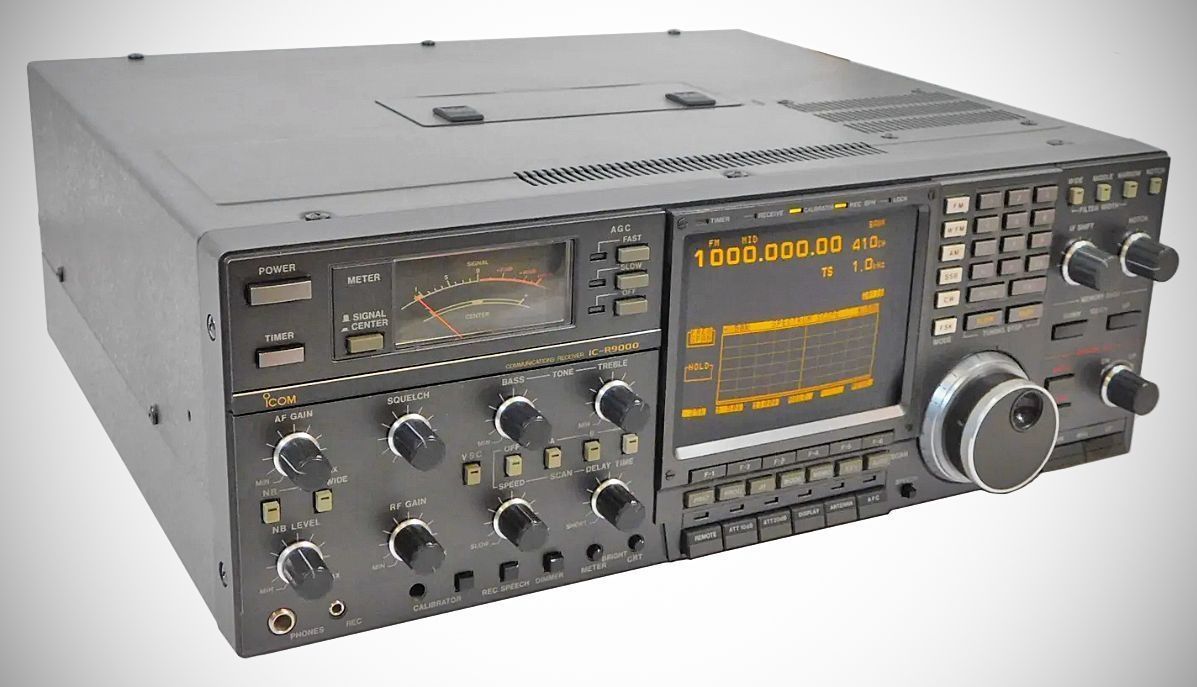
The Icom IC-R9000 is a legendary wideband communications receiver that served as Icom's flagship model for almost 18 years. Introduced in 1989, it was designed for professional surveillance, frequency spectrum monitoring, and high-end amateur radio use.
The pre-SDR era R9000 is a classic "heavy metal" superheterodyne receiver, known for its massive physical presence and exceptional analog performance. When released in 1989, the MSRP was approximately $5,000 USD.
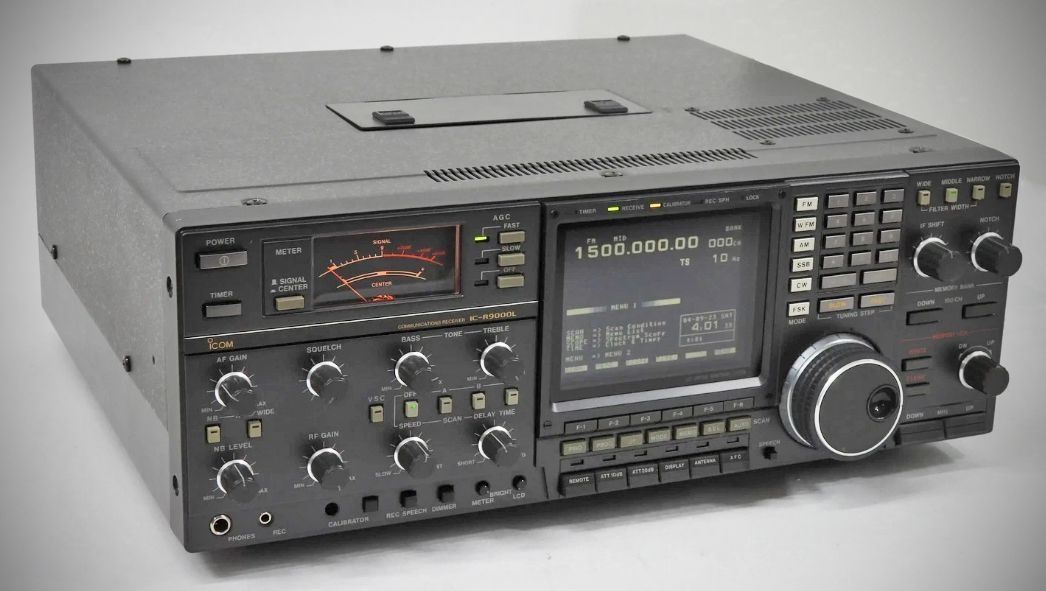
The "L" Version: In 1999, Icom released the IC-R9000L, which replaced the amber CRT with an LCD screen to address "burn-in" issues and reduce heat, though many collectors still prefer the original CRT's aesthetic.
The 9000 remained in production until 2007, when it was succeeded by the IC-R9500.
The R9000 is often compared to the IC-781 transceiver, as they share a similar front-panel layout and design philosophy, though the R9000 is a dedicated wideband receiver with significantly different internal circuitry for VHF/UHF coverage.
Features
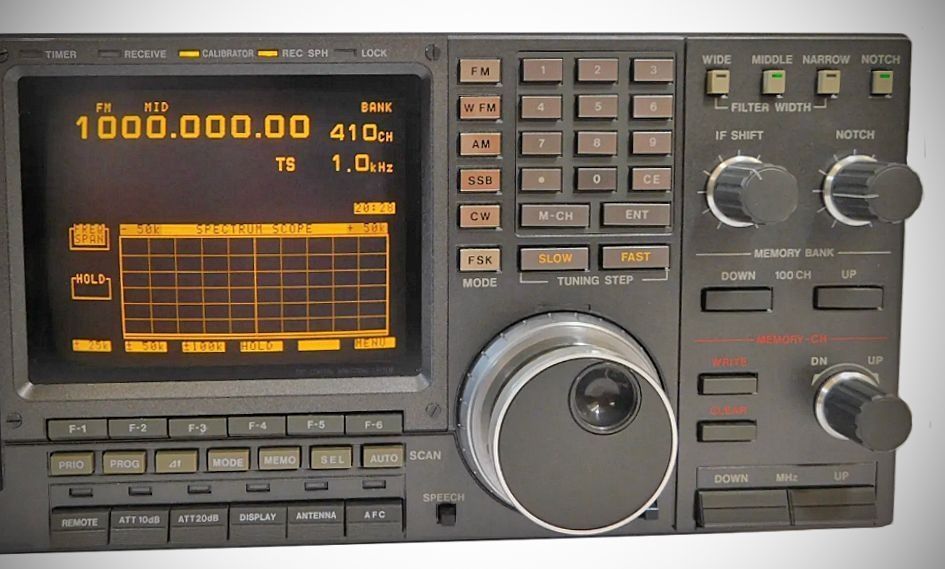
– Multifunction CRT Display: Its most iconic feature is a 5-inch amber Cathode Ray Tube (CRT) used for the spectrum scope, memory lists, and even as a terminal monitor for RTTY/packet data.
– Continuous Coverage: It covers 100 kHz to 1999.8 MHz. (Note: Due to US laws at the time, cellular frequencies were blocked in consumer versions).
– Spectrum Scope: Long before modern LCD scopes, the R9000 provided a visual representation of signals ±25, ±50, or ±100 kHz from the center frequency.
– Professional Build: It features a rack-mountable design with heavy-duty handles and a weight that reflects its complex internal shielding.
– Dual Clocks & Timers: Includes five independent daily timers and two sleep timers, controlled via the CRT interface.
Specifications
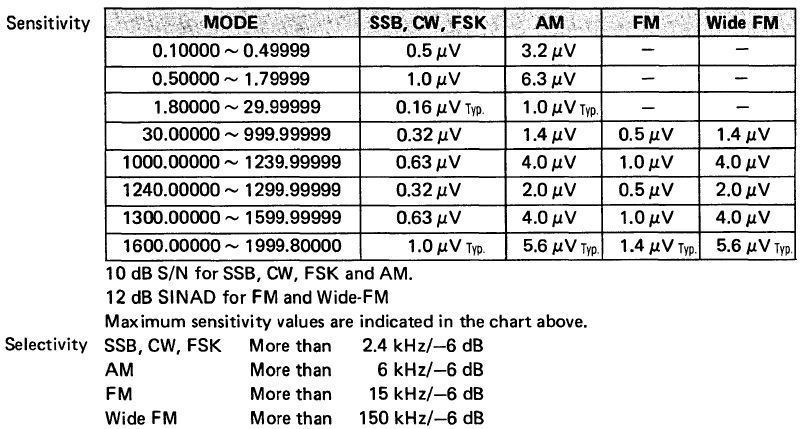
– Frequency Coverage: Continuous coverage from 100 kHz to 1999.8 MHz.
– Operating Modes: SSB (USB/LSB), AM, FM, Wide FM (WFM), CW, and FSK.
– Frequency Stability:
±0.25 ppm for ranges greater than 30 MHz (0∘C to +50∘C).
±25 Hz for ranges less than 30 MHz (0∘C to +50∘C).
– Memory Channels: 1,000 channels total, organized into 10 banks of 100 channels each.
– Tuning Steps: 10 Hz, 100 Hz, 1 kHz, 5 kHz, 9 kHz, 10 kHz, 12.5 kHz, 20 kHz, 25 kHz, and 100 kHz.
– Antenna Impedance: 50 Ω for standard connectors; 400–500 Ω for the high-impedance [HF ANT 2] jack.
– Operating Temperature Range: −10∘C to +50∘C (+14∘F to +122∘F).
– Dynamic Range: 103.5 dB (measured on the 14 MHz band in CW mode with a narrow filter).
– Scan Speed: 13 channels per second or faster.
– Spectrum Scope Span: Selectable for ±25 kHz, ±50 kHz, or ±100 kHz.
– Attenuator: Selectable levels of 10 dB, 20 dB, or 30 dB (by pushing both the 10 dB and 20 dB buttons).
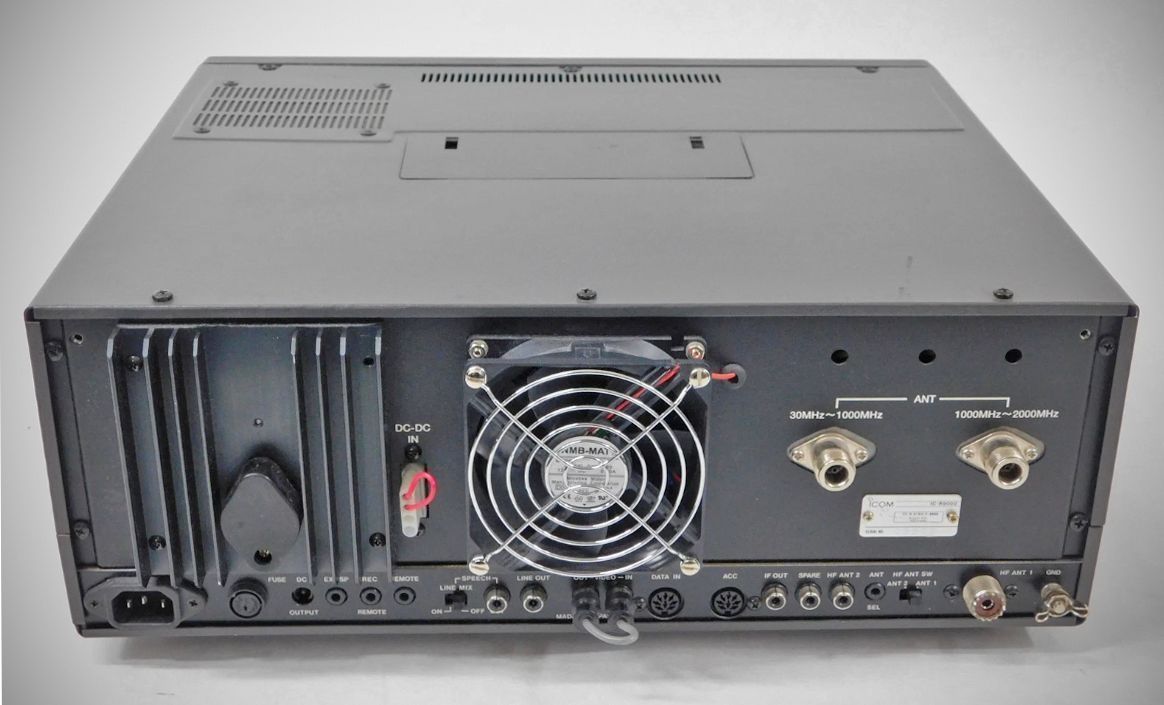
– Antenna Connectors:
HF ANT 1: PL-259 (50 Ω) for frequencies below 30 MHz.
HF ANT 2: RCA jack (400–500 Ω) for high-impedance antennas below 30 MHz.
30–1000 MHz: Type-N connector (50 Ω).
1000–2000 MHz: Type-N connector (50 Ω).
– Headphones: Standard 1/4 inch jack for 4–16 Ω mono or stereo.
– External Speaker: 8 Ω jack.
– Record Jack: Fixed level output for tape recorder AUX input.
– Other Ports:
IF Output: 10.7 MHz signal output.
Remote Jack: CI-V system for computer control.
Antenna Selector Output: 13.8 V DC (max 100 mA) for external preamplifiers or selectors.
Key Functions
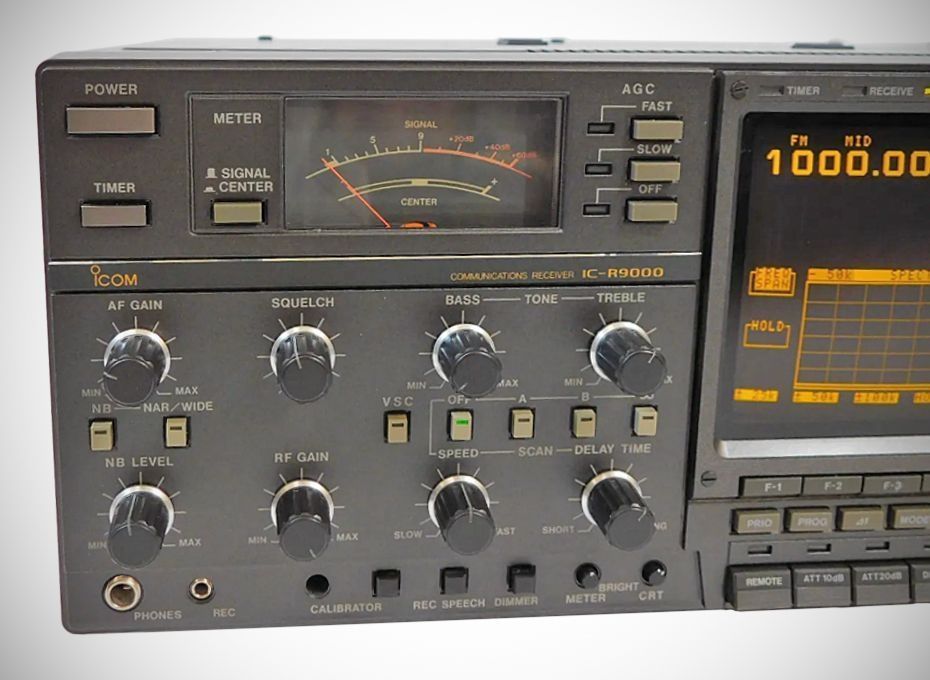
– Interference Rejection: Features IF Shift, Notch Filter (except in FM/WFM), and a threshold-adjustable Noise Blanker with selectable narrow/wide widths.
– Scan Types: Programmed Scan, Memory Scan, Selected Number Memory Scan, Selected Mode Memory Scan, Priority Scan, AF Scan, and Auto Memory Write Scan.
– Clocks/Timers: Dual clock system with two sleep timers and five independent daily timers.
Power Supply Requirement: 100–120V AC (Internal) or 13.5–15V DC via a regulated power source.