Note
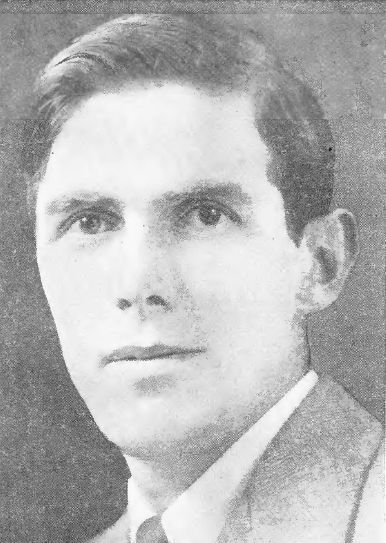
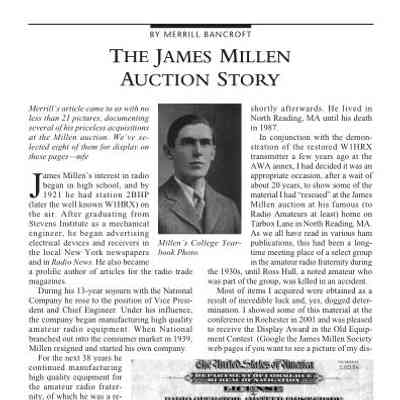
James Millen (1904–1987) was a titan of the "Golden Age" of radio, uniquely blending rigorous electrical engineering with an artist’s eye for industrial design. While many engineers of his era focused solely on what happened inside the chassis, Millen became famous for the way a radio felt in the hands of the operator.
James Millen was essentially the industrial designer of the vacuum tube era—a man who believed that a radio should be as much a piece of art as it was a piece of engineering. While his peers were often content with "black boxes" and messy wiring, Millen brought a mechanical engineer’s precision (honed at MIT) to the physical interface of radio.
Millen was a rare hybrid: a high-level executive who remained a hands-on "maker" at heart. He was known for his obsessive attention to detail, specifically regarding ergonomics.
– The "Feel" of Radio: He pioneered the use of heavy, smooth-acting tuning knobs and calibrated dials that didn't just move—they glided.
– The Millen Look: He popularized the "black crinkle" finish and the symmetrical, logical layout of front panels. To Millen, if a circuit was elegant, its housing should reflect that elegance.
– Independence: His decision to leave the prestigious National Company in 1939 to start the James Millen Manufacturing Company was a statement of his desire for absolute creative control over quality, rather than mass-market quantity.
Early Life and Education
Born in 1901, Millen was part of the first generation of "radio men" who transitioned from spark-gap experimentation to vacuum tube technology. He graduated from the Massachusetts Institute of Technology (MIT) with a degree in Mechanical Engineering, a background that would define his career-long obsession with precision tuning mechanisms and robust physical construction.
The National Company Years (1924–1939)
Millen is perhaps most synonymous with the National Company of Malden, Massachusetts. Joining the firm in the mid-1920s, he eventually rose to the position of General Manager and Chief Engineer. Under his leadership, National shifted from a manufacturer of toy trains and household parts to the premier name in high-end communication receivers.
Key Innovations and the HRO
The SW-3: Millen oversaw the development of the "Thrill Box" SW-3, a regenerative receiver that became a staple for amateur radio operators during the Great Depression due to its simplicity and efficiency.
The HRO Receiver: Millen’s crowning achievement was the HRO (Hell-of-a-Rush-Order). Released in 1935, it introduced the iconic "micrometer" dial. This wasn't just a display; it was a mechanical masterpiece that allowed for unprecedented tuning accuracy and reset-ability.
Collaboration with Herbert Hoover Jr.: Millen worked closely with the son of the U.S. President (a dedicated ham himself) to refine the technical specifications of National’s amateur gear.
James Millen Manufacturing Company
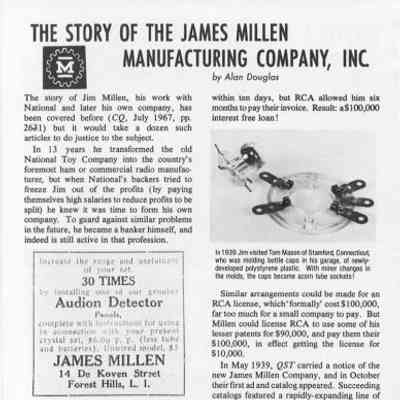
In 1939, Millen left National to form his own firm, the James Millen Manufacturing Company, also located in Malden. This move allowed him total creative control over his designs.
While National focused on complete receivers, Millen’s own company became the industry standard for components and specialized equipment. If a piece of gear featured a beautifully machined ceramic insulator, a high-voltage connector, or a distinctive "Millen-style" knob, it was likely his.
Grid Dip Meters: The Millen 90651 Grid Dip Meter became a legendary tool in the ham shack, known for its reliability and precision.
Aesthetic Signature: Millen products were characterized by "crinkle finish" paint, heavy-duty hardware, and a logical, symmetrical layout that remains highly sought after by vintage collectors today.
Legacy in Radio History
In the history of the hobby, Millen occupies the space between the "basement tinkerer" and the "corporate giant."
The Gold Standard of Receivers: As the driving force behind the National HRO, he gave amateur radio its first truly "professional" receiver. The HRO’s micrometer dial became the benchmark for frequency accuracy for decades.
The "Homebrewer's" Best Friend: Through his own company, he didn't just sell finished radios; he sold the components—the high-voltage insulators, the beautifully machined coils, and the iconic "grid dip meters"—that allowed thousands of hams to build gear that looked as good as anything coming off a factory line.
W1HRX: He wasn't just a manufacturer looking at a market; he was an active operator. His call sign, W1HRX, was a fixture in the community, and he often used his own gear to test the limits of what his designs could do.
Ultimately, Millen's legacy is the elevation of the amateur station. He transformed the "ham shack" from a collection of loose wires and breadboards into a sophisticated laboratory, proving that amateur equipment could rival—and often exceed—the quality of military and commercial gear.
He remained active in the radio community throughout his life, holding the amateur call sign W1HRX. His influence persists in the modern era; any transceiver that prioritizes "ergonomics" owes a silent debt to Millen’s early insistence that a radio should be as beautiful to look at as it is to operate.
James Millen died on June 8, 1987, at the age of 82.
His health had been in decline for a decade prior to his death. In May 1977, Millen suffered a significant heart attack that forced him to drastically reduce his professional activities. This health crisis led to the closure of the James Millen Manufacturing Company factory in Malden, Massachusetts, as the building was also facing urban renewal pressures and new safety regulations that Millen was no longer in a position to manage.
Final Years and Legacy
Retirement: Following the closure of his company, he spent his final years in North Reading, Massachusetts, where he had lived for over 50 years.
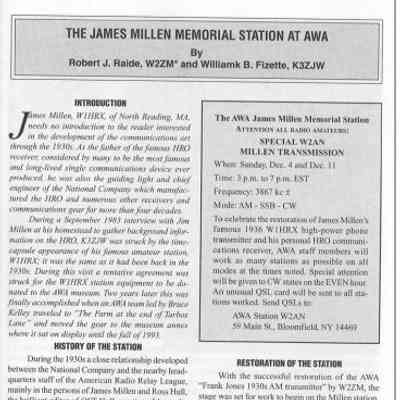
Donation to History: A few years before his death, he ensured his technical legacy would be preserved by donating his personal, legendary 1930s radio setup (under his call sign W1HRX) to the Antique Wireless Association (AWA) Museum in Bloomfield, New York.
The "Millen" Standard: By the time of his passing, he was recognized as one of the few engineers who successfully bridged the gap between the experimental "spark" era and modern solid-state electronics, leaving behind a body of work defined by mechanical perfection.
While he stepped away from the manufacturing floor in 1977, he remained a respected figure in the amateur radio community until his death, often remembered as the man who proved that a radio's "soul" was found in its mechanical design.
"The difference between a piece of equipment and an instrument is the soul the engineer puts into the mechanical design." — Attributed to the Millen design philosophy.