Note
73, Nov 1966, p. 118.
CQ, Feb 1967, p. 44.
Ham Radio, Dec 1968, p. 105. (Mk II)
Ham Radio, Jan 1971, p. 89.
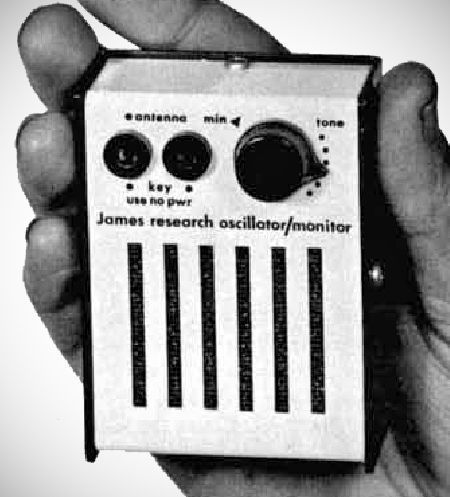
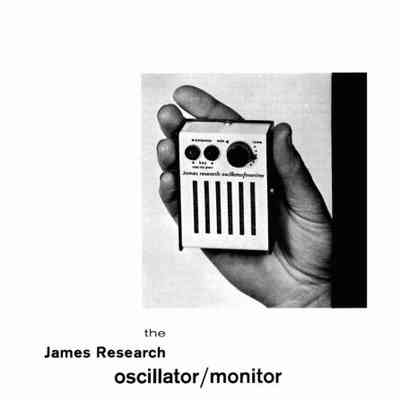
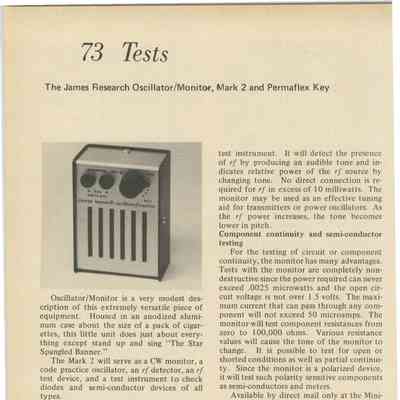
The Oscillator/Monitor serves as a highly sensitive, wireless CW sidetone monitor. Placing it near a transmitter allows it to emit an audible tone when keyed, or assist in tuning for maximum transmitter power output.
It can also be used to test continuity, resistors, diodes, and transistors. It identifies open/shorted junctions, diode polarity, and transistor types (NPN vs. PNP). It can also test capacitors down to ~0.5 µF, using tone burst length to indicate capacitor health.
By attaching a telegraph key across its input terminals, it functions as an audio code-practice oscillator loud enough for a large room or across long wiring distances.
Features
– Internal Architecture: Built around an untuned broadband RF detector connected to a high-gain DC amplifier, which triggers an audio tone oscillator.
– Sensitivity & Limits: Detects RF sources down to 10 mW wirelessly (using an 8-inch pickup wire). Direct connection increases sensitivity, but inputs directly connected above 100 mW risk burning out the input circuit.
– Triggering Range: Resists input resistance from 0 to 100,000 ohms using a 50–100 µA trigger current.
Specifications
– Frequency Range 100 kHz to 1000 MHz
– Sensitivity 10 mW (without direct connection)
– Semiconductors 4 transistors, 2 diodes
– Power Supply Single 1.5 V AA battery
References
Review. Ham Radio, Mar 1968, p. 91.
Review. 73, May 1969, p. 68.