Note
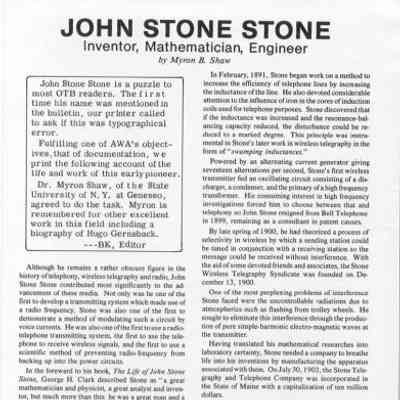
Here is a summary of the article documenting the life, work, and legacy of early radio pioneer John Stone Stone:
Key Innovations and Early Career
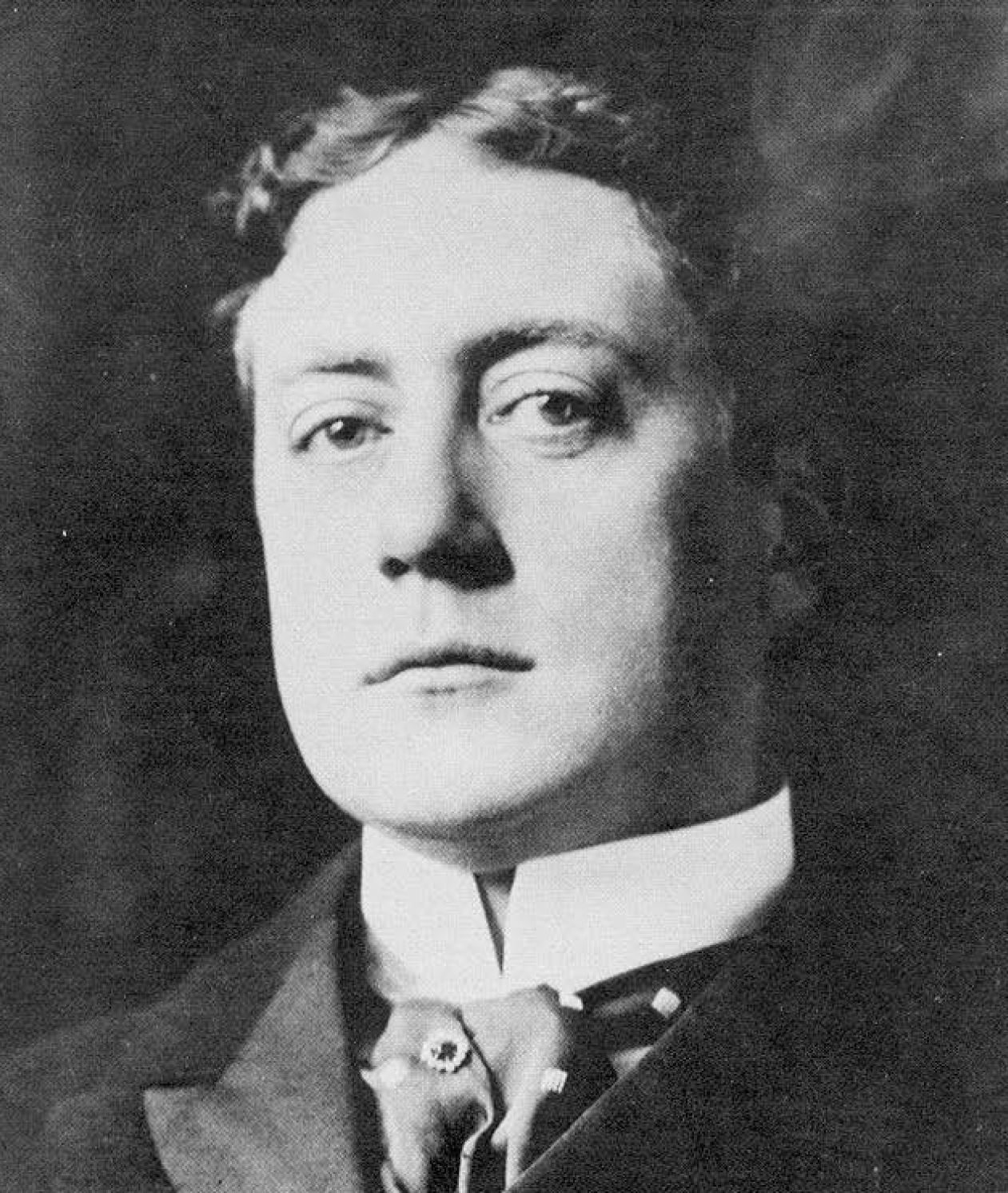
Pioneering Achievements: John Stone Stone was a highly influential mathematician, physicist, and inventor who significantly advanced early telephony, wireless telegraphy, and radio. He was among the first to develop a radio frequency transmitting system, modulate a circuit using voice currents, use a radio telephone transmitting system, utilize a telephone to receive wireless signals, and prevent radio frequencies from backing up into power circuits.
Bell Telephone and Resonance: Born in 1869, Stone studied at Columbia University and Johns Hopkins University. He worked for the Bell Telephone Company in Boston, where he made critical breakthroughs in increasing telephone line efficiency through inductance and discovered principles of electrical resonance, which he later applied to wireless telegraphy as "swamping inductances". He resigned from Bell in 1899 to focus fully on high-frequency investigations.
Commercial and Naval Ventures
Company Foundations: In December 1900, he founded the Stone Wireless Telegraphy Syndicate, followed by the incorporation of the $10 million Stone Telegraphy and Telephone Company in July 1902 to manufacture his inventions. His notable inventions included the wave meter.
Naval Contracts: The Stone Company achieved several milestones, installing oscillation transformers and equipment at the Boston and Portsmouth Navy Yards in 1905, making the first naval ship wireless installation on the USN Lebanon , and designing a massive 15,000-watt transmitter for the New York Navy Yard in 1908.
Financial Downfall: Despite major Navy contracts, the company faced financial ruin and went to a receiver's sale on May 28, 1913, after the U.S. Navy abruptly adopted a competing "quenched gap wireless system" designed by German engineer Seibt.
Later Contributions and Legacy
Industry Leadership: In 1908, Stone founded the Society of Wireless Telegraph Engineers—the first wireless technical association in the U.S.—which later evolved into the Institute of Radio Engineers. Though delicate health kept him from serving in World War I, he organized radio personnel for the Defense Committee.
Mathematical Research and Short Wave Radio: Stone moved to San Diego in 1919 and worked as a consultant for the American Telephone and Telegraph (AT&T) starting in 1920. He uniquely chose to conduct his research and test his inventions entirely through mathematical analysis rather than using a laboratory. During this later period, he secured roughly 31 patents (covering fields like relaying, simultaneous transmission/reception, and directional signals) and spent twelve years acting as a pioneering "apostle" for short wave radio.
Character: Highly praised by his peers, including Dr. Lee DeForest, Stone was remembered at his death in 1943 not just as a brilliant mathematical analyst of radio principles, but as a "great gentleman" whose elegant, precise language elevated even his patent specifications to the level of literature.