Note
Kit form or assembled.
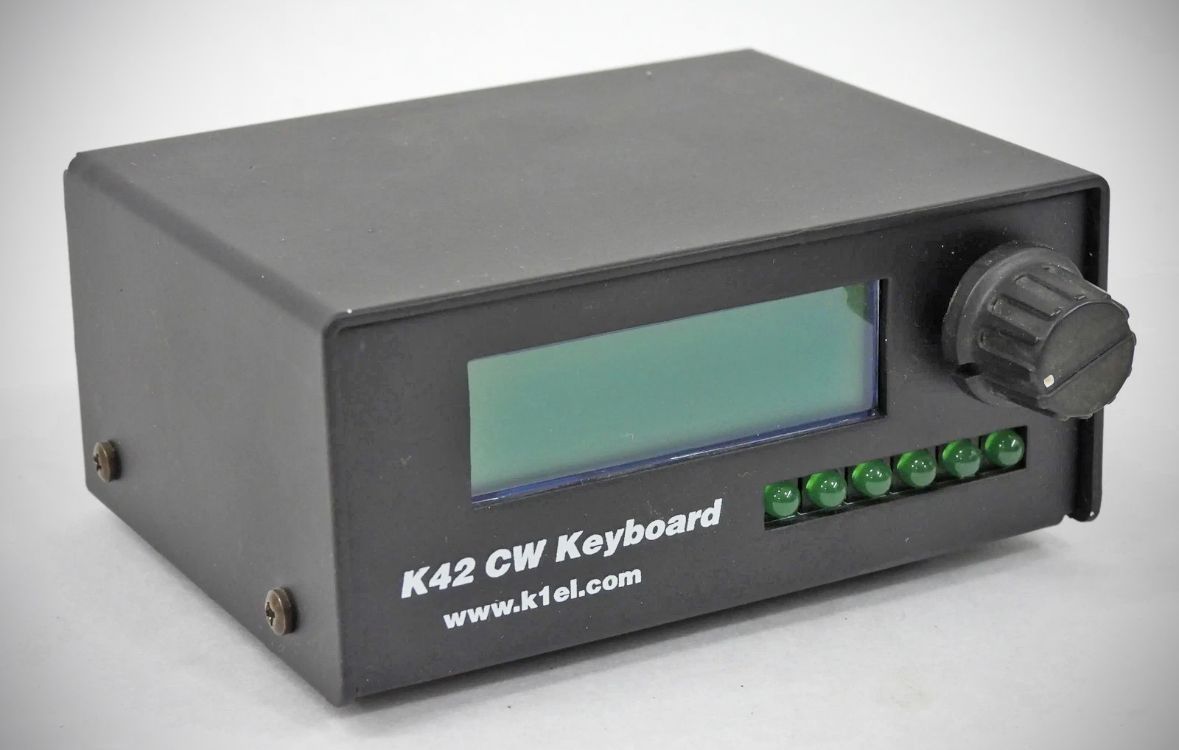
Often described as the "Swiss Army knife of CW keyers," the K1EL K42 (and its updated counterpart, the K42B) is a highly versatile, compact Morse code multifunctional device. It combines a standalone CW keyboard interface, a built-in Morse code reader, and an advanced iambic paddle keyer into a single desktop unit.
Core Hardware Components
– Display: A 16-character by 2-line backlit LCD that acts as a visual interface for both transmitting and receiving. It provides real-time text feedback, status modes, and system settings.
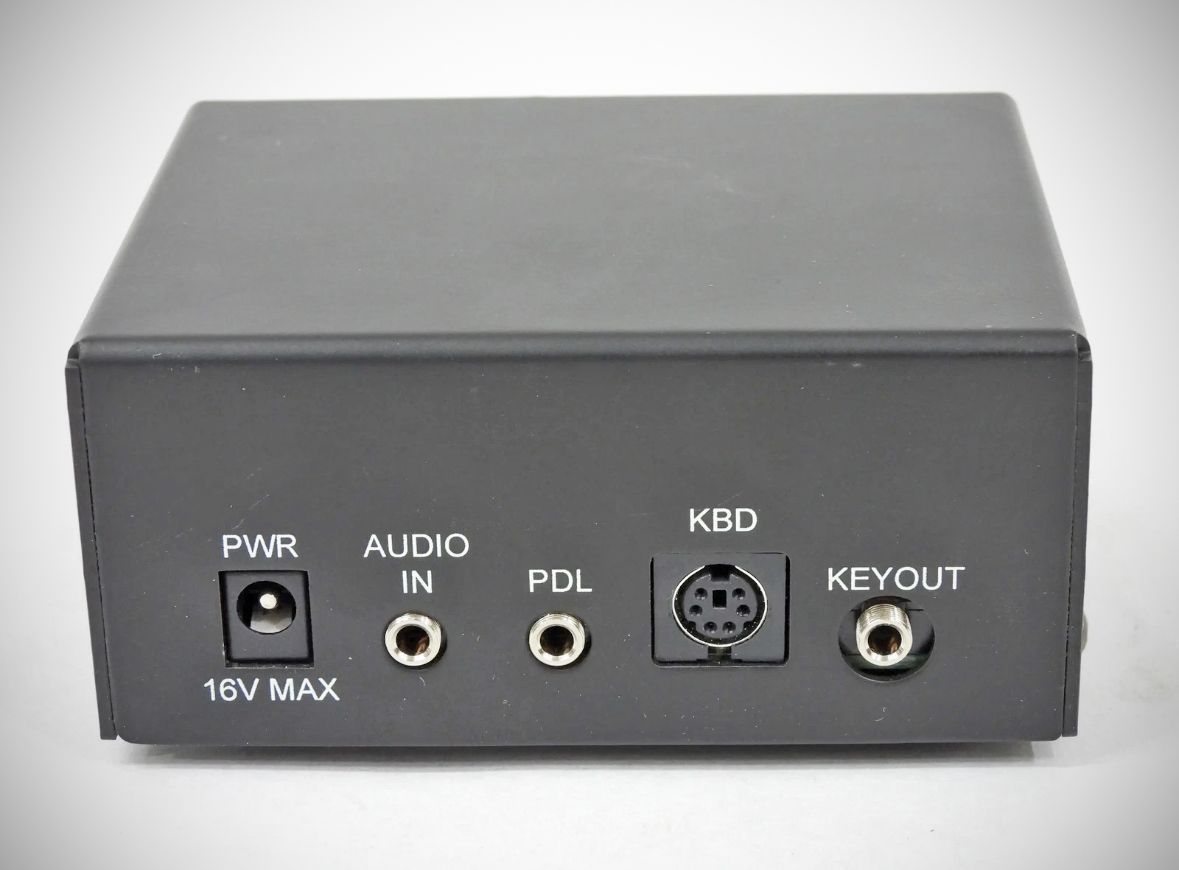
– Keyboard Interface: Designed to accept a standard IBM PS/2 keyboard. It features a 200-character type-ahead buffer, allowing you to fluidly type out transmission text well before the Morse code elements finish sending.
– Optically Isolated Outputs: Built with high-voltage, optically isolated keying circuits capable of handling positive or negative voltages up to 300 VDC. This allows the keyer to safely interface with virtually any vintage or modern transmitter, protecting the unit from chassis ground loops and high-voltage key lines.
– Speed Control: Features an onboard rotary encoder to smoothly dial in transmitting speed dynamically.
Transmit & Keyer Capabilities
The transmit side relies on the robust K1EL CW command language used across many of their standalone chips, offering deep configuration options:
– Speed Range: Supports conventional CW transmission from 5 to 120 WPM, with extended operations for specialized modes like High-Speed CW (HSCW) and QRSS (very slow CW) reaching up to 140 WPM.
– Advanced Timing Adjustments: Includes precise settings for weighting, autospacing, Farnsworth spacing, keying compensation, and first dit/dah compensation to help clear up transceiver relay lag.
– Message Memory: Packs a 2,048-byte EEPROM message memory split into 12 custom memory slots. These slots can be instantly triggered via the keyboard's function keys to chain, nest, call, or loop macros—ideal for contesting or running a programmable beacon delay.
– Contesting Features: Includes an onboard automatic serial number generator and support for custom prosigns or European character sets.
The Built-in CW Reader (CWR)
One of the standout features of the K42 is its integrated receiver decoding circuit, which allows you to translate incoming Morse code onto the LCD.
– Audio Processing: It takes an audio feed directly from a transceiver's headphone or external speaker jack. It routes the signal through a sharp, internal 8-pole bandpass audio filter fixed at a lock frequency of 690 Hz.
– Visual Tuning Array: A front-panel LED bar graph acts as a tuning indicator. As you slowly turn the transceiver's VFO and pass the target signal through the 690 Hz sweet spot, the LEDs peak to the right, letting you zero-in visually.
– Speed Tracking: Features an automatic speed-locking algorithm that accurately tracks and decodes incoming CW from roughly 10 WPM to over 35 WPM, adapting on the fly to varying inter-letter spacing and noise thresholds.
Operating Environment & Legacy
The K42 operates on 9 volts DC, idling around 40 mA and peaking at 80 mA when driving the internal sidetone speaker. For operators who strictly want a transmit keyboard or prefer copying strictly by ear, the CW reader circuitry can be turned completely off.
While the K42 series was eventually retired to make room for the surface-mount, menu-driven K44 (which integrates the newer WinKeyer3 emulation engine), the K42 remains a highly regarded piece of station gear on the secondhand market and hamfest tables due to its dual keyboard/paddle flexibility, rugged isolation, and reliable standalone operation.
K42C Features
– IBM PS/2 Keyboard Interface
– 5 - 120 WPM CW Transmit
– Adjustable sidetone frequency
– Iambic keyer w/autospace
– Farnsworth spacing
– Adjustable weighting
– Keying Compensation
– First dit/dah compensation
– Optically Isolated HV Outputs
– Adjustable PTT delay
– 2048 byte message memory
– 12 memory slots
– Messages can be chained, called, or repeated
– Programmable beacon delay
– K1EL CW command language
– 200 character type ahead
– HSCW and QRSS Tx support
– Serial number generator
– Keyboard key paddle
– Custom Prosigns
– European character support
– RFI filtering on interconnect leads
– 16 character by 2 line LCD
– Rotary Encoder speed control