Note
Kit form or assembled.
It was designed as a modern evolution of the older K42, inheriting the powerful Winkeyer3 engine and upgrading both the internal processing and the decoding firmware. Though it has since been succeeded by the K45, it remains a favorite for operators who want comprehensive CW capabilities without relying on a full computer setup.
– Stand-Alone Operation: You can plug a standard PC keyboard directly into the K44 to transmit perfect Morse code without needing a computer running logging software.
– Hardware Interface: It utilizes an IBM PS/2 (mini-DIN) connector. While it does not support native USB keyboards, standard legacy PS/2 keyboards work perfectly.
– Type-Ahead Buffer: Features a 200-character type-ahead queue. A flashing Caps Lock light on your keyboard alerts you if the transmission is paused while characters are waiting in the buffer.
CW Reader (Morse Decoder)
– Audio Processing: The K44 accepts low-level line audio or speaker audio from your receiver, routing it through a 6-pole bandpass audio filter.
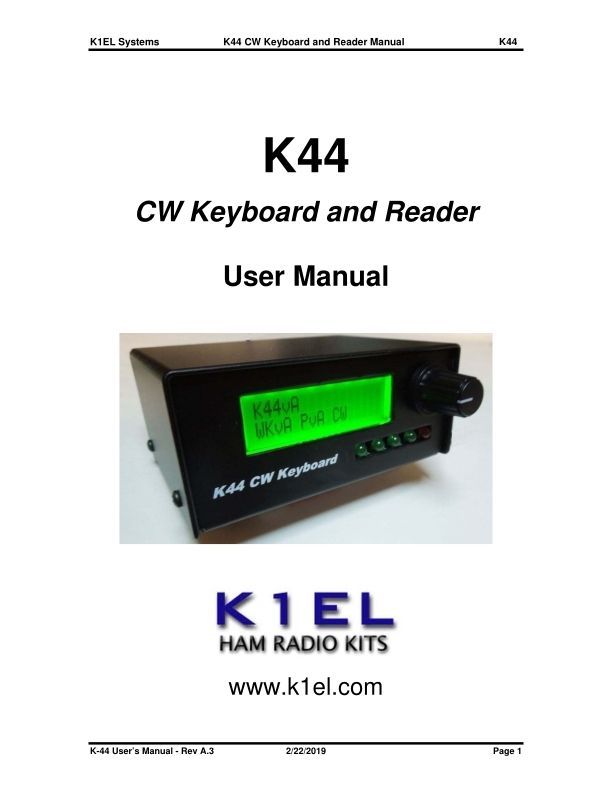
– Demodulation & Display: It automatically locks onto signals between 10 and 40+ WPM, demodulates the audio, and scrolls the decoded text across a built-in 16-character by 2-line backlit LCD.
– Tuning Array: A 5-element LED array on the front panel serves as a visual tuning indicator, helping you lock onto the target station's pitch centered precisely at 725 Hz.
– Rx-to-Tx Locking: You can lock your transmitting speed directly to the speed of the incoming decoded signal.
Iambic Paddle Keyer
– Modes: Serves as a full standalone iambic keyer supporting Autospace, Ultimatic, and Bug operational modes.
– Timing Adjustments: Inherits full Winkeyer3 flexibility, providing precise adjustments for weighting, keying compensation, and first dit/dah compensation.
– Speed Range: Supports conventional CW transmission from 5 up to 120 WPM, alongside specialized high-speed modes like QRSS (very slow) and HSCW (high-speed meteor scatter).
Memory & Command Structure
– Storage: Contains 2048 bytes of non-volatile EEPROM message memory split into 12 memory slots (triggered easily via keyboard Function keys).
– Macro Functions: Messages can be easily chained, nested, set to repeat with programmable beacon delays, or configured with an embedded automatic serial number generator for contesting.
– The Command Language: Settings are handled via K1EL's native text-prompted menus on the LCD screen, allowing you to change variables, edit saved messages directly with an interactive keyboard editor, or alter the LCD contrast without tweaking hardware pots.
Full list of chages from the K42
– The K44 logic board is mostly surface mount construction and is pre-assembled and tested in kit versions.
– The two PICs and PSoC are through hole parts and are carried in sockets to allow easy service and upgrade.
– There are no on board adjustments, the LCD contrast is now controlled by keyboard command.
– The rotary encoder is now attached to the main logic board through a breakout board. This greatly improves reliablility and ease of assembly.
– Only 5 tuning LEDs are required for the K44, the LED array functionality is much better than the K42
– An on/off switch is included on the K44 logic board. The unit is turned on and of by pressing in on the encoder.
– The K44 firmware is a vast improvement over the K42. It uses the Winkeyer3 keyer engine and inherits all of those functions.
– Most of the parameter commands are menu driven with text prompts.
– Now employs a real editor for entering and modifying K44 messages.
– Supports two keyboard layouts, QWERTY and AZERT.
– The CWR PSoC has been completely rewritten. The new version is remarkably better than the K42. It works better in noisy band conditions and also weak signal detection.