Note
QST, Oct 1980, p. 148.
QST, Feb 1981, p. 155.
QST, Jan 1982, p, 110.
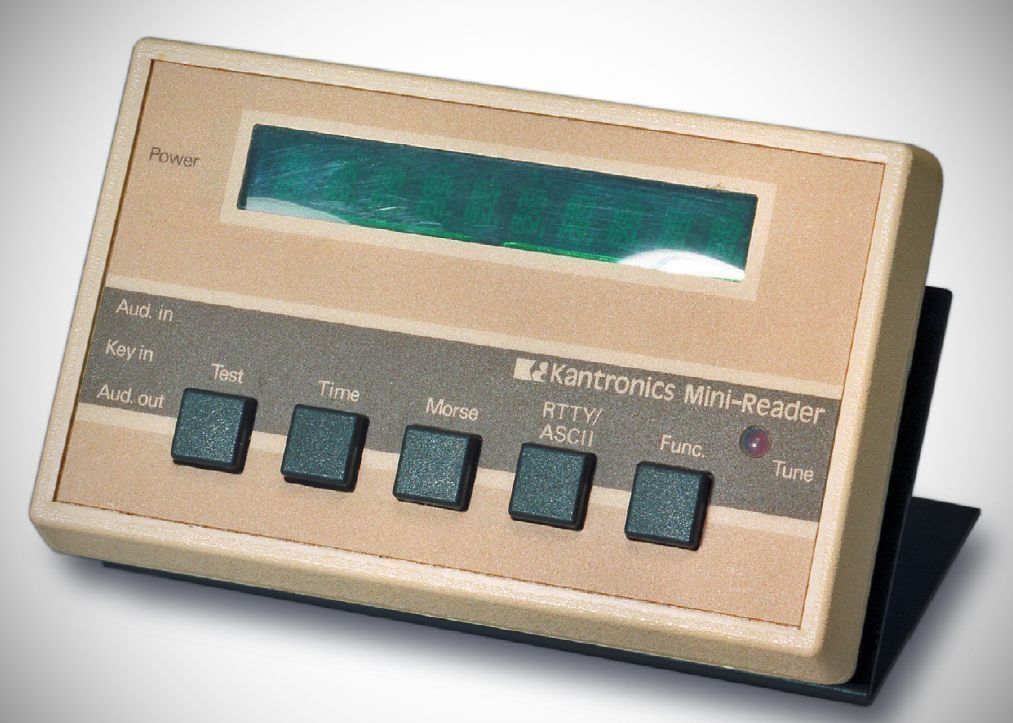
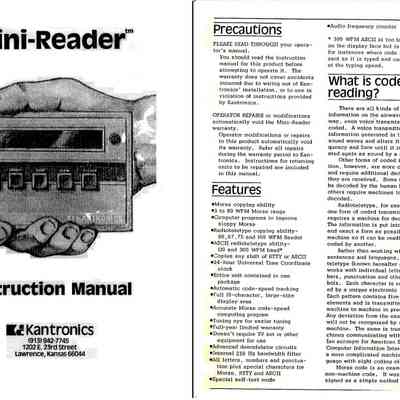
The Kantronics Mini-Reader is a portable, all-in-one computer and code reader designed to decode Morse code, radioteletype, and ASCII transmissions directly from a receiver. The entire unit is contained in a single portable package that does not require an external television screen or complex station equipment to operate.
Features
– Display: It features a full, large-size 10-character display using 14-segment alphanumeric units that are 3/8 inch high.
– Tuning Eye: A dedicated "tuning eye" LED on the front panel blinks in sync with incoming audio signals, allowing users to visually find and perfectly center a station's frequency for optimum copy accuracy.
– Side-Panel Interface: The unit has four main jack inputs/outputs, which are explicitly labeled on the front panel for ease of use:
– Power Jack: Compatible with a 2.5mm phone plug.
– Audio Input (AUD IN): A 3.5mm compatible jack used to capture audio from a receiver's external speaker or headphone output (requires a minimum input voltage of 70 mV RMS).
– Key Input (KEY IN): A 3.5mm compatible jack used to connect a hand key or external electronic keyer for direct code tracking, training, or frequency counting.
– Audio Output (AUD OUT): A 3.5mm compatible jack that passes receiver audio back out to an external speaker.
Operational Modes & Demodulation
– Morse Code Copying: It tracks Morse code automatically at speeds ranging from 3 to 80 Words Per Minute (WPM). It has a specialized "editing" program that compensates for variations and errors in human-sent code. It also includes a "Practice" mode where this program is relaxed to strict Morse specifications for training purposes.
– Radioteletype (RTTY): It decodes standard Baudot RTTY signals at speeds of 60, 67, 75, and 100 WPM across any signal shift.
– ASCII Demodulation: It decodes data transmissions at 110 and 300 baud.
– Internal Filtering: It uses advanced demodulator circuits with a highly selective active internal bandpass filter centered at approximately 750 Hz with a 250 Hz bandwidth to clear up crowded or weak band conditions.
– Audio Frequency Counter: It features a built-in counter mode capable of measuring audio frequencies from 0 to 79 kHz through the KEY IN jack with ±0.01% accuracy.
– UTC Clock: It includes an on-board 24-hour Universal Time Coordinate clock.
– Self-Test Mode: An integrated test function cycles sequentially through all letters, numbers, and punctuation marks to verify display functionality.
Specifications
– Input Impedance: 8 ohms.
– Power Requirements: Operates on an external direct current source supplying 8 VDC to 18 VDC at roughly 240 mA.
– Character Set: Recognizes all baseline letters and numbers across all modes, along with a vast selection of prosigns for Morse (like AR, AS, BT, KN, SK), punctuation for RTTY, and extended text symbols for ASCII.