Note
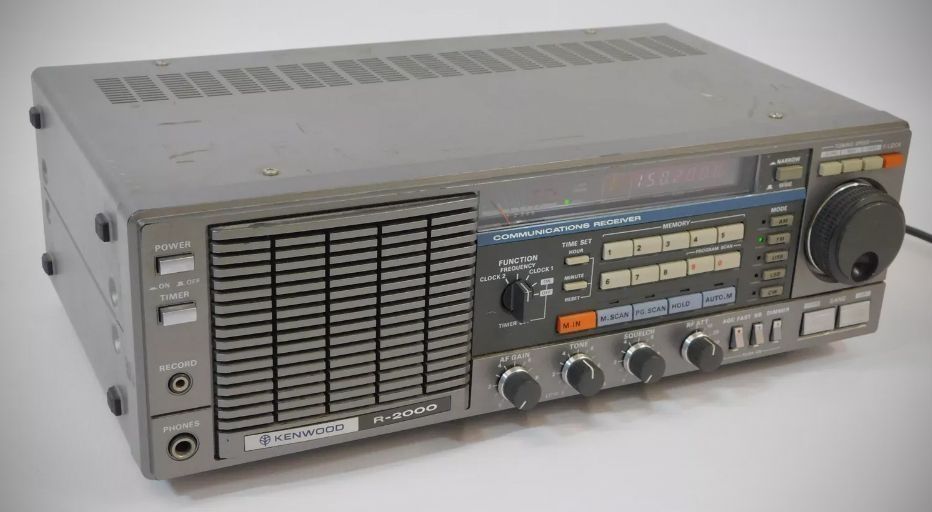
The Kenwood R-2000 is a celebrated solid-state communications receiver produced during the 1980s. It is often remembered for bridging the gap between professional-grade performance and a user-friendly, tabletop design. It covers a wide frequency range from 150 kHz to 30 MHz, encompassing longwave, medium wave, and shortwave bands.
At its launch, it was positioned as a more affordable, user-friendly alternative to the professional-grade Icom R-70 or the JRC NRD-515, making it a favorite for "utility" monitors and DXers alike.
The receiver utilizes a triple-conversion superheterodyne design, which contributes to its high sensitivity and image rejection. While it lacks the advanced "IF Shift" or "Passband Tuning" found in its larger sibling (the R-5000), it is widely regarded for its excellent audio quality, especially when paired with a high-quality external speaker.
Key Technical Specifications
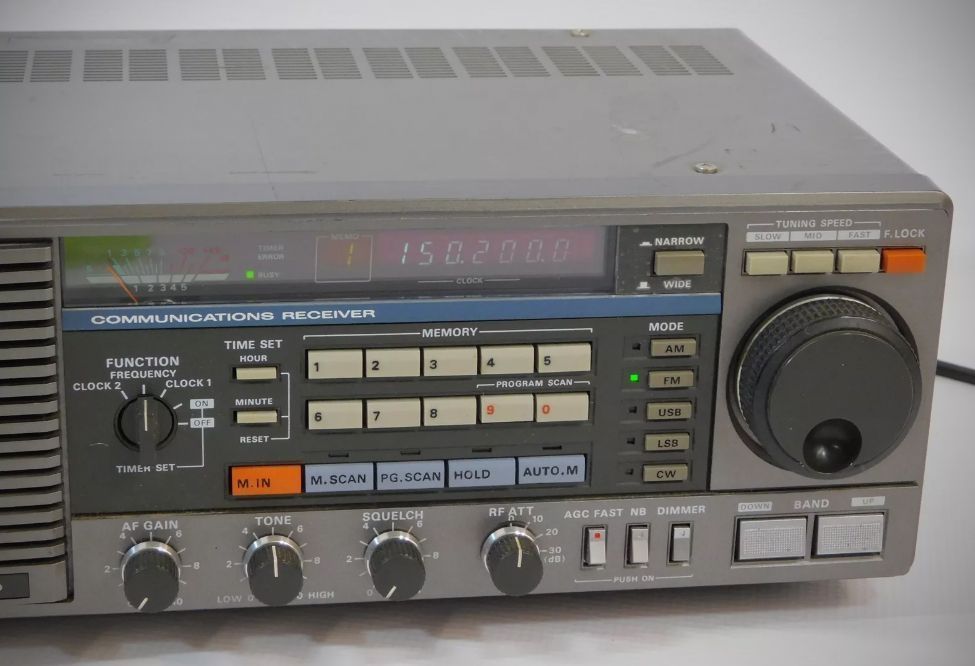
– Modes: It supports AM, FM, USB, LSB, and CW, making it highly versatile for both broadcast listeners and utility monitors.
– Frequency Entry: Features a full ten-key pad for direct frequency entry, alongside a smooth weighted tuning knob.
– Memories: It was one of the early receivers to offer 10 internal memory channels, which was a significant convenience at the time of its release.
– Dual VFOs: The inclusion of two VFOs (A and B) allows for quick switching between two different frequencies or monitoring split-frequency operations.
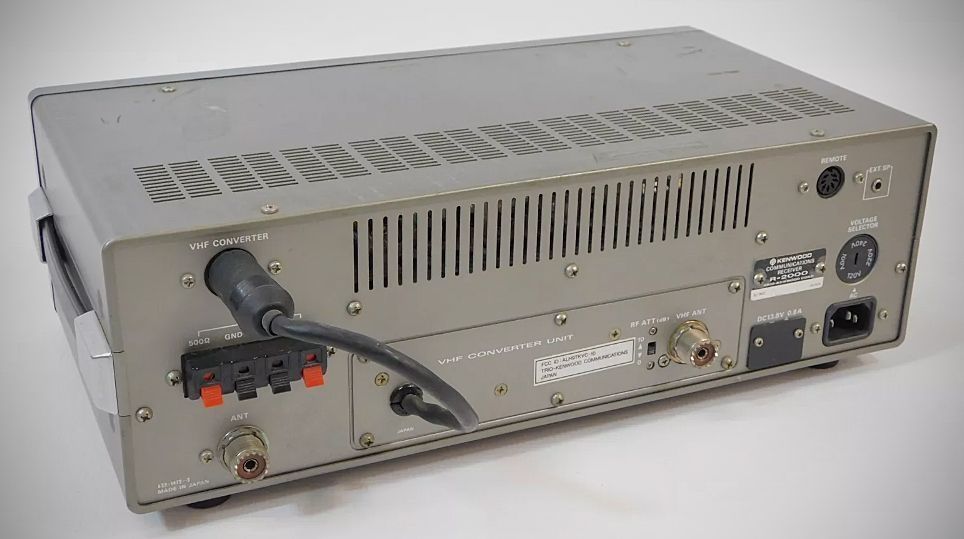
– VHF Expansion: A unique aspect of the R-2000 is the optional VC-10 converter unit. When installed, this expands the receiver's range to include the 118 MHz to 174 MHz VHF band, covering aviation and 2-meter amateur bands.
– Filtering: It includes a narrow/wide selectivity switch and an effective noise blanker, which is particularly useful for clearing up interference from automotive ignitions or power lines.
– Display: It utilizes a bright fluorescent digital display that shows the frequency down to 100 Hz.
Specifications
– Frequency Range: HF: 150 kHz to 30 MHz
VHF (Optional): 118 MHz to 174 MHz (with VC-10 converter)
– Modes: AM, FM, SSB (USB/LSB), CW
– Antenna Impedance:
Low Impedance: 50Ω (SO-239 connector)
High Impedance: 500Ω (Push terminals)
– Frequency Stability:
Within ±300 Hz during the first hour after 1 minute of warm-up.
Within ±50 Hz during any 30-minute period thereafter.
– Frequency Accuracy: ±10×10−6 or better (at normal temperatures).
– Receiver Circuitry: Triple conversion superheterodyne.
– Intermediate Frequencies (IF):
1st IF: 45.85 MHz to 45.90 MHz
2nd IF: 9.85 MHz to 9.90 MHz
3rd IF: 455 kHz
– Sensitivity (0 dBμ=1μV):
SSB/CW (10 dB S+N/N)
150 kHz−2 MHz: < 2μV
2 MHz−30 MHz: < 0.4μV
AM (10 dB S+N/N)
150 kHz−2 MHz: < 20μV
2 MHz−30 MHz: < 4μV
FM (20 dB S+N/N)
2 MHz−30 MHz: < 1μV
Power Requirements: 100/120/220/240 V AC,50/60 Hz or 13.8 V DC (with optional DCK-1 kit).
Power Consumption: 14 W (at no signal).