Note
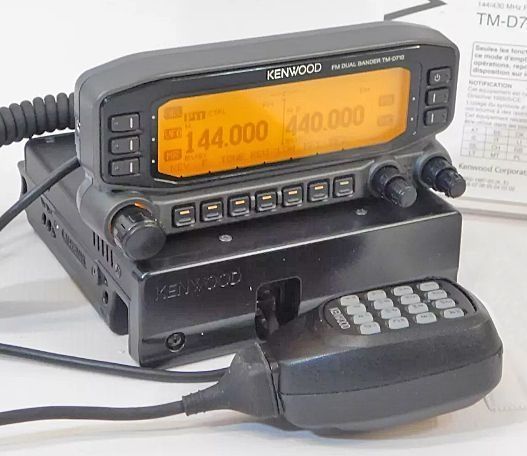
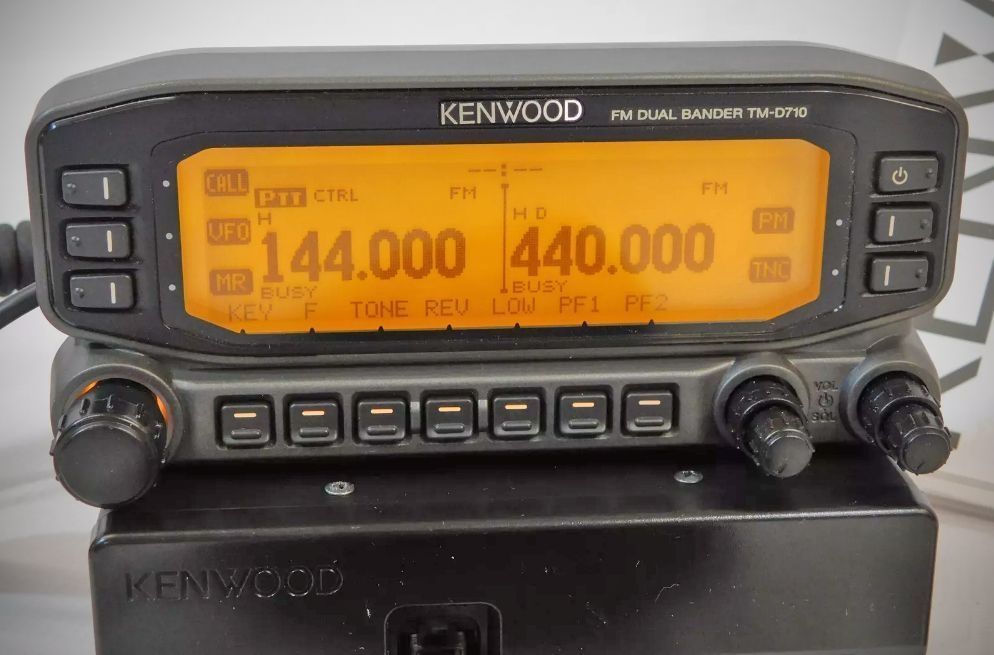
The Kenwood TM-D710A/E is a multi-communicator FM dual-bander (144/440 MHz or 144/430 MHz) designed for both voice and data communications. It features a separate operation panel and a TX/RX main unit, allowing for versatile installation in mobile or fixed station environments. The device is specifically engineered to support advanced data protocols like APRS, EchoLink, and Packet operation without requiring extensive external hardware.
The TM-D710A served as the successor to the TM-D700A (released in 2000) and remained the flagship APRS mobile unit until it was updated to the TM-D710GA (which added an integrated GPS) in 2013
APRS Operations and Features
Developed in collaboration with Bob Bruninga (WB4APR), the system is designed as a local tactical information resource rather than just a vehicle tracking system. Key features include:
– Situational Awareness: The unit provides real-time information on weather, traveler info, and the location of nearby stations and objects.
– Station Management: The transceiver can store and display a list of the nearest 100 stations heard, including their current voice operating frequencies.
– Network Efficiency: It implements "decay algorithms" and "proportional pathing" to refresh local information frequently while minimizing interference from distant data.
– Two-Way Messaging: Supports full two-way human-to-human messaging, allowing for communication in the field without a PC.
– SmartBeaconing: An advanced function that adjusts the transmission interval of position beacons based on the vehicle's speed and heading changes.
EchoLink Integration
The TM-D710A/E is notable for being one of the first transceivers with built-in EchoLink capabilities.
– Mobile Use: It supports "node memories" that store DTMF sequences for favorite nodes, allowing mobile users to connect to distant stations via short-cut commands.
– Sysop Mode: Using an optional PC cable kit (PG-5H), the radio can be configured as a fixed EchoLink node, acting as a gateway between the Internet and local RF channels.
– Simultaneous Operation: Users can operate both EchoLink Sysop mode and APRS/Packet mode at the same time by assigning them to different bands on the transceiver.
Software and Customization
– MCP-2A Memory Control Program: This PC software allows users to manage memory channels, menu settings, and EchoLink memories more easily than through the radio's front panel.
– GPS Interfacing: The unit uses the NMEA 0183 standard to communicate with GPS units. It features a specialized "Tactical Mode" when used with an AvMap G5, allowing for real-time tracking of specific APRS assets (callsigns) directly on the GPS map.
Key Features
– Built-in TNC: Includes a Terminal Node Controller conforming to the AX.25 protocol for easy packet operation with a portable computer.
– APRS Support: Features integrated support for Automatic Packet/Position Reporting System (APRS) data formats.
– High Memory Capacity: Offers 1,000 memory channels that can be named with up to 8 alphanumeric characters.
– Programmable Memory (PM): Allows users to save entire operating environments into PM channels for quick recall.
– Advanced Squelch: Features both Continuous Tone Coded Squelch System (CTCSS) and Digital Code Squelch (DCS) to reject unwanted calls.
– EchoLink Ready: Includes dedicated menu settings and memory for EchoLink operation.
– GPS Connectivity: Equipped with a dedicated GPS jack for connecting external GPS receivers or weather stations.
– Flexible Installation: The detachable operation panel can be mounted separately from the main TX/RX unit.
Specifications
Frequency coverage:
Transmit: 144 ~ 148 MHz and 438 ~ 450 MHz
Receive:
Band A: 118 ~ 524 MHz.
Band B: 136 ~ 524 MHz, and 800 ~ 1300 MHz.(cell blocked)
Frequency Stability: Within ±5 ppm (–10°C to +50°C)
Antenna Impedance: 50 Ω
– RF Power Output: High: 50; Mid: 10, Low: 5 watts.
– Modulation: Reactance modulation.
– Max Frequency Deviation: Within ±5 kHz.
– Spurious Radiation: Less than –60 dB.
– Modulation Distortion: Less than 3% (300 Hz – 3 kHz).
– Receiver Circuitry: Double super heterodyne.
– Intermediate Frequencies:
1st IF: 45.05 MHz (Band A) / 49.95 MHz (Band B).
2nd IF: 455 kHz (Band A) / 450 kHz (Band B).
– Sensitivity (Amateur bands): Less than 0.16 µV (–16 dBµ).
– Operating Temperature: –20°C to +60°C (–4°F to +140°F)
Power Requirements
13.8 V DC ±15% (Negative ground)
Current Drain (TX): < 13.0 A at High power (VHF/UHF)
Current Drain (RX): < 1.2 A (at 2W audio output)