Note
QST, Nov 1976, p. 6.
QST, Nov 1977, p. 183.
Features
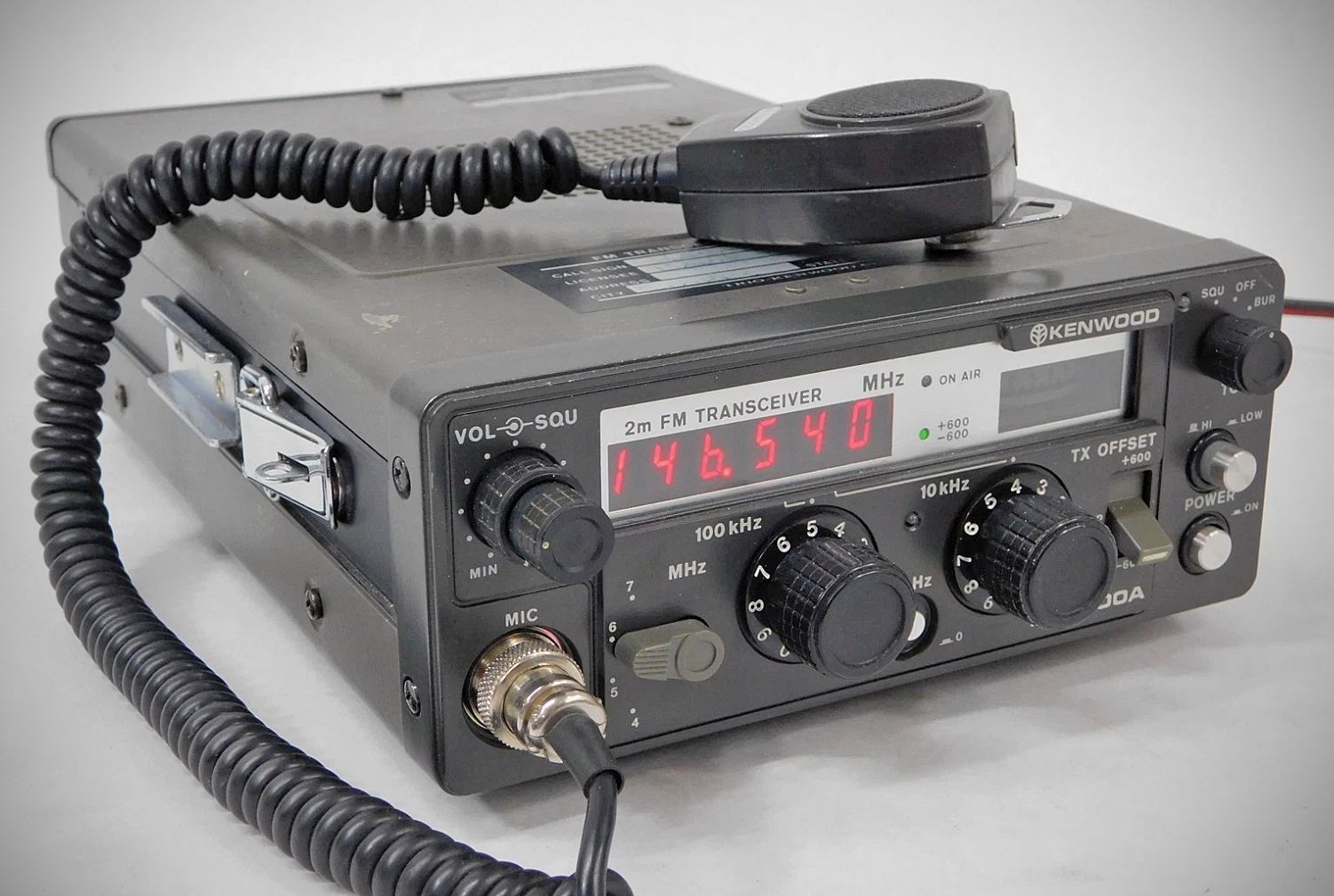
– Covers the entire 2-meter band using phase-locked loop (PLL) synthesis.
– Offers 400 channels spaced every 10 kHz, along with a push button 5 kHz offset.
– Features a three-position switch for ±600 kHz repeater offsets or simplex operation.
– RF Power: Rated for 25 Watts output, though testing yielded over 30 Watts in High Power mode. Low power is factory-adjusted to 5 Watts (and adjustable up to 10 Watts).
– Final Protection: Protects the output stage during impedance mismatches by reducing power rather than completely shutting down.
– Squelch Modes: Supports continuous tone-coded squelch (CTCSS either encode/decode or encode-only using active filters to eliminate time lag), tone burst, and standard carrier squelch.
– Modular System: Uses plug-in optional modules inserted via computer-type connectors near the internal ceramic filter. Kenwood offered 25 different frequency modules for tone squelch and tone burst.
– Double conversion superheterodyne with a 10.7 MHz 1st IF and a 455 kHz 2nd IF.
– Utilizes a MOSFET front end, large helical resonators, and a 10.7 MHz monolithic crystal filter.
– Digital Readout & LED Illumination: Bright red, 1-inch high LED display for frequency. Includes dedicated LED indicators for transmit, continuous tone-coded squelch, unlock warning (which automatically shuts down the radio if the PLL unlocks), and transmitter offset color coding (Red for -600 kHz, Green for +600 kHz, off for simplex).
– Multimeter indicates power output and SWR (a reading of 8 out of 10 in High Power indicates an SWR under 1.5:1).
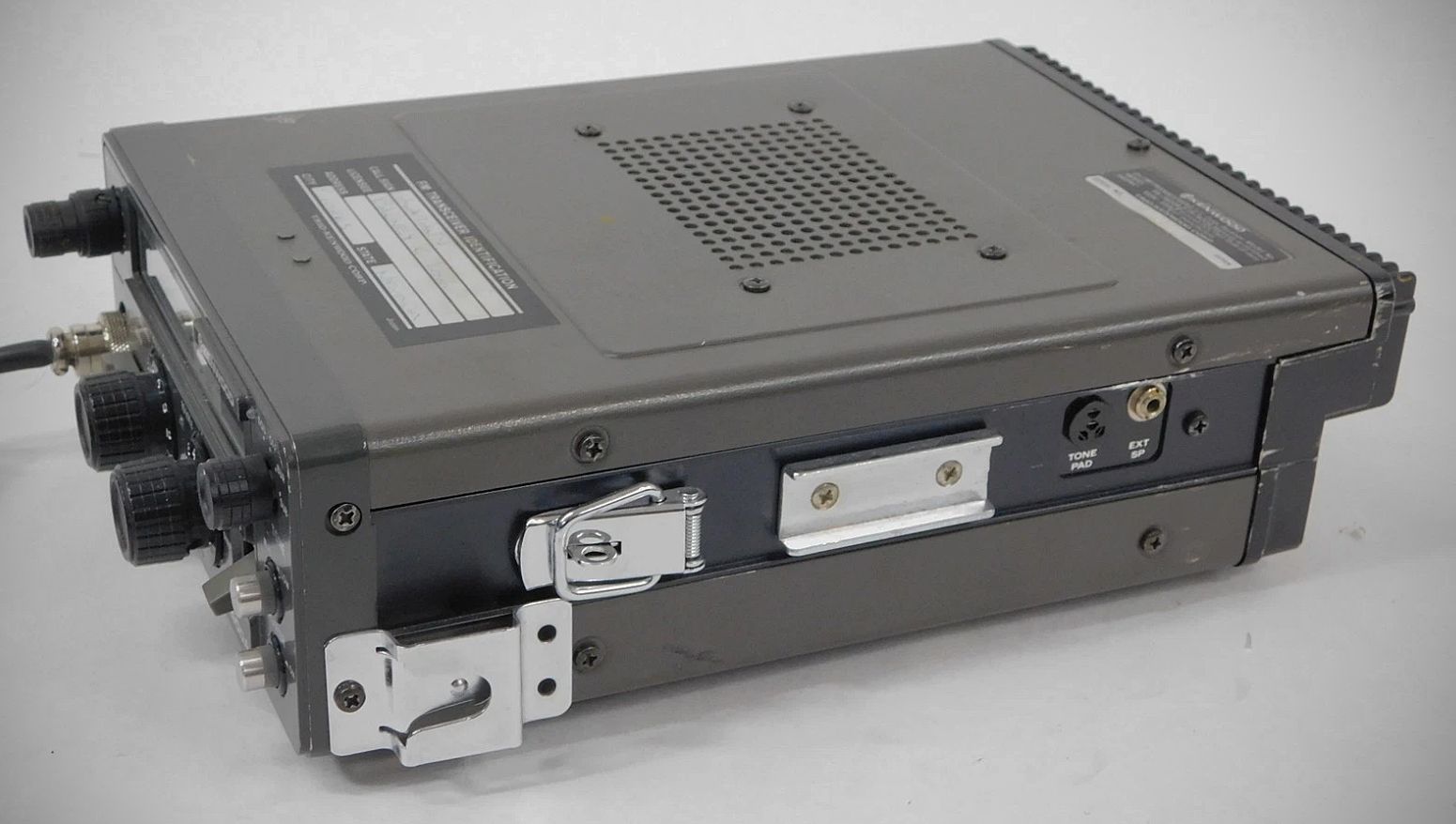
– Side Panel Connections: Equipped with mini-jacks for a Touch-Tone pad input and an external speaker, eliminating hard-to-connect multi-pin sockets.
Specifications
Semiconductors:
Transistors: 8
FETs: 8
ICs: 19
Diodes: 63
– Frequency Range: 144.00 to 147.995 MHz
– Frequency Synthesizer: Digital (TTL Logic) control of phase-locked VCO
– Synthesizer Stability: Less than ± 750 Hz at 25C
– Mode: FM
– No. of Channels: 800
– Operating Temperature: -20C to +50C
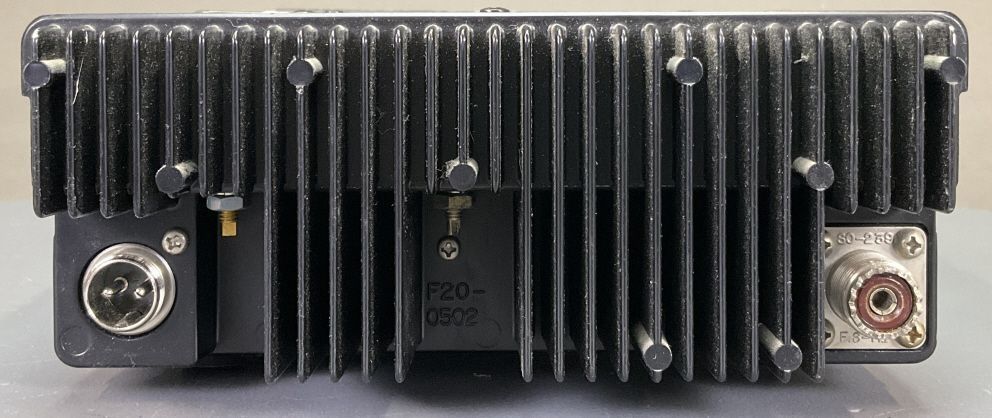
– Antenna Impedance: 50 ohms
– RF Output Power:
High: 25 watts (min.)
Low: Approx. 5 watts (adjustable up to 15 watts)
– Modulation: Variable reactance direct shift
– Max. Frequency Deviation: ± 5 kHz
– Spurious Radiation: Less than -60 dB
– Touch Tone Input Impedance: 600 ohms
– Microphone: Dynamic microphone with PTT switch, 500 ohms
– Receiver: Double superheterodyne
– Intermediate Frequency:
1st IF: 10.7 MHz
2nd IF: 455 kHz
– Sensitivity:
Better than 0.4 uV for 20 dB quieting
Better than 1 uV for 30 dB S/N)
– Squelch Sensitivity: Better than 0.25 uV
– Pass Band Width: More than 12 kHz at 6 dB down
– Selectivity (2 Signal): More than 72 dB at 30 kHz of adjacent channel
– Image Rejection: More than 70 dB
– Spurious Interference: More than 60 dB
– Intermodulation: More than 66 dB
– Audio Output: More than 1.5 watts across 8 Ohms load (10% distortion)
Tone Squelch
– Tone Deviation: ± 0.5 kHz (adjusted)
– Encoder Response: Less than 0.5 sec.
– Frequency Stability: Less than ± 1%
– Tone Squelch Open Sensitivity: Less than SINAD 10 dB
– Tone Distortion: Less than 5%
Tone Burst
– Burst Time: Approx. 0.5 sec. (adjusted)
Power requirements: 11.5 VDC to 16.0 VDC (13.8 VDC as reference)
Grounding: Negative grounding
DC Current:
Less than 1 A in receive with no input signal
Less than 8 A in transmit (HI)
Less than 4.5 A in transmit (LOW) (at 13.8 VDC)
Power supply is PS-8.