Note
QST, Jul 1977, p. 6.
QST, Sep 1977, back cover.
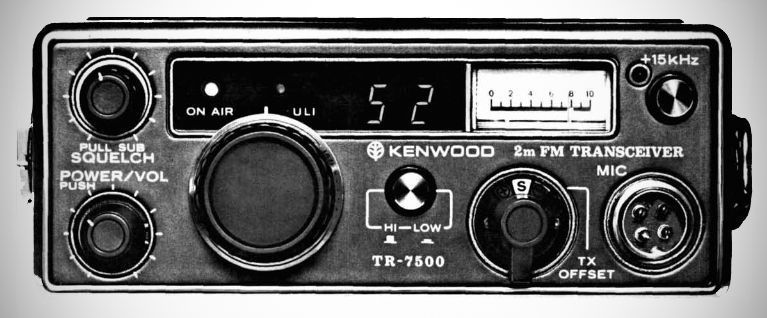
The Kenwood TR-7500 is a classic 2-meter FM mobile amateur radio transceiver introduced in 1977.
It represented an important step in mobile ham radio design, bridging early crystal-controlled channelized rigs and modern fully variable VFO transceivers by using a phase-locked loop (PLL) synthesizer with fixed channel steps.
It is important to note that of the unit's 100 channels, 88 are pre-programed and cannot be changed by the user.
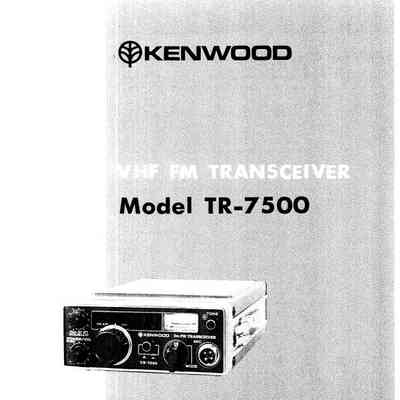
The attached user manual is for the European version, which has different frequency coverage and only 40 channels, all of which a pre-programmed. We have not yet found an American version of the manual. Still, this manual should serve as a useful reference.
Features
– PLL synthesized.
– 100 channels (88 pre-programmed).
– 12 extra diode programmable channels.
– Single knob channel selection.
– LED digital frequency display.
– Powered tone pad connection.
– Receiver uses helical resonators.
Tranmitter Section
– RF Output Power: High: 10 watts, Low: 1 watt (approximately)
– Modulation: Variable reactance frequency shift
– Frequency Deviation: ±5 KHz
– Spurious Radiation: Better than –60dB
– Antenna Impedance: 50 Ohms
– Tone pad input impedance: 600 Ohms
– Microphone: Dynamic microphone with PTT switch, 500 ohms
Receiver Section
– Receive System: double conversion superheterodyne
– IF: 1st IF, 10.7 MHz; 2nd IF, 455 kHz
– Sensitivity: better than 0.4 uV for 20dB quieting Better than 1 uV for 30dB S/N
– Squelch sensitivity: better than 0.25 uV
– Selectivity: 12kHz @ –6dB down; 40 kHz @ –70dB down
– Image rejection: better than –70dB
– Spurious interference: better than –60d8
– Audio output: more than 1.5 watts across 8 ohms load, 10% distortion
– Intermodulation: Better than 66dB
Semiconductors
Transistors, 41
FETS, 8
ICs, 7
Diodes, 35
Mode: FM
No. of Channels: 100
Operating Temperature: —20 to + 50 degrees C
Power
Current drain: Less than 0.5A in receive with no input signal
Less than 3A in transmit
(HI) Less than 1.5A in transmit (LOW)
(at 13.8V DC)
Input voltage: 11.5 to 16.0V DC (13.8V DC nominal)
Grounding polarity: negative ground
Power supply is PS-6.