Note
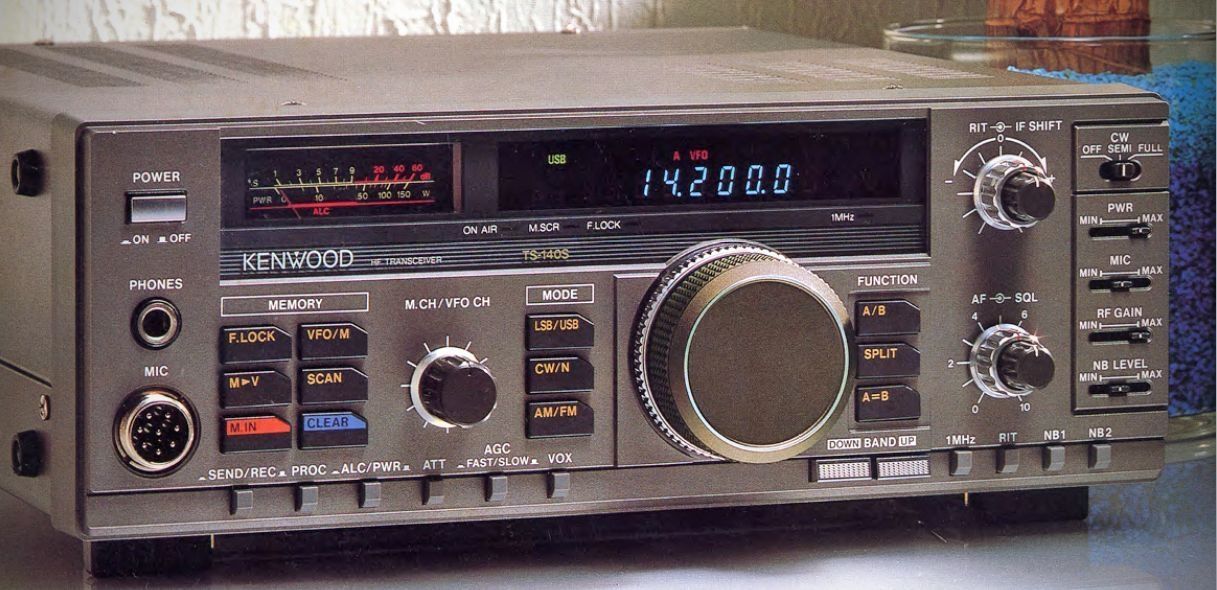
The Kenwood TS-140S, released in 1988, is a compact HF transceiver that remains a favorite for its straightforward design and robust performance. It was designed as an all-mode transceiver, covering the 160-meter through 10-meter amateur bands, while providing a general coverage receiver that spans from 500 kHz all the way up to 30 MHz.
The TS-680S is essentially the same rig, but with the addition of 6 meters.
Technical Architecture and Performance
Under the hood, the TS-140S utilizes a triple-conversion superheterodyne system. This design choice provides excellent sensitivity and selectivity, which was a significant step up for mid-range rigs at the time of its release.
The transmitter is capable of 100 watts of output power on SSB, CW, and FM modes, and 40 watts on AM. One of its standout internal features is the heavy-duty die-cast aluminum heat sink and an internal cooling fan that engages automatically, allowing for reliable operation during long periods of transmission or digital mode use.
User Interface and Experience
The front panel is remarkably uncluttered compared to modern digital rigs. It features a large, easy-to-read amber LCD that displays the frequency down to 10 Hz. For tuning, it uses a high-quality optical encoder that provides a smooth, "weighted" feel when searching across the bands.
Features
– Operating Range: Covers all Amateur bands from 160 to 10 meters, including the WARC bands (30, 17, and 12 meters).
– General Coverage Receiver: Features a high-performance receiver spanning 500kHz to 30MHz.
– Operating Modes: Supports SSB (LSB/USB), CW, AM, and FM.
– Dual Digital VFOs: Built-in 10Hz step VFOs (100Hz in AM/FM) that operate independently for split frequency or cross-band operation.
– CW Capabilities: Offers full break-in (QSK) for rapid response, which is switchable to semi break-in via a front panel control.
– 31 Memory Channels: Stores frequency, mode, and narrow/wide information.
– Split Channels: Channels 10–19 store transmit and receive frequencies independently.
– Band Markers: Channels 20–30 establish upper and lower limits for programmable band markers.
– Memory Scroll: Allows checking stored data or finding vacant channels without changing the current operating frequency.
– Dual-Mode Noise Blanker: Includes "NB 1" for pulse-type ignition noise and "NB 2" for longer-duty cycle interference like the "woodpecker".
– IF Shift: Moves the IF passband away from interference without changing the center frequency.
– Speech Processor: Includes a compression amplifier to increase average "talk-power" and intelligibility.
– Switchable AGC: Offers FAST and SLOW settings for optimum operation across different modes.
– Computer Control: Compatible with personal computers via optional IF-232C or IF-10C interface units.
Specifications
– RF Power Output: SSB: 110W PEP; CW: 100W; FM: 50W; AM: 40W
– Receiver Circuitry: Double conversion system
– Intermediate Frequencies: 1st IF: 45.055 MHz; 2nd IF: 455 kHz
– Dynamic Range: 102dB with an overall intercept point of +12dBm
– Sensitivity (SSB, CW): Less than 0.25μV (1.6–21.5MHz) at 10dB S+N/N
– Frequency Stability: Better than ±10×10−6 (−10∘C to +50∘C)
– RIT Variable Range: ±1.28 kHz
– Audio Output: 1.5W into 8 ohms at 10% distortion
Power Requirement
13.8 VDC, max transmit current 20A