Note
The TS-440S served as the successor to the TS-430S, which had been in production since 1982. The TS-440S remained a flagship mid-range HF transceiver for Kenwood until it was eventually followed by the TS-450S in the early 1990s.
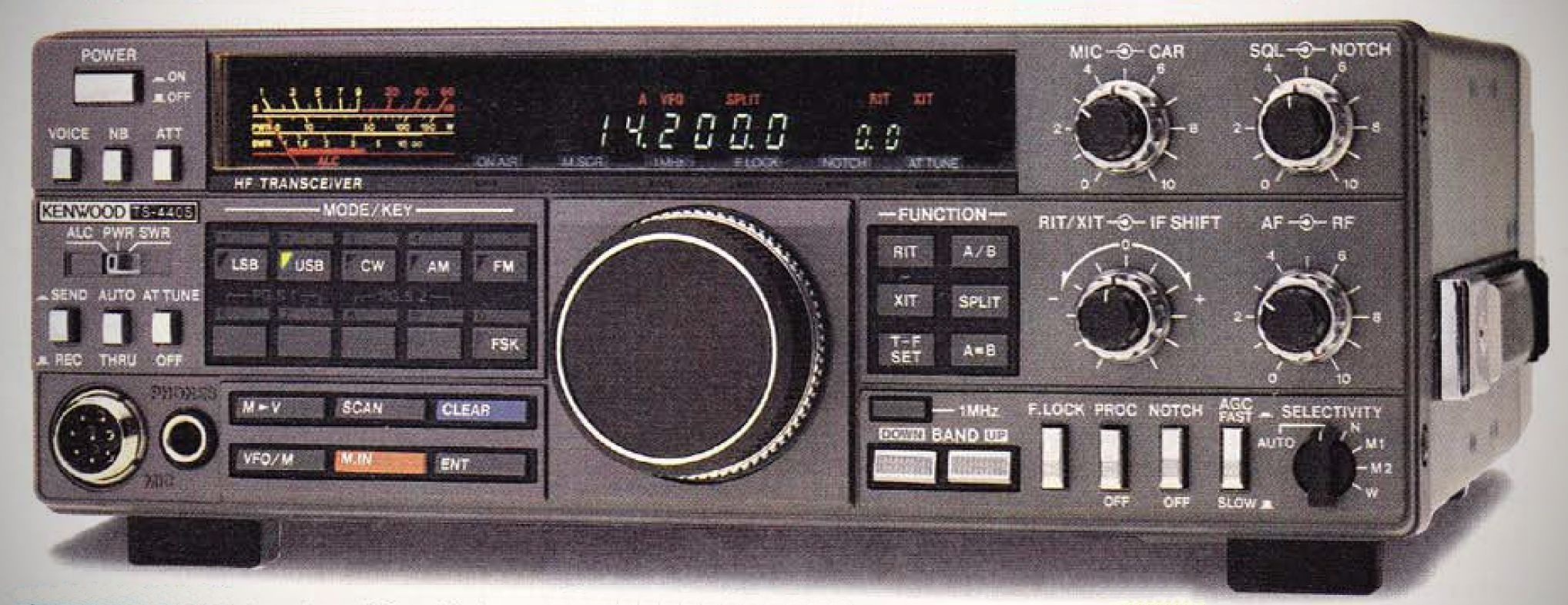
The 440S is an HF transceiver designed for both fixed-station and mobile operations. It features a robust design capable of 100% continuous duty transmit and a wide dynamic range for superior reception.
The TS-440SAT included a build-in automatic antenna tuner.
Key Features
– All-Mode Operation: Supports USB, LSB, CW, AM, FM, and AFSK modes.
– General Coverage Receiver: Provides continuous tuning from 100 kHz to 30 MHz.
– Automatic Antenna Tuner (Optional/Built-in): Operates from 3.5 to 28 MHz to match various antenna systems. Not operational on 160 meters or outside the ham bands.
– Advanced Frequency Control: Includes 100 memory channels (including 10 odd-split channels), dual digital VFOs for split-frequency operation, and direct frequency entry via a numeric keypad.
– CW Full Break-in: Supports full break-in (QSK) for seamless CW communication.
– IF Bandwidth & Shift: Features a switchable IF bandwidth (Auto, Wide, Medium, Narrow) and an IF SHIFT control to eliminate adjacent-channel interference.
– Interference Rejection: Equipped with a tunable NOTCH filter (approx. 400 to 2600 Hz) and a Noise Blanker (NB).
– Scanning Versatility: Offers memory scan, programmable band scan, and adjustable scan speeds.
General Specifications
RF Power Output:
SSB, CW, FM, FSK: 200 watts PEP
AM: 110 watts
– Frequency Range (Transmit): Covers all amateur bands from 160m to 10m (1.8 MHz to 28 MHz).
– Frequency Range (Receive): Continuous general coverage from 100 kHz to 30 MHz.
– Modes of Operation: USB, LSB, CW, AM, FM, and AFSK.
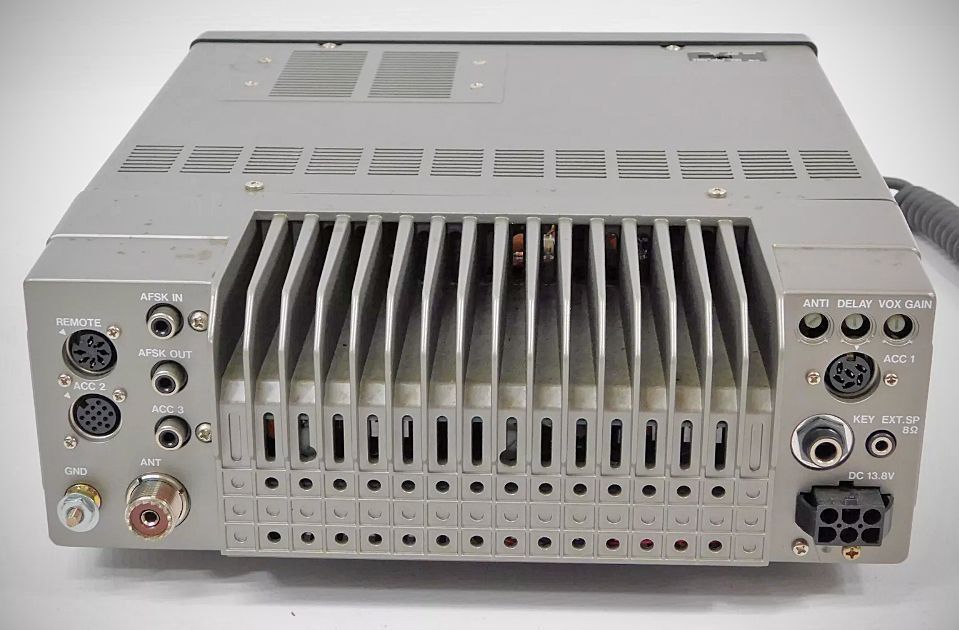
– Standard Operating Voltage: 13.8 VDC (operational range of 12 V to 16 V).
– Duty Cycle: Rated for 100% continuous duty transmit for relatively long durations (up to one hour) in any mode, including FM and AFSK.
– Dynamic Range: 102 dB possible with a 500 Hz IF bandwidth.
– Frequency Control: Dual digital VFOs (A/B) utilizing a single reference oscillator circuit for high accuracy.
– Tuning Resolution: Basic 10 Hz steps, with the display showing down to the nearest 100 Hz.
– Memory Channels: 100 channels (including 10 odd-split channels) to store frequency, band, and mode.
– Antenna Impedance: 50 ohms nominal; the internal Automatic Antenna Tuner (AT) can match loads between 20 and 150 ohms.
– IF Bandwidth Selection: Five-position switch (AUTO, W, M1, M2, N). In AUTO mode, the radio selects the optimum bandwidth for the operating mode.
– IF SHIFT: Allows shifting the IF passband without changing the actual receive frequency to eliminate nearby interference.
– NOTCH Filter: Tunable filter to eliminate heterodyne or CW-type interference, effective within a range of approximately 400 to 2600 Hz.
– RIT (Receiver Incremental Tuning): Allows shifting the receive frequency by ±1.2 kHz without affecting the transmit frequency.
– AGC (Automatic Gain Control): Switchable between FAST and SLOW time constants; disabled during FM operation.
– Noise Blanker (NB): Designed to reduce pulse-type noise.
– All-Mode Squelch (SQL): Eliminates background noise during no-signal periods across all modes.
– CW Full Break-in (QSK): Supports rapid transmit/receive switching for CW and data communications like AMTOR.
– XIT (Transmitter Incremental Tuning): Allows fine-tuning of the transmitter frequency by ±1.2 kHz without affecting the receiver.
– Speech Processor (PROC): Increases effective transmit power in SSB, FM, and AFSK modes.
– CAR (Carrier Level) Control: Sets the carrier level for CW, FM, and AM modes.
– Automatic Antenna Tuner (Built-in or Optional): Operates from 3.5 to 28 MHz; automatically engages via the AT TUNE switch and turns off once tuning is complete.
– Direct Frequency Entry: Allows for immediate frequency selection using the front-panel numeric keypad.
– Scanning Versatility: Includes memory scan, program scan (between two ranges), and adjustable scan speeds (fast/slow).
– Memory Scroll (M.SCR): Allows reviewing memory channel contents without interrupting the current reception.
– T-F SET: Used during split-frequency operation to quickly check or set the transmit frequency while in receive mode.
– Adjustable Dial Torque: Dial drag can be increased or decreased by adjusting the inner and outer tuning knobs.
Operating Voltage: 13.8 VDC (operational range of 12 V to 16 V).
Current Drain: Requires more than 18A at 13.8 VDC during full-power transmission; maximum current draw is between 18A and 20A.
Duty Cycle: Rated for 100% continuous duty transmit for relatively long durations (up to one hour) in any mode, including FM and AFSK.
Accessories
AT-440: Internal automatic antenna tuner (80 m–10 m).
AT-250: External automatic antenna tuner (160 m–10 m).
AT-130: Compact mobile antenna tuner (160 m–10 m).
PS-50 (heavy duty), PS-430, and PS-30 DC power supplies.
External Speakers: SP-430 (desktop), SP-40, and SP-50 (mobile).
Microphones: MC-60A, MC-80, and MC-85 desk microphones; MC-55 (8P) mobile microphone.
Headphones: HS-4, HS-5, HS-6, and HS-7.
Filters & Internal Units
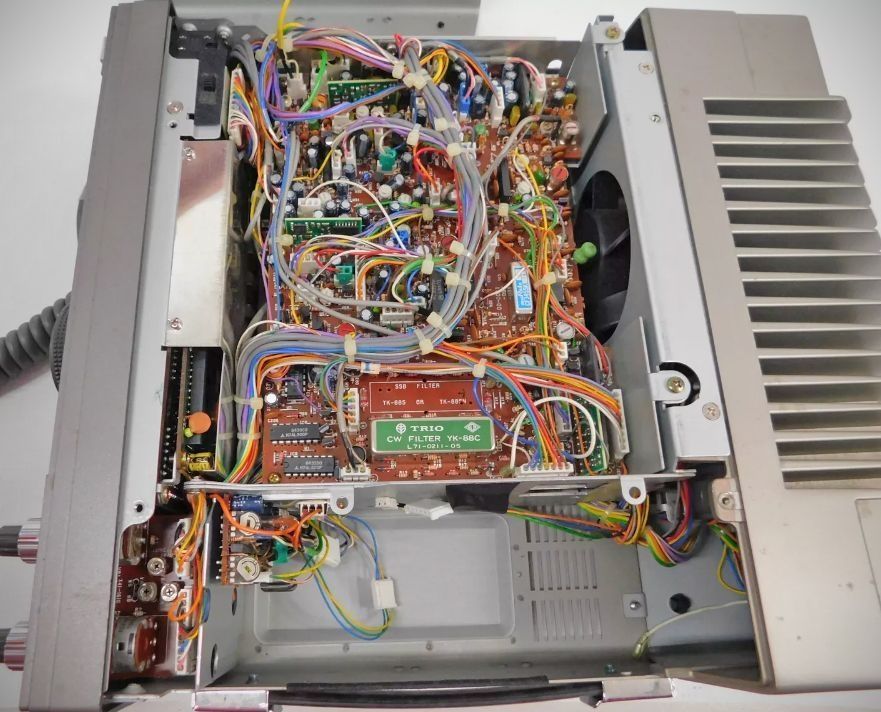
CW Filters: YK-88C (500 Hz) and YK-88CN (270 Hz).
SSB Filters: YK-88S (2.4 kHz) and YK-88SN (1.8 kHz).
VS-1 Voice Synthesizer: Provides audible frequency announcements.
TU-8 CTCSS Tone Unit: For sub-tone memory and repeater operation.
Computer Interface: IF-232C/IC-10 level translator and modem IC kit.
Station Monitor: SM-220.
Linear Amplifier: TL-922A (2 kw PEP).
SWR/Power Meters: SW-100A, SW-200A, and SW-2000.