Note
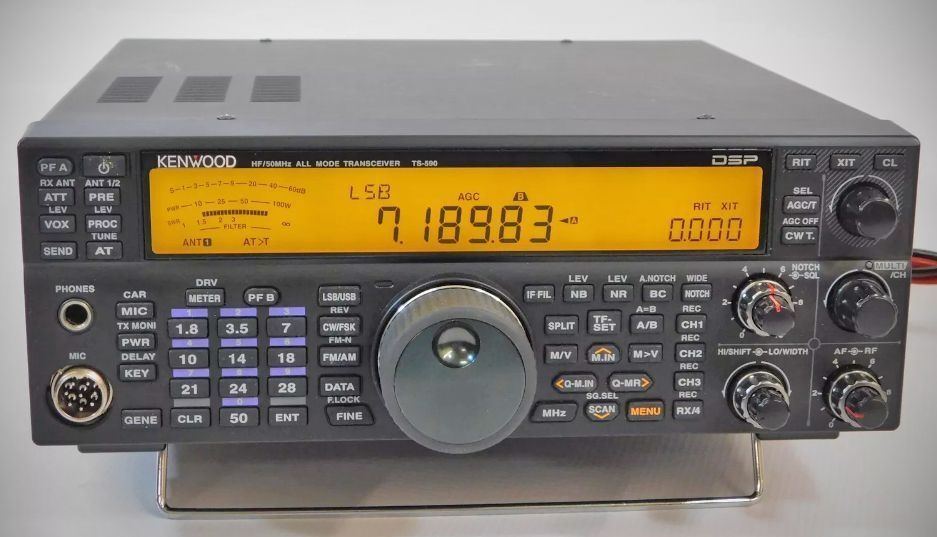
The Kenwood TS-590S (and its successor, the TS-590SG) represents a significant milestone in modern amateur radio design, specifically noted for its high-performance receiver architecture and its blending of traditional analog feel with digital signal processing.
The defining characteristic of the TS-590 series is its down-conversion architecture on the primary amateur bands. When operating within the 160, 80, 40, 20, or 15-meter bands, the first intermediate frequency (IF) is set at 11.059 MHz. This lower frequency allows for the use of high-quality, narrow-bandwidth roofing filters right at the beginning of the signal chain.
By employing a 500 Hz or 2.7 kHz roofing filter early in the process, the radio significantly reduces the impact of strong, adjacent signals. This design choice resulted in a dynamic range and third-order intercept point that rivaled much more expensive "contest grade" transceivers upon its release. On other bands, the radio utilizes a more traditional up-conversion path with a first IF of 73.095 MHz.
The transceiver relies heavily on a 32-bit floating-point DSP (Digital Signal Processing) unit. This system handles everything from the IF AGC to the adjustable passband tuning. One of its most praised features is the dual-mode noise reduction (NR1 and NR2). NR1 uses a traditional spectral subtraction method, while NR2 is an auto-correlation "spaceline" filter, which is particularly effective at pulling weak CW signals out of the noise floor.
The TS-590 provides a stable 100-watt output across all HF bands plus 6 meters. It is housed in a compact but rugged chassis, featuring a large, multi-colored LCD display and a heavy, die-cast aluminum heat sink. The cooling system is notably quiet, using dual fans that adjust their speed based on the internal temperature, making it a favorite for those who operate in quiet environments.
The TS-590SG Revision
In late 2014, Kenwood released the "G" model, which introduced several refinements:
– Enhanced Receiver: Further tuning of the AGC circuitry for better "snappiness" and feel.
– CW Features: Inclusion of a new Morse code decoder that scrolls text across the display.
– Aesthetics: A redesigned main tuning knob and a change to amber/green/white backlighting options.
– Functional Splits: A dedicated "Quick Split" button to make working DX pileups more intuitive.
TS-590SG70
In 2017, a limited 70th Anniversary Edition (TS-590SG70) was released. Only 70 units were produced, featuring a "TRIO" logo and an elegant crystal black finish to commemorate Kenwood's founding.
Core Receiver Features
The TS-590S is designed with a focus on high-performance reception, utilizing a unique dual-mode conversion frequency configuration to handle different signal environments.
– Down-Conversion Path: For the 1.8/3.5/7/14/21 MHz amateur bands, the radio uses a down-conversion design with a first IF of 11.374 MHz. This allows the use of narrow-bandwidth roofing filters that are difficult to produce at higher IF frequencies.
– Up-Conversion Path: For all other frequencies and conditions, it uses a triple superheterodyne up-conversion path with a first IF of 73.095 MHz.
– Roofing Filters: Equipped with powerful 500 Hz and 2.7 kHz roofing filters that are automatically selected during CW, FSK, and SSB modes based on the final passband setting.
– High-Precision DDS: Features a Direct Digital Synthesizer that provides a superior carrier-to-noise (C/N) ratio, significantly reducing noise from unwanted adjacent signals.
– Digital Signal Processing (DSP): The transceiver relies heavily on a 32-bit floating-point DSP operating at 221 MHz to manage signal quality and interference.
– Advanced AGC Control: Digital AGC is processed from the signal derived at the IF stage for precise gain management.
– WIDTH/SHIFT: Allows for manual adjustment of the passband to avoid interference.
– IF Notch and Auto Notch: For eliminating specific beat frequencies.
– Digital Noise Blanker (NB2): Specialized IF processing to remove pulse-type noise.
– Noise Reduction (NR1/NR2): NR1 uses spectral subtraction or line enhancer methods, while NR2 provides additional AF-based noise reduction.
– Beat Cancel: DSP-based AF processing to eliminate multiple interfering heterodynes.
– Equalization: Offers both a 10-band RX equalizer and a TX equalizer to tailor audio quality to the user's preference.
Transmitter Specifications & Features
– Power Circuitry: Uses a high-reliability FET final circuit for stable output.
– Automatic Antenna Tuner: Built-in high-speed relay-controlled tuner for quick impedance matching.
– Drive Out (DRV) Terminal: Provides a low-level (0 dBm/1 mW) output signal, allowing for operation in the 135 kHz band or connection to a transverter.
– Speech Processor: Increases "talk power" by averaging amplitude differences in the audio signal; includes HARD and SOFT settings.
– CW Keyer: Built-in electronic keyer with selectable Mode A and Mode B memory timings.
Physical & Operational Features
– Large Dual-Color Display: Features a large LCD with a selectable LED backlight in two colors.
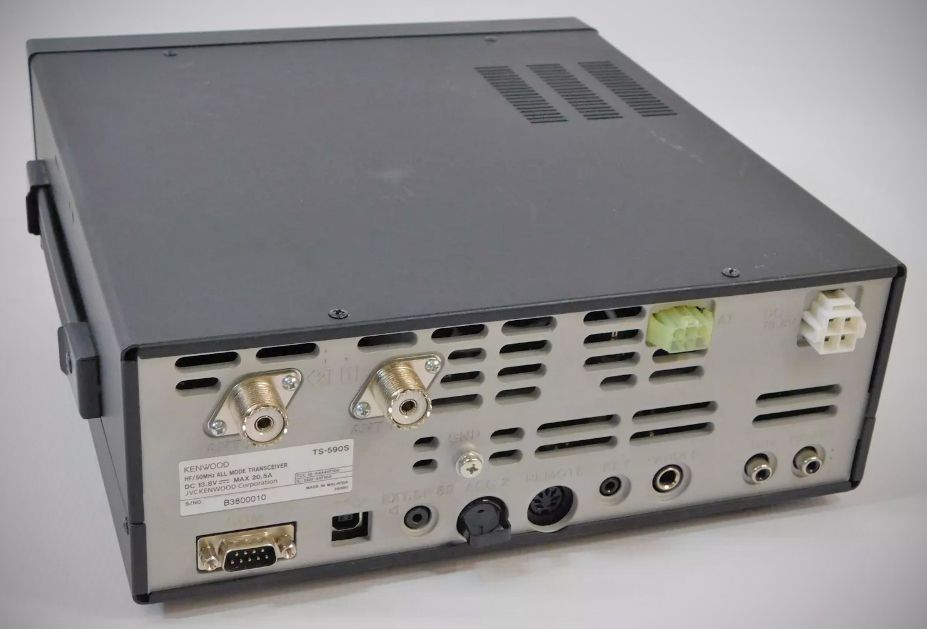
– USB Connectivity: A rear-panel USB port enables both PC-based control and the input/output of transmit/receive audio signals without needing a dedicated sound card interface.
– Programmable Function (PF) Keys: Two customizable keys on the front panel (and more accessible via the microphone) for quick access to frequent functions.
– Accessibility: Includes physical projections on the rear panel near specific connectors (DRV, RX ANT, ANT1, ANT2) to help sight-impaired operators identify them by touch.
Technical Specifications
– Frequency Range: HF/50 MHz (Amateur bands)
– Modes: SSB, CW, FSK, AM, FM
– Frequency Stability: ±5 ppm (standard) or ±0.5 ppm (with optional SO-3 TCXO)
– First IF (Down-Conv): 11.374 MHz
– First IF (Up-Conv): 73.095 MHz
– DSP: 32-bit Floating Point, 221 MHz clock
– Roofing Filters: 500 Hz, 2.7 kHz, 6 kHz, 15 kHz (bandwidth varies by mode/path)
– Audio Interface: USB Audio and standard headphone jack
Power Requirements: 13.8 VDC, < 27 amps
Compatible with PS-60 Regulated DC Power Supply