Note
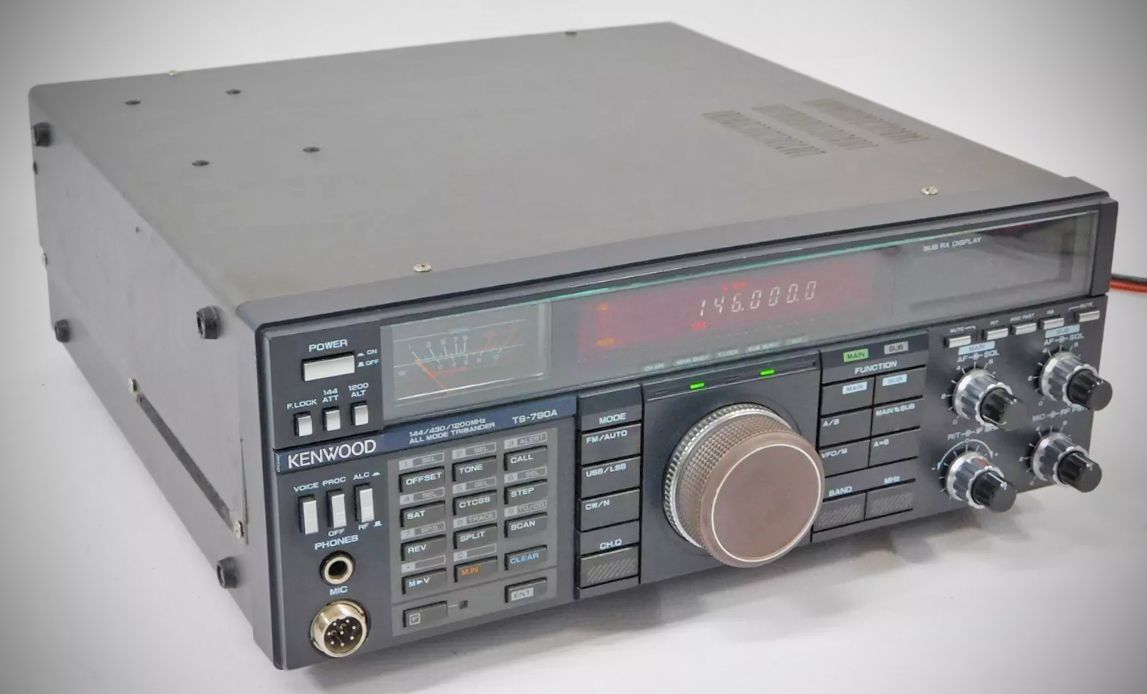
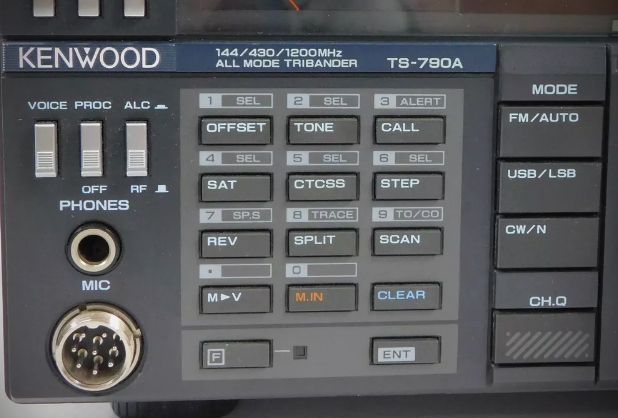
The TS-790 series is a dual-band transceiver by default, covering 2 meters (144 MHz) and 70 centimeters (430/440 MHz). It is particularly valued for its:
– Satellite Mode: Features full-duplex cross-band operation and Doppler effect frequency correction, allowing you to track and adjust for frequency shifts during satellite passes.
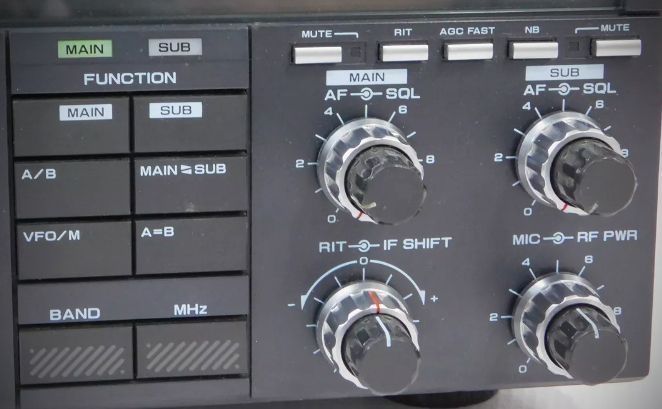
– Dual Watch: Independent MAIN and SUB bands with separate frequency displays, S-meters, and volume/squelch controls, effectively making it two radios in one chassis.
– Tri-Band Expansion: Many units are equipped with the optional UT-10 module, which adds the 23 cm (1200 MHz) band.
– Receiver Front-End: Uses GaAs FETs to achieve high sensitivity and a wide dynamic range, which is critical for pulling weak SSB signals out of the noise.
– IF Shift: Provides effective interference rejection by shifting the IF passband center frequency.
– CW Filtering: Includes a 500 Hz narrow CW filter.
Specifications
– Modes: SSB (LSB/USB), CW, FM
– Power Output (2m): 45W FM / 35W SSB/CW
– Power Output (70cm): 40W FM / 30W SSB/CW
– Power Output (23cm): 10W (with optional UT-10 unit)
– Memories: 59 multi-function channels with lithium battery backup
– Frequency Stability: Less than ±3 ppm (within operating temp range)
– Frequency Range
(2 m band): 144–148 MHz
(70 cm band): 430–450 MHz
(23 cm band): 1240–1300 MHz (available as an option).
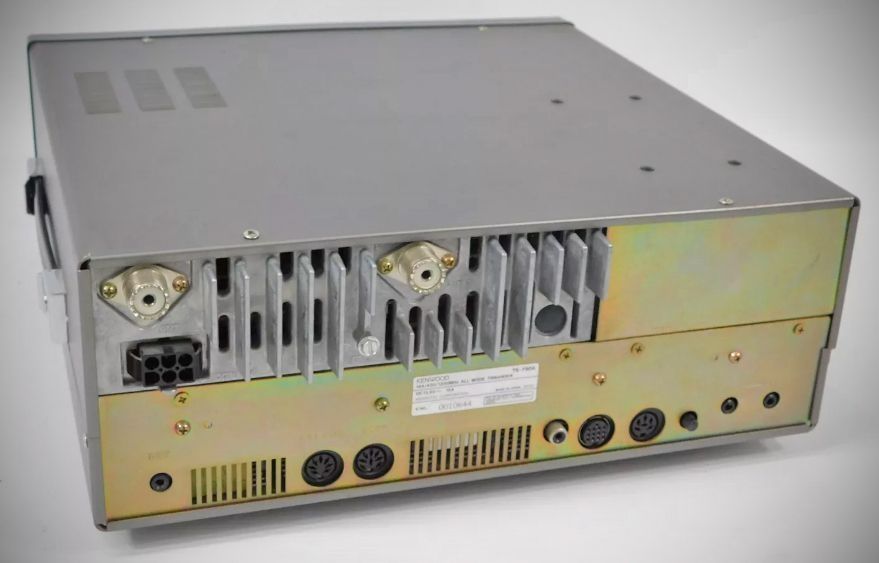
– Antenna Impedance: 50 ohms.
– Operating Temperature: -10°C to +50°C (+14°F to +122°F).
– Modulation: Balanced modulation for LSB and USB; Reactance modulation for FM.
– Spurious Radiation: Less than 60 dB for 2 m and 70 cm bands; less than 50 dB for the 23 cm band.
– Carrier Suppression: More than 40 dB with a 1.5 kHz reference.
– Unwanted Sideband Suppression: More than 40 dB with a 1.5 kHz reference.
– Maximum Frequency Deviation (FM): ±5 kHz.
– Frequency Response (SSB mode): 400 to 2600 Hz at -6 dB.
– Microphone Impedance: 600 ohms.
– Receiver Circuitry:
2 m band: Single conversion superheterodyne (LSB/USB/CW) or double conversion superheterodyne (FM).
70 cm band: Double conversion superheterodyne (LSB/USB/CW) or triple conversion superheterodyne (FM).
23 cm band: Triple conversion superheterodyne (LSB/USB/CW) or quadruple conversion superheterodyne (FM).
– Sensitivity (LSB, USB, CW at 10 dB S+N/N): Less than 0.16 µV for all bands.
– Sensitivity (FM at 12 dB SINAD): Less than 0.22 µV for all bands.
– Selectivity:
LSB, USB: 2.1 kHz at -6 dB; 4.8 kHz at 60 dB.
FM: 12 kHz at -6 dB; 24 kHz at 60 dB.
CW: 500 Hz at 6 dB; 2 kHz at 50 dB.
– Image Ratio: More than 65 dB (2 m), 60 dB (70 cm), and 55 dB (23 cm).
– IF Shift Variable Range: More than ±0.9 kHz.
– RIT Variable Range: ±1.9 kHz for LSB/USB/CW and ±9.9 kHz for FM.
– Squelch Sensitivity: Less than 0.20 µV for LSB/USB/CW and less than 0.16 µV for FM.
– Audio Output: 1.5 W across an 8-ohm load with 10% distortion.
– Output Load Impedance: 8 ohms.
Power Requirement: 13.8 VDC ±15%.
Current Drain (Receive mode): 2.5 A with no input signal.
Current Drain (Transmit mode):
(2m) 12 A
(70 cm) 15 A
(23 cm) 8 A
Accessories
– PS-31: Matching heavy-duty power supply.
– SP-31: Matching external speaker with filtering.
– MC-60A / MC-85: Desk microphones frequently paired with this model for base station use.
– VS-2: Voice synthesizer for frequency announcements.