Note
QST, Feb 1981, p. 6.
QST, Jun 1982, back cover.
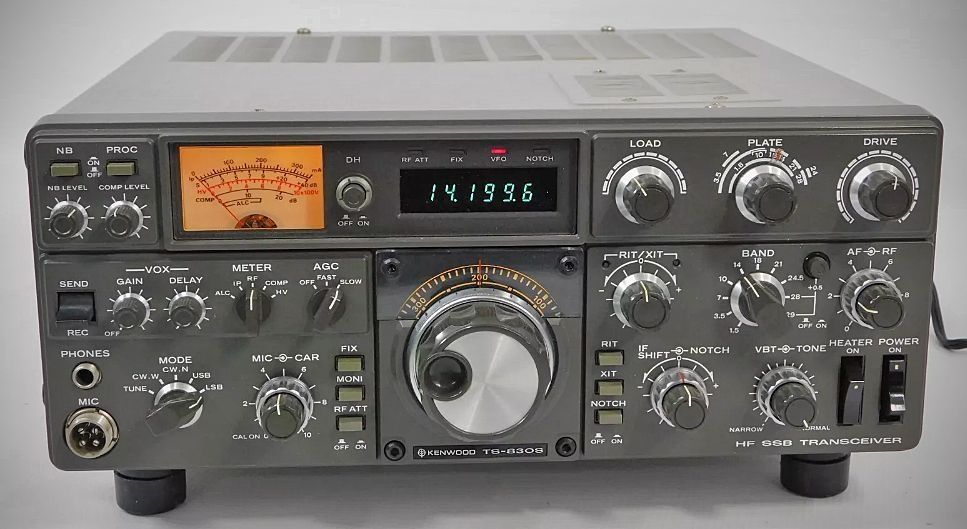
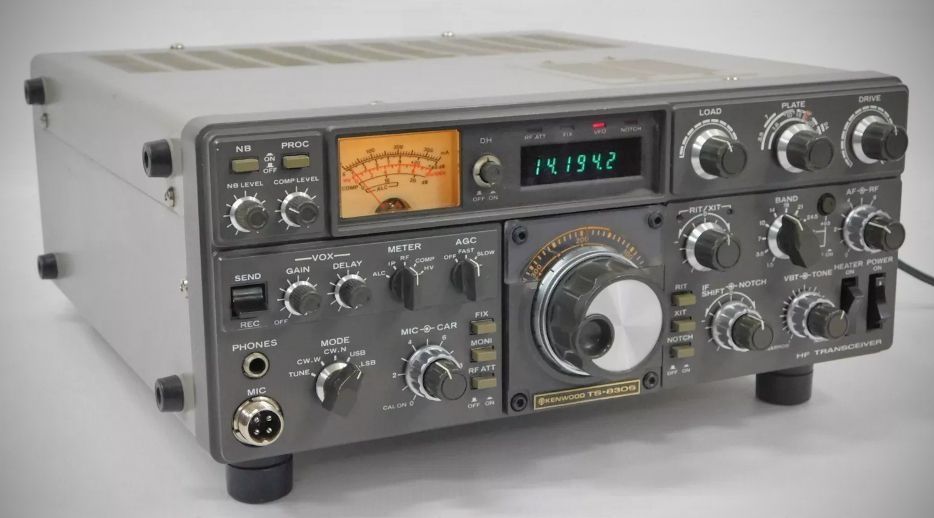
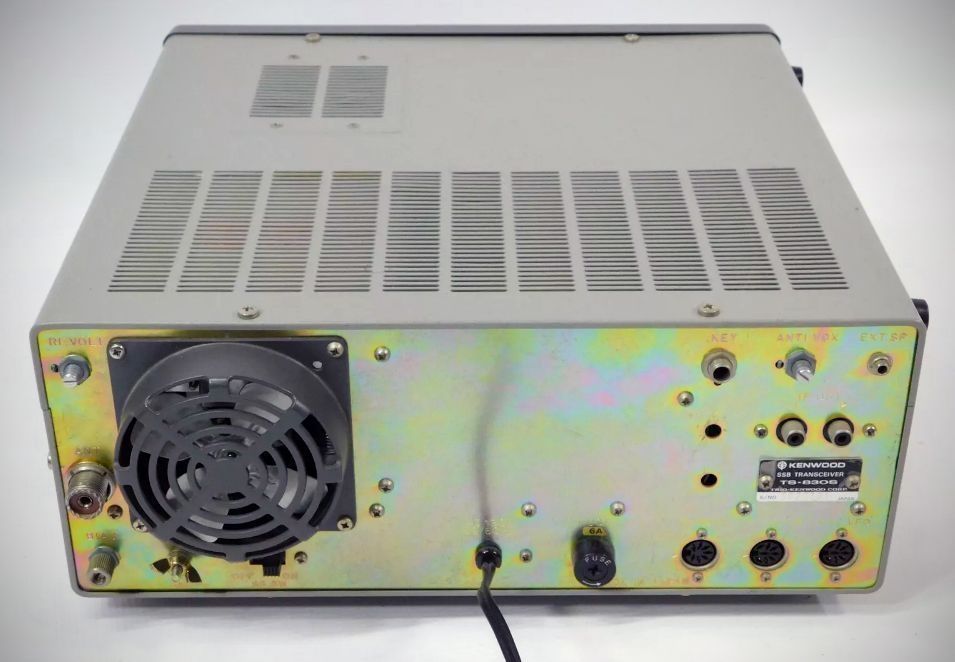
The TS-830S combines a high dynamic range with variable bandwidth tuning (VBT), IF shift, and an IF notch filter, as well as very sharp filters in the 455-kHz second IF. Its optional VFO-230 remote digital VFO provides five memories.
Features
– 160-10 meters, including three new bands. Covers all Amateur bands from 1.8 to 29.7 MHz (LSB, USB, and CW), including the new 10, 18, and 24-MHz bands. Receives WWV on 10 MHz.
– Wide receiver dynamic range. Junction FETs with optimum IMD (intermodulation distortion) characteristics and low noise figure in the balanced mixer, a MOSFET RF amplifier operating at low level for improved dynamic range (high amplification level not needed because of low noise in mixer), dual resonator for each band, and advanced overall receiver design result in excellent dynamic range.
– Variable bandwidth tuning (VBT). Continuously varies the IF filter passband width to reduce interference. VBT and IF shift can be controlled independently for optimum interference rejection in any condition.
– IF notch filter. Tunable high-Q active circuit in 455-kHz second IF, for sharp, deep notch characteristics.
– IF shift. Shifts IF passband toward higher or lower frequencies (away from interfering signals) while tuned receiver frequency remains unchanged.
– 6146B final with RF NFB. Two 6146B's in the final amplifier provide 220 W PEP (SSB) / 180 W DC (CW) input on all bands. RF negative feedback provides optimum IMD characteristics for high-quality transmission.
– Built-in digital display. Six-digit large fluorescent tube display, backed up by an analog dial. Reads actual receive and transmit frequency on all modes and all bands. Includes a Display Hold (DH) switch.
– Various IF filter options. Either a 500-Hz (YK-88C) or 270-Hz (YK-88CN) CW filter may be installed in the 8.83-MHz first IF, and a very sharp 500-Hz (YG-455C) or 250-Hz (YG-455CN) CW filter is available for the 455-kHz second IF.
– Optional digital VFO. VFO-230 operates in 20-Hz steps and includes five memories. Also allows split-frequency operation. Built-in digital display. Covers about 100 kHz above and below each 500-kHz band.
– Built-in RF speech processor. For added audio punch and increased talk power in DX pileups.
– RIT/XIT. Receiver incremental tuning (RIT) shifts only the receiver frequency. Transmitter incremental tuning (XIT) shifts only the transmitter frequency.
Matching Accessories & Component Options
YK-88C (500-Hz) and YK-88CN (270-Hz) CW filters for 8.83-MHz IF
YG-455C (500-Hz) and YG-455CN (250-Hz) CW filters for 455-kHz IF
HS-5 and HS-4 headphones
MC-30S and MC-35S noise-cancelling hand microphones
Here is the text from the specifications page (Page 3) of the Kenwood TS-830S Instruction Manual:
Specifications
Frequency Range
160 m Band: 1.8 ~ 2.0 MHz
80 m Band: 3.5 ~ 4.0 MHz
40 m Band: 7.0 ~ 7.3 MHz
30 m Band:10.1 ~ 10.15 MHz (10.0 MHz WWV receive only)
20 m Band: 14.0 ~ 14.35 MHz
17 m Band: 18.068 ~ 18.168 MHz
15 m Band: 21.0 ~ 21.45 MHz
12 m Band: 24.89 ~ 24.99 MHz
10 m Band: 28.0 ~ 29.7 MHz
Note: Will transmit on the 30, 17, and 12 meter bands. Diodes were installed for preventing accidental transmission before government Amateur authorization. Insure that these have been removed.
– Modes: SSB / CW
– Final Power Input
220W PEP for SSB operation
180W DC for CW operation
– Audio Input Impedance: 500Ω ~ 50 kΩ
– RF Output Impedance: 50Ω ~ 75Ω
– Frequency Stability
Within 100 Hz during any 30 minute period after warmup.
Within 1 kHz during the first hour after 1 minute of warmup.
– Carrier Suppression: Better than 40 dB
– Sideband Suppression: Better than 60 dB
– Spurious Radiation: Better than 60 dB
– Harmonic Radiation: Better than 40 dB
– Audio Freq. Response: 400 to 2,600 Hz, within -6 dB
– 3rd Order Intermodulation Distortion: Better than 36 dB
– Receiver Sensitivity: 0.25 uV at 10 dB $S+N/N
– Image Ratio: Better than 60 dB
– IF Rejection: Better than 80 dB
– Receiver Selectivity
SSB/CW WIDE: 2.4 kHz (-6 dB), 3.6 kHz (-60 dB)
CW NARROW
With YK-88C (option): 500 Hz (-6 dB), 1.5 kHz (-60 dB)
With YK-88CN (option): 270 Hz (-6 dB), 1.1 kHz (-60 dB)
With YG-455C (option): 500 Hz (-6 dB), 820 Hz (-60 dB)
With YG-455CN (option): 250 Hz (-6 dB), 500 Hz (-60 dB)
– Variable Bandwidth
SSB: 500 Hz ~ 2.4 kHz (-6 dB) continuously variable
CW: 150 Hz ~ 500 Hz (-6 dB) continuously variable (with optional filters YK-88C and YG-455C added).
– Notch-filter Attenuation: Better than 40 dB
– Audio Output Impedance: 8Ω ~ 16Ω
– Audio Output: 1.5W (8Ω)
– Power Requirement: 120V AC (220V modifiable), 50/60 Hz
– Power Consumption
Transmit: 295 watts
Receive: 32 watts (with heaters off)
References
Review. QST, May 1981, p. 38.