Note
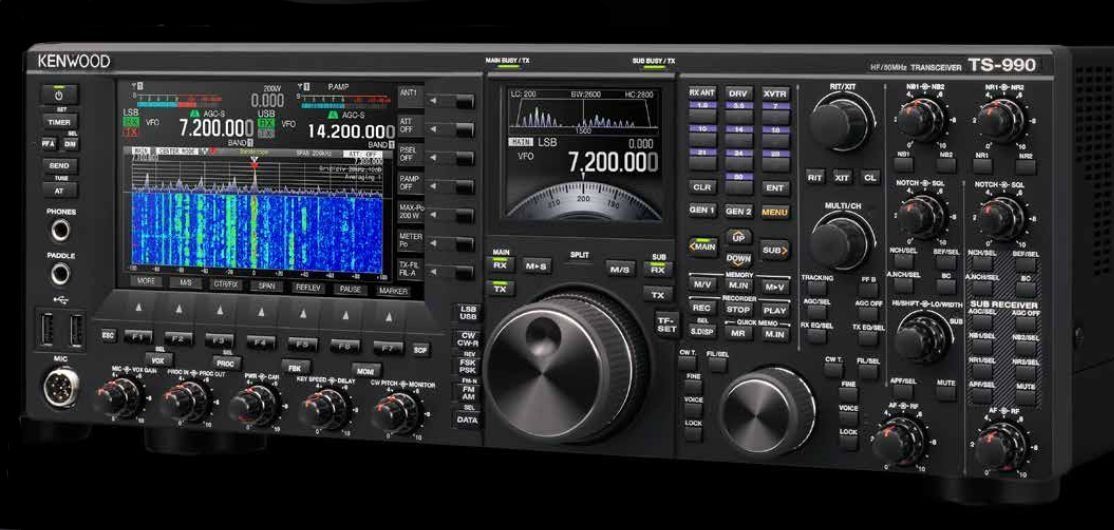
The Kenwood TS-990S is widely considered the flagship of the Kenwood amateur radio line. Released as a successor to the legendary TS-950SDX, it is a heavy-duty, full-featured HF/50MHz transceiver designed for serious DXing and contesting. It is a "heavyweight" in the literal sense, weighing approximately 54 lbs (24.5 kg).
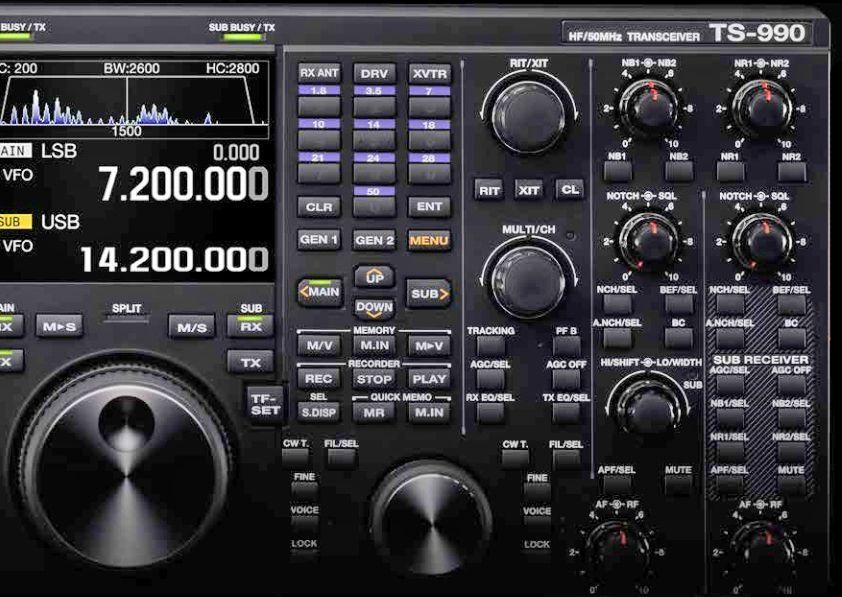
The TS-990S is built around a dual-receiver configuration, allowing for simultaneous monitoring of two different bands or frequencies.
The 990 remains a benchmark for Kenwood’s "Total Performance" philosophy, prioritizing receiver transparency and "listenability" that minimizes operator fatigue during long hours of use.
To commemorate the model's history, Kenwood also released a limited "10th Anniversary Edition" in 2023, marking a decade since the flagship's original debut.
Core Features
– Main Receiver: Utilizes a down-conversion architecture for all amateur bands. This design provides a high dynamic range and excellent close-in interference rejection.
– Roofing Filters: It is equipped with five High-IP roofing filters (270Hz, 500Hz, 2.7kHz, 6kHz, and 15kHz) to effectively block strong off-frequency signals.
– Sub-Receiver: While the main receiver is optimized for pure performance, the sub-receiver is based on the proven down-conversion technology found in the TS-590S, ensuring high-quality reception on both sides.
– Output Power: The TS-990S provides 200W of RF output across HF and 6 meters.
– Internal Power Supply: Unlike many modern high-power rigs that require an external 50A supply, the TS-990S features a built-in switching power supply, keeping the station footprint cleaner.
– Final Amplifier: It uses VRF150MP MOSFETs in a push-pull configuration, known for reliability and linear performance at high power.
– Antenna Tuner: Includes a high-speed automatic antenna tuner (ATU) capable of matching impedances from 16.7 Ω to 150 Ω.
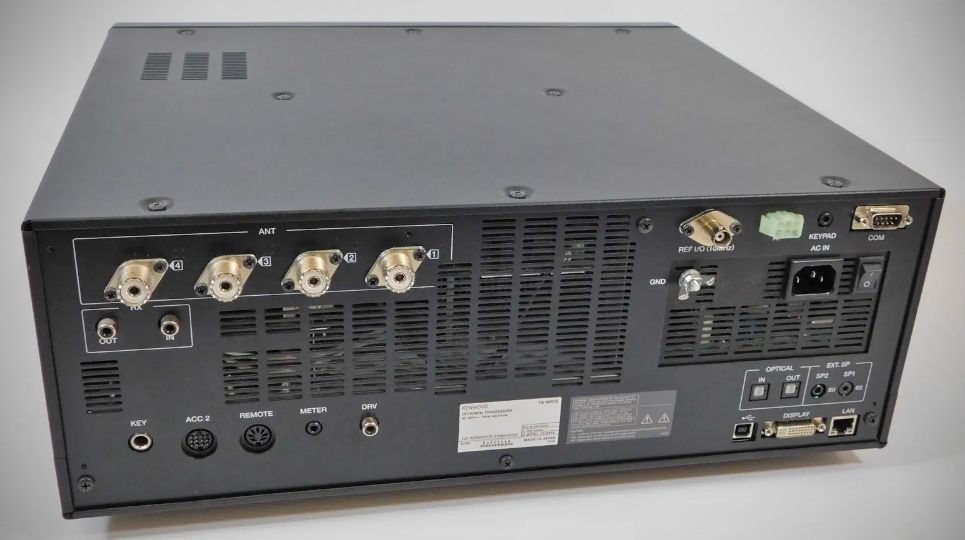
– Connectivity: Extensively equipped with USB ports (Type-A and Type-B), an Ethernet port for remote control, and multiple antenna ports for flexible station routing.
Display and User Interface
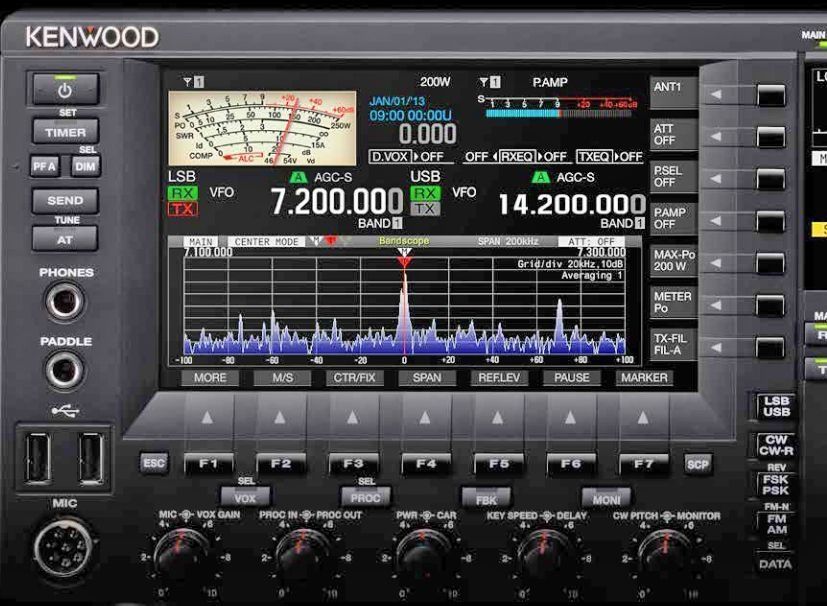
One of the most striking features of the TS-990S is its Dual TFT Display system:
– Main Display: A 7-inch color screen provides a high-speed waterfall, band scope, and comprehensive status information.
– Sub-Display: Located above the main tuning knob, this smaller display shows the sub-receiver frequency and can be configured to show various meters (S-meter, power, etc.) or a dedicated audio scope/FFT.
Digital Signal Processing (DSP)
The radio employs three dedicated DSP chips to handle everything from IF filtering and noise reduction to auto-notch and speech processing. This allows for:
– Variable IF bandwidth control.
– Selectable filter shapes (Soft/Sharp).
– Advanced Noise Reduction (NR1/NR2).
Specifications
General
– Frequency Range (Transmitter, MHz):
1.8 to 2.0
3.5 to 4.0
5.1675/5.25 to 5.45
7.0 to 7.3
10.1 to 10.15
14.0 to 14.35
18.068 to 18.168
21.0 to 21.45
24.89 to 24.99
28.0 to 29.7 MHz
50.0 to 54.0
– Frequency Range (Receiver): 0.13 to 30 MHz and 50 to 54 MHz; the VFO offers continuous coverage from 30 kHz to 60 MHz.
– Modes: CW, SSB, FSK, PSK, AM, FM).
– Frequency Stability: Within ±0.1 ppm from 32 °F to 122 °F (0 °C to +50 °C).
– Antenna Impedance: 50 Ω.
– Antenna Tuner Load Range: 16.7 Ω to 150 Ω.
Transmitter
– RF Output Power: 200 W for CW/SSB/FSK/PSK/FM and 50 W for AM.
– Modulation: Balanced (SSB), Low Power (AM), and Reactance (FM).
– Maximum Frequency Deviation (FM): Wide is ±5 kHz or less; Narrow is ±2.5 kHz or less.
– Spurious Emissions: HF harmonics are -60 dB or less; 50 MHz is -66 dB or less.
– Carrier Suppression: -60 dB or less.
– Unwanted Sideband Suppression: -60 dB or less.
– Transmit Frequency Response: Within -6 dB between 300 and 2700 Hz.
– Microphone Impedance: 600 Ω.
– XIT Variable Range: ±9.999 kHz.
Receiver
– Circuit Architecture:
Main Receiver: Double superheterodyne.
Sub 1 Receiver: Double superheterodyne.
Sub 2 Receiver: Triple superheterodyne.
– Intermediate Frequencies (1st IF): Main is 8.248 MHz, Sub 1 is 11.374 MHz, and Sub 2 is 73.095 MHz.
– Sensitivity (SSB, CW, FSK, PSK at 10 dB S/N): Typically 0.2 μV for 1.705 to 24.5 MHz and 0.13 μV for 24.5 to 54 MHz.
– Image Rejection Ratio (50 MHz): 70 dB or less (60 dB or less).
– IF Rejection Ratio: 70 dB or less.
– Selectivity:
SSB: 2.4 kHz or more (-6 dB); 4.4 kHz or less (-60 dB).
CW, FSK, PSK: 500 Hz or more (-6 dB); 1.2 kHz or less (-60 dB).
AM: 6.0 kHz or more (-6 dB); 12 kHz or less (-50 dB).
FM: 12 kHz or more (-6 dB); 25 kHz or less (-50 dB).
– Notch Filter Attenuation: 60 dB or more in Auto mode; 70 dB or more in Manual mode.
– Audio Output: 1.5 W or more (8 Ω).
Supply Voltage: Standard AC 120 V (60 Hz) with a range of AC 90 V to 132 V or 180 V to 264 V.
Power Consumption: 720 VA or less at maximum transmit; 120 VA or less at receive with no signal.