Note
QST, Dec 1976, pp. 108–109. (Multi-2700)
QST, Feb 1977, p. 125.
QST, Dec 1977, p. 116.
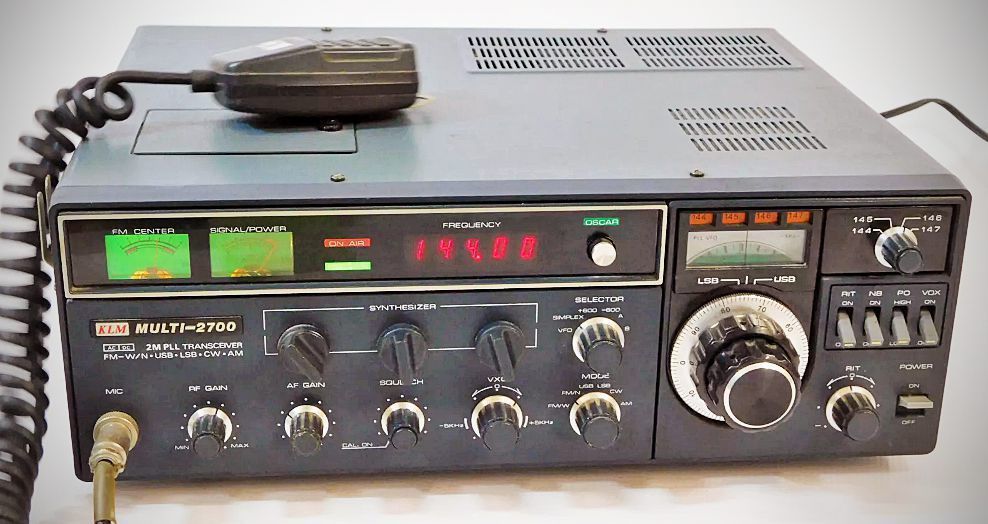
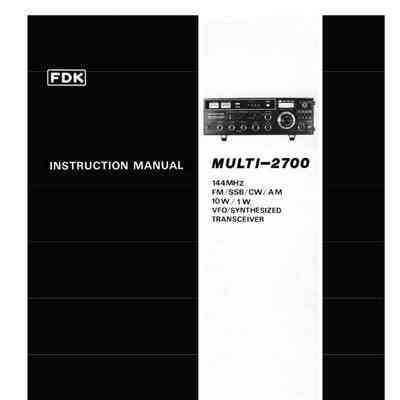
The Multi-2700 was designed as a top-tier base station/mobile rig capable of operating all modes on 2 meters, with special features intended for early satellite operation (OSCAR).
The Multi-2700 includes a dedicated 29 MHz receiver system alongside its 145 MHz transmitter. It synchronizes the 29 MHz receive circuit with the 145 MHz transmit circuit while automatically maintaining a constant 116.45 MHz frequency difference between them.
Features
– All Solid-State All-Mode Operation: Supports USB, LSB, FM (Wide and Narrow), CW, and AM.
– Flexible Frequency Control:
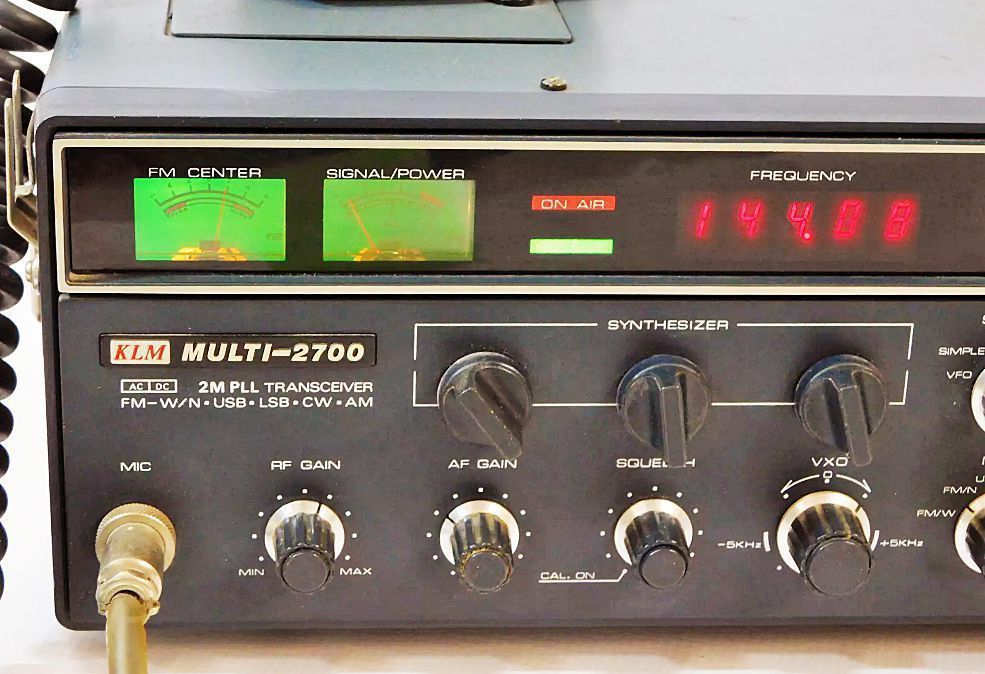
– Digital Phase-Locked Loop (PLL) synthesizer with LED display covering 600 channels at 10 kHz intervals.
– Built-in Variable Crystal Oscillator (VXO) variable by ± 7 kHz for continuous tuning when using the synthesizer.
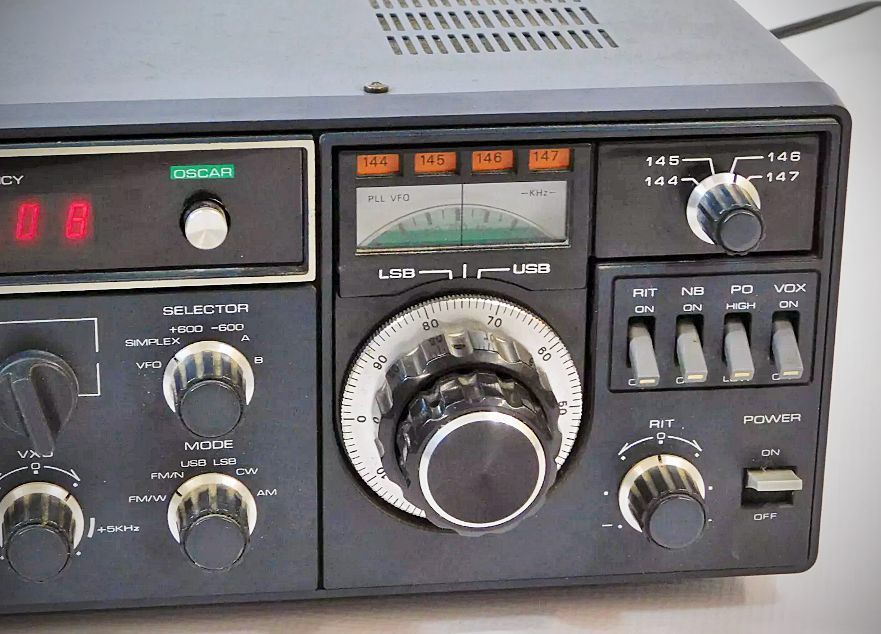
– High-stability VFO with a dual-speed vernier dial mechanism (5:1 gear ratio; 20 kHz per revolution inner knob, 100 kHz per revolution outer knob).
– OSCAR Satellite Ready: Features an integrated 29 MHz receiver synchronized with 145 MHz transmission for working OSCAR Mode A satellites.
– Selectable FM Bandwidth: Front-panel switch to toggle between FM-Narrow (± 5 kHz deviation) and FM-Wide (± 15 kHz deviation).
– Advanced Signal Processing:
Powerful pulse-type Noise Blanker (NB) operating on SSB, CW, and AM.
Speech Compressor switch inside the top access hatch that increases average SSB talk power by 3–4 times.
– Field Effect Transistor (3SK40 FET) balanced mixer in the heterodyne circuit for low spurious emissions.
– Receiver Incremental Tuning (RIT) variable by ± 3.5 kHz.
– Metering & Controls: Dual meters consisting of a combination S-Meter / RF Output meter and a dedicated FM center-tuning meter.
– Operating Convenience: Includes VOX (Voice Operated Control), semi-break-in CW operation, CW monitor, fast/slow AGC control, separate SSB/FM mic gain controls, and a top access hatch for adjustments.
Specifications
– Frequency Range: 143.00 MHz to 149.00 MHz (synthesizer/VXO/VFO)
– Modes: FM-W (F3), FM-N (F3), USB/LSB (A3J), CW (A1), AM (A3H)
– Antenna Impedance: 50 Ohms
– Microphone Impedance: 500 Ohms (adjustable 500–600 Ohms)
– RF Power Output:
High Power: 10 W PEP (SSB), 10 W (FM-W / FM-N / CW), 3 W (AM)
Low Power: 1 W PEP (SSB), 1 W (FM-W / FM-N / CW / AM)
– Modulation Systems: Variable reactance frequency modulation (FM), balanced modulation (SSB), low-power modulation (AM)
– Max Frequency Deviation: ± 5 kHz (FM-N); ± 15 kHz (FM-W)
– Spurious Radiation: Less than -60 dB
– Carrier Suppression: More than 40 dB
– Unwanted Sideband Suppression: More than 40 dB
– Receiving System: Single superheterodyne (FM-W); Double superheterodyne (FM-N, SSB, CW, AM)
– Intermediate Frequencies (IF):
1st IF: 16.9 MHz
2nd IF: 455 kHz
– Sensitivity:
SSB / CW: S/N more than 10 dB for 0.5,muV input
FM-N: S/N more than 26 dB for 1,muV input
FM-W: S/N more than 34 dB for 1,muV input
AM: S/N more than 10 dB for 2,muV input
– Squelch Sensitivity: -6 dB
– Selectivity:
SSB / CW / AM: -6 dB at > 2.4 kHz; -60 dB at < 4.8 kHz
FM-N: -6 dB at > 12 kHz; -60 dB at < 24 kHz
FM-W: -6 dB at > 20 kHz; -60 dB at < 40 kHz
– Image Ratio: More than 60 dB
– IF Interference Ratio: More than 60 dB
– Frequency Stability (VFO):
Less than ± 2 kHz against temperature change (-10 to +60 C)
Less than ± 2 kHz from 1 to 30 minutes after power-on; less than 200 Hz per 30 minutes thereafter
– Audio Output & Impedance: More than 2 W at 8 Ohms (10% distortion)
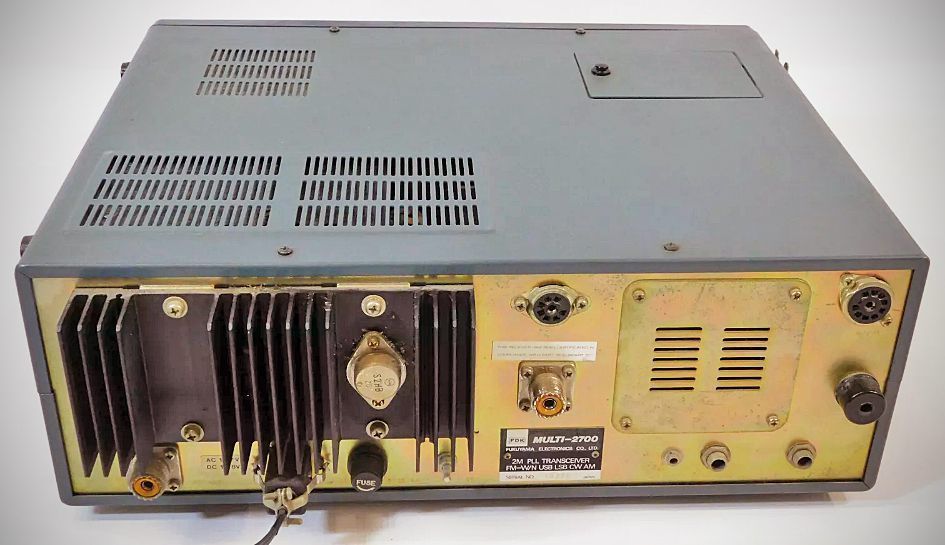
Power Source: Dual AC/DC (117 VAC depending on destination region; 13.8 VDC)
Power Consumption:
Transmission (Max): 110 VA @ AC 117 V / 4 A @ DC 13.8 V
Reception (No Signal): 40 VA @ AC 117 V / 1.1 A @ DC 13.8 V