Note
Allied catalog 1939, p. 124.
Allied catalog 1947, p. 120. ""A new and completely redesigned Ocean Hopper..."
Allied Radio catalog 1951 (copyright 1950), p. 168.
Allied Radio catalog 1953 (copyright 1952), p. 188.
Allied Radio catalog 1954 (copyright 1953), p. 216.
Popular Electronics, Feb 1957, p. 8. (shown with a cabinet)
Radio News, Oct 1957, p. 149.
Allied Radio catalog 1959 (copyright 1958), p. 255.
Allied Radio catalog 1960 (copyright 1959), p. 248.
Allied Radio catalog 1962 (copyright 1961), p. 430. (list of coils)
Allied Radio catalog 1967 (copyright 1966), p. 98.
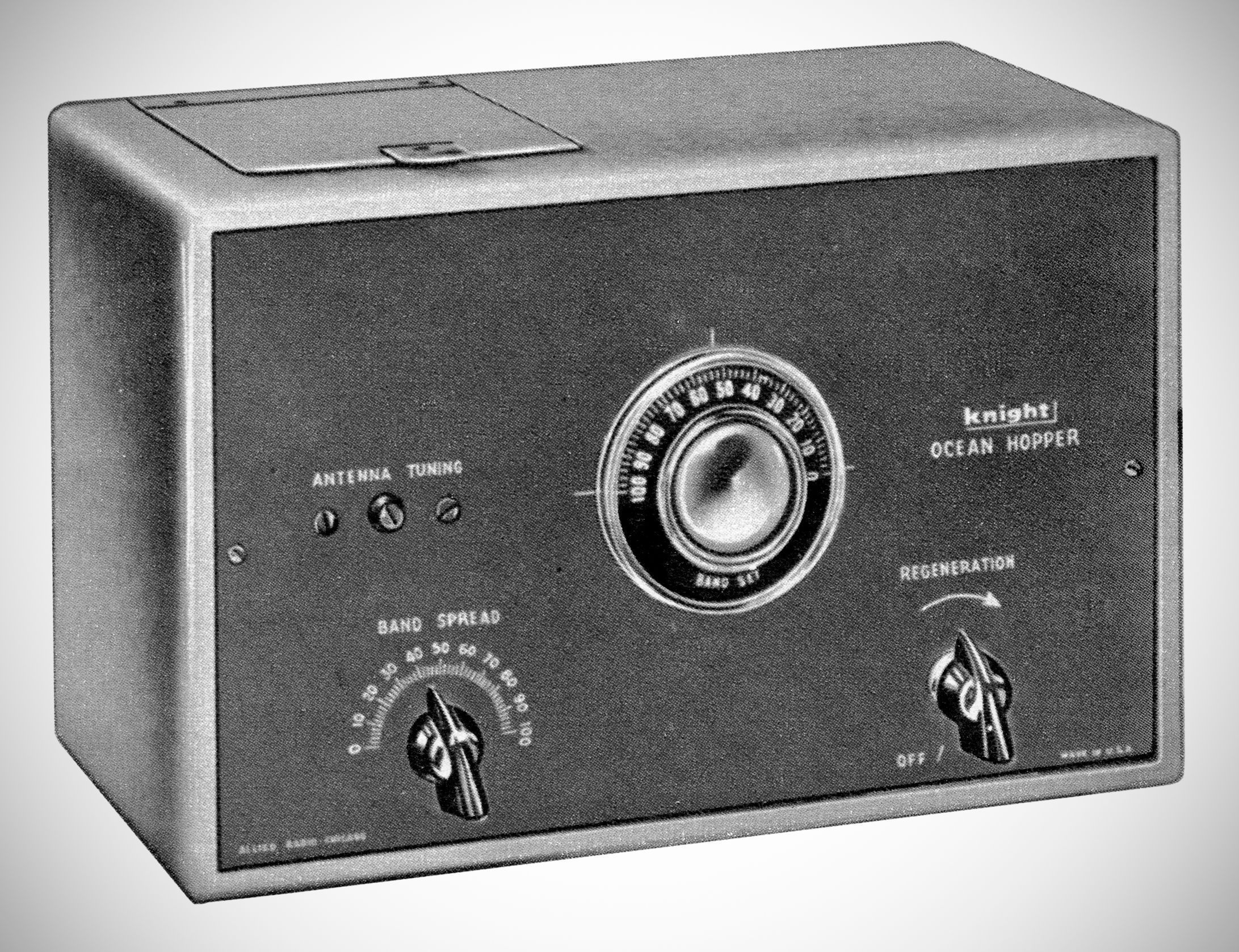
The Knight-Kit "Ocean Hopper," is an historic regenerative radio receiver kit sold by the Allied Radio Corporation beginning in 1939. It was a simple, but very sensitive shortwave and broadcast radio receiver kit targeted at hobbyists, allowing them to listen to foreign broadcasts, amateurs, ships at sea, and police calls.
Introduced in1939, it went through several design iterations before settling into its most popular form by 1959.
Unlike many competing beginner kits of its era that only allowed headphone use, the Ocean Hopper featured a built-in audio amplifier stage, enabling it to power a standalone speaker. It evolved through three major tube lineups:
1. 1939 Original: Utilized a 12SJ7 regenerative detector, a 70L7 audio amplifier, and a rectifier tube (likely a 35Z5).
2. 1947 Redesign: Kept the 12SJ7 detector but moved to a 117P7 combination audio amplifier/rectifier tube.
3. 1953 Version: Shifted to 7-pin miniature tubes, featuring a 12AT6 detector, a 50C5 audio output stage, and a 35W4 rectifier.
4. 1959 Version: Mostly cosmetic changes.
Frequency Coverage & Coils
The Ocean Hopper achieved wide frequency flexibility by using interchangeable plug-in coils. Users could swap or wind their own coils to cover everything from 500 kHz to 30 MHz, encompassing the standard AM broadcast band, long wave, and shortwave frequencies.
Front Panel Controls
The front panel featured a clean layout designed for fine-tuning incoming signals:
– Main Tuning: The prominent center dial used for general station surfing.
– Bandspread: A secondary control knob dedicated to separating tightly grouped shortwave stations.
– Antenna Trimmer (Antenna Tuning): To peak the incoming signal from the antenna.
– Off-On / Regeneration: Combined power switch and feedback control to adjust the sensitivity of the detector circuit.
References
Review. Popular Electronics, Mar 1955, p. 24