Note
Allied Radio catalog 1956 (copyright 1955), p. 197.
QST, Jan 1956, p. 160.
Allied Radio catalog 1958 (copyright 1957), p. 229.
Allied Radio catalog 1959 (copyright 1958), p. 265.
Allied Radio catalog 1960 (copyright 1959), p. 267.
Allied Radio catalog 1961 (copyright 1960), p. 283.
Allied Radio catalog 1962 (copyright 1961), p. 412.
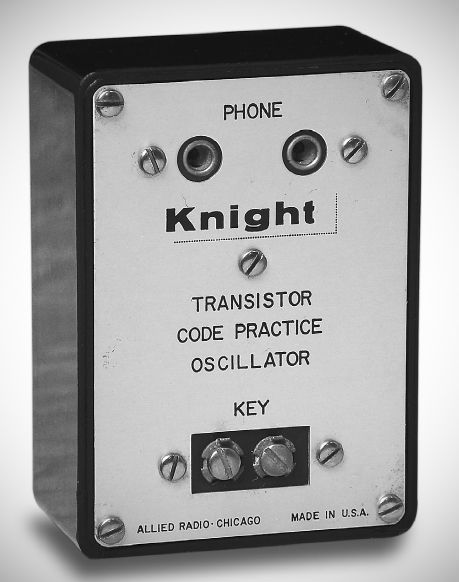
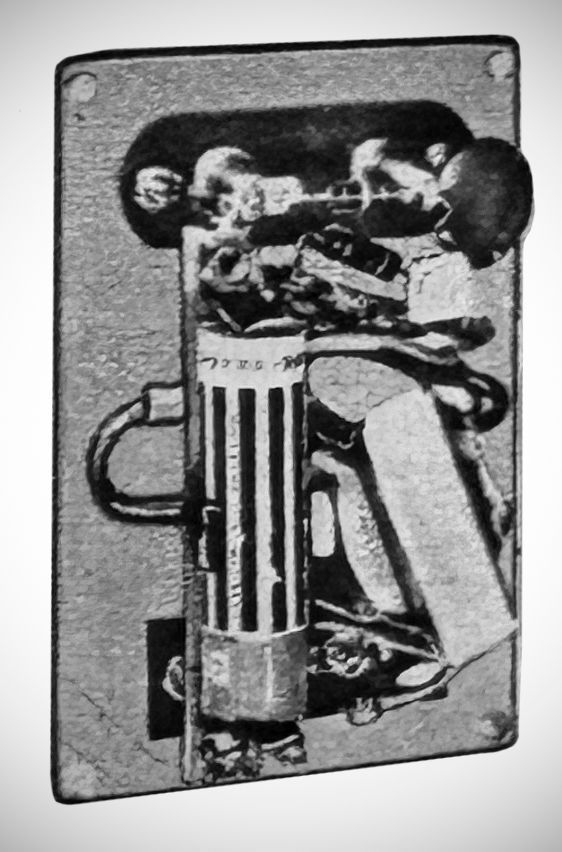
The Knight Transistor Code Practice Oscillator (CPO) is a compact, single-transistor audio oscillator powered by a single penlight cell. Originally sold in kit form by Allied Radio under the Knight-Kit brand for $3.89, it takes roughly half an hour to assemble using the included step-by-step instructions and clear diagrams.
The basic oscillator circuit uses a CK-722 transistor. This may make the device of considerable interest to collectors.
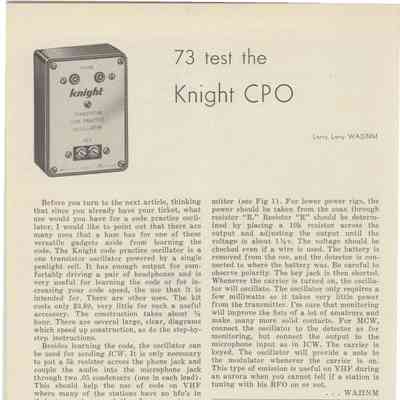
Beyond code practice, the review outlines several simple modifications for the oscillator:
– ICW (Interrupted Continuous Wave) Generator:
By placing a $5\text{ k}\Omega$ resistor across the phone jack and coupling the audio into a microphone jack via two 0.05 µF capacitors (one per lead), it can generate tone-keyed signals. This is particularly useful on VHF bands where transceivers might lack a BFO.
– Audio Signal Generator:
Configured similarly to the ICW setup, it serves as a lightweight audio source for troubleshooting modulators and audio gear.
– CW Monitor / MCW Generator:
By removing the internal battery and wiring a simple RF detector circuit in its place, the oscillator can monitor your transmitted CW signal:
Detector Components: Uses a 1N34 diode, an RF choke, and a 0.005 µF capacitor.
RF Pickup: For high-power transmitters, a simple pickup wire near the rig provides enough RF. For lower-power rigs, RF is tapped from the coax line through a resistor adjusted to supply approximately 1.5 V across a 10kΩ test load.
Power Source: Single 1.5V AA battery (draws only a few milliwatts of power).
Headphone Output: Provides sufficient audio drive for standard headphone listening.
.
References
Short review. Radio News, Dec 1957, p. 156.