Note
Allied Radio catalog 1957 (issued 1956), p. 202.
QST, Jan 1956, p. 160.
Allied Radio catalog 1958 (copyright 1957), p. 229.
Allied Radio catalog 1959 (copyright 1958), pp. 265, 377.
Allied Radio catalog 1960 (copyright 1959), p. 266.
Allied Radio catalog 1961 (copyright 1960), p. 282.
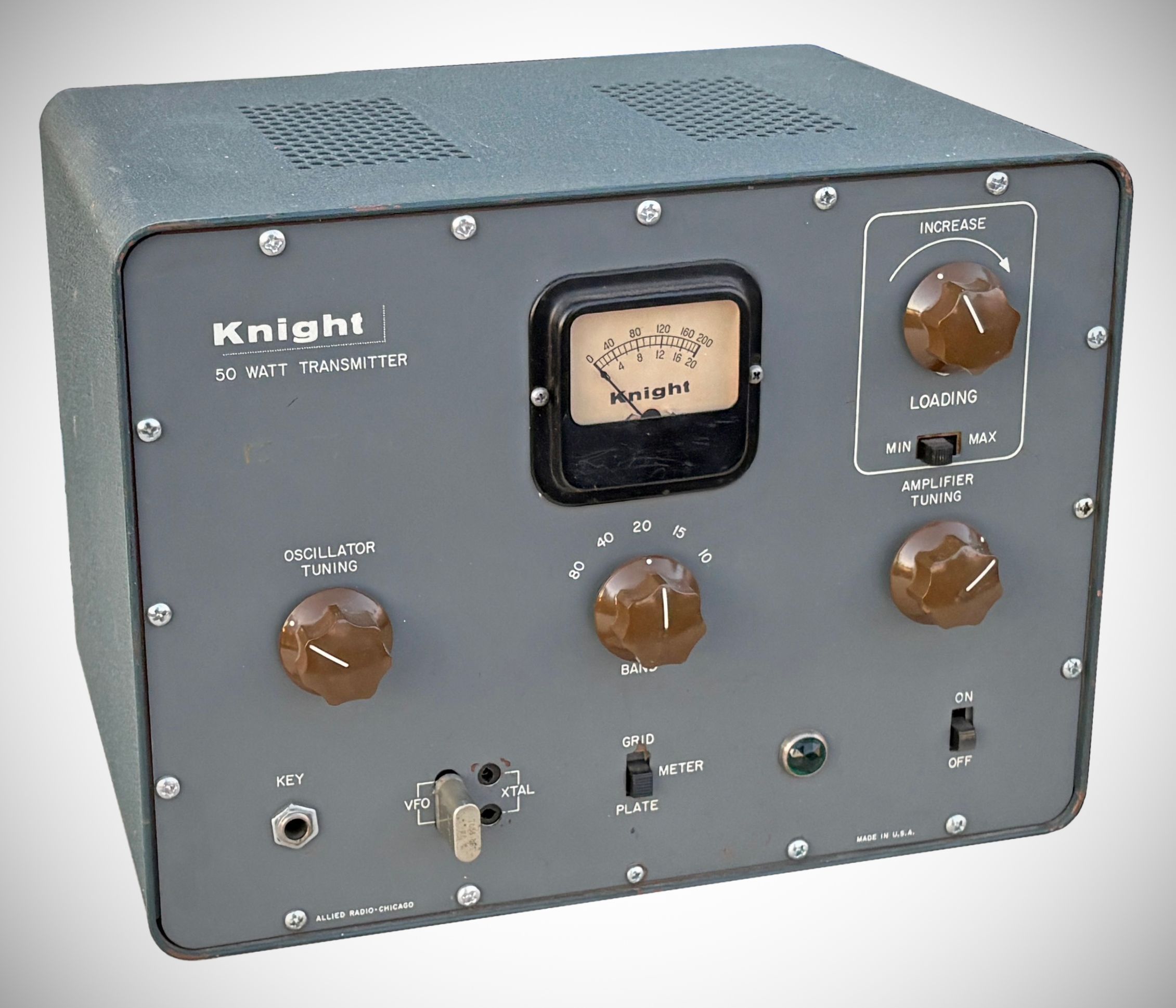
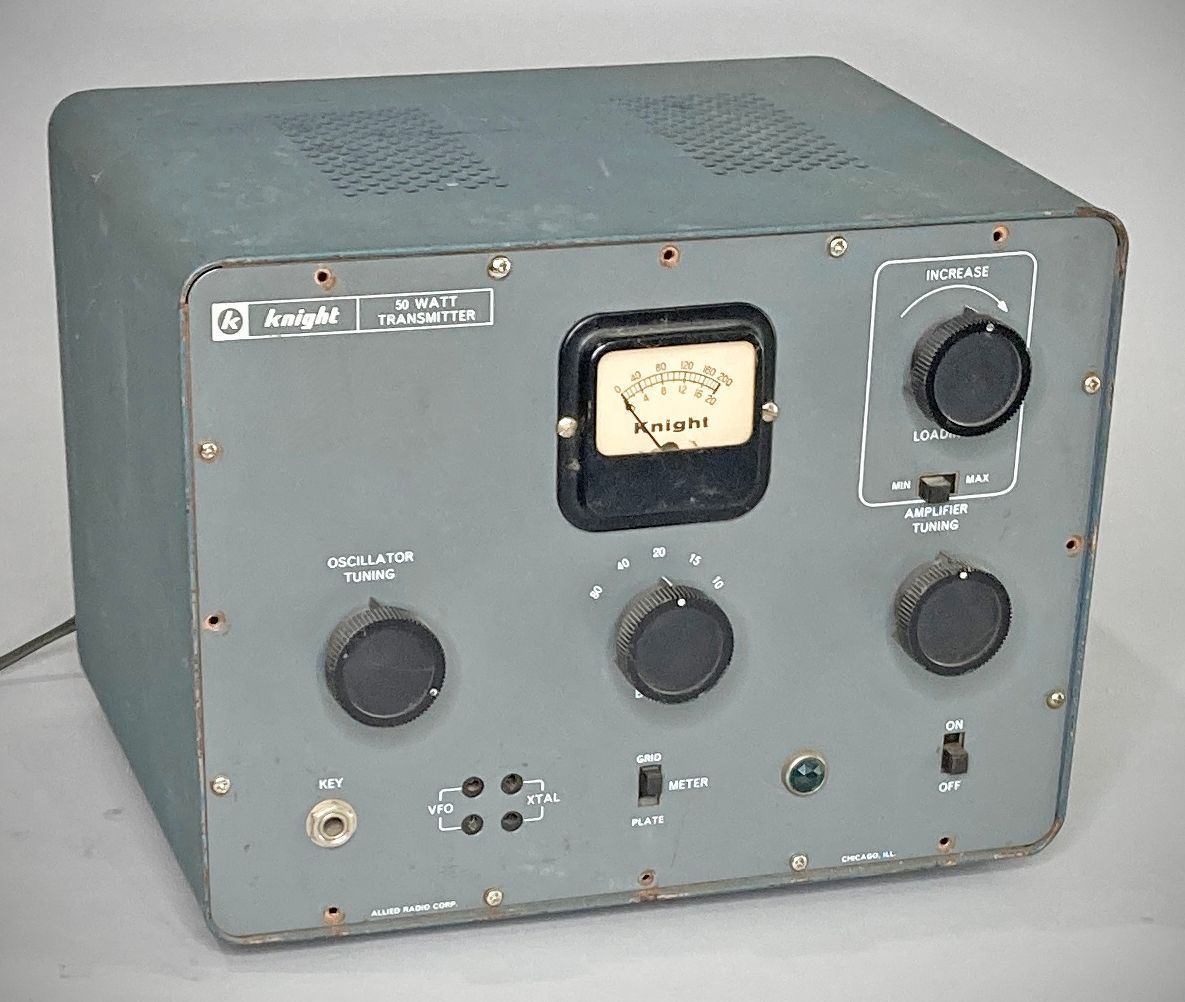
The Knight-Kit T-50 is a classic crystal controlled entry-level transmitter introduced in 1955. Sold by Allied Radio of Chicago, it was designed to be an affordable and approachable way for new novice class operators to get on the air during the golden age of kit-building.
The T-50 is often compared to the E.F. Johnson Viking Adventurer. While the Adventurer was considered slightly more premium due to its aluminum chassis, the T-50 used a copper-plated steel chassis and offered improved features like a standard SO-239 coaxial connector, whereas many competitors still used older RCA jacks.
Allied Radio phased out the T-50 in 1961 in favor of the Knight-Kit T-60. The T-60 was more compact and included built-in AM capability, whereas T-50 users had to add an external modulator for anything other than CW.
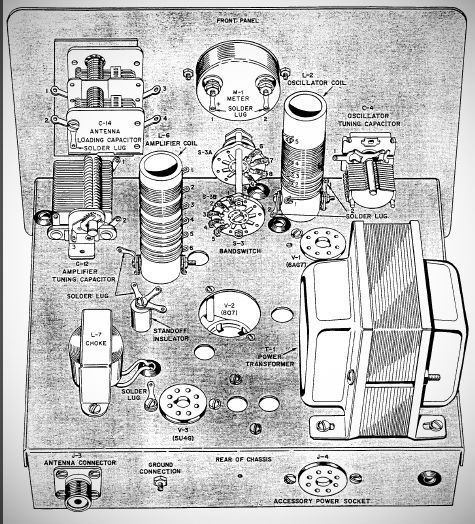
The heart of the T-50 is the 807 beam power pentode. This tube is legendary for its durability and "cool" aesthetic, featureing a top-cap plate connection.
Knight's 50 watt CW transmitter came in kit form. It offered band-switching coverage of 80-10 meters, with a 6AG7 /807 tube lineup and a 5U4 rectifier in its internal power supply.
The Knight T-50 is a complete, self-contained, crystal-controlled CW (continuous wave) transmitter designed for amateur radio use. It is engineered as a kit that appeals to both novice and experienced operators, providing a reliable means for world-wide communication. The unit is fully shielded within its cabinet to minimize harmonic radiation and reduce TVI.
– Simple Bandswitching: Band changing is achieved in seconds by turning a bandswitch and resonating two circuits; there are no coils to change manually.
– Pi-Network Output: The amplifier stage utilizes a pi-network circuit, which allows the transmitter to match a wide variety of antennas and feed lines (unbalanced loads from 50 to 1200 ohms) while providing harmonic attenuation.
– VFO Capability: While crystal-controlled by default, the T-50 includes a socket for an external Variable Frequency Oscillator (VFO).
– Modulation Provision: The design includes a provision for connecting an external modulator for phone operation. Allied made the V-44 VFO specifically for the T-50.
– Complete Shielding: The chassis is well-bonded to the cabinet with metal-to-metal seals at all junctions to ensure minimum harmonic radiation.
Specifications
– Power Input: 50 watts minimum (final amplifier) on all bands
– Frequency Range: 80, 40, 20, 15, 11, and 10 meters
– Frequency Control: Crystal or external VFO
– Output Connector: SO-239
Tubes
(1) 6AG7, (1) 807, (1) 5U4G
References
Use on 6 meters. CQ, Aug 1957, p. 90.