Note
The following information was distilled from:
elecraft.com
and
copland.udel.edu/~mm/ham/elecraft/history/
The history of Elecraft is a story of two amateur radio enthusiasts, Wayne Burdick (N6KR) and Eric Swartz (WA6HHQ), who turned a shared vision for a "modular" transceiver into one of the most respected brands in the ham radio industry.
Wayne Burdick (N6KR): Wayne’s design philosophy is rooted in Cognitive Science, the subject of his degree from UC San Diego. This background allowed him to model human-machine interaction, leading to Elecraft’s reputation for "ergonomic" radios where the most important controls are always at the operator's fingertips. Before Elecraft, he was a prolific designer in the QRP community, creating the Safari-4, NorCal 40A, and the Sierra.
Eric Swartz (WA6HHQ): Eric is the business engine and performance architect of the company. A longtime ham since age 14 and a former Silicon Valley entrepreneur, he focused on building a company that was debt-free and "self-funded by the founders." His meticulous approach to performance metrics ensured that Elecraft rigs weren't just "fun to build" but could compete with the world's most expensive commercial transceivers.
Inception and the "Ultimate Field Day Rig" (1997)
The company grew out of an extended conversation between Wayne and Eric about whether a radio could be designed to emulate a do-it-yourself PC—modular, customizable, and user-upgradeable.
At the time, Wayne had already designed several popular QRP kits, while Eric was a DX enthusiast who demanded "big-rig" performance. They realized their combined philosophies could create the ultimate "Field Day" radio: a rig with a bullet-proof receiver, internal battery, and an internal automatic antenna tuner.
In October 1997, they announced their intention to start Elecraft at Pacificon, a major California hamfest. They didn’t even have a working prototype yet—only a foam-core mockup with photo-realistic renderings glued to the front and sewing pins holding it together.
The K2 Era (1998–1999)
The founders spent 1998 working nonstop on their first product, the K2. Wayne focused on the user interface and firmware, while Eric focused on electrical engineering and rigorous performance testing.
The Name: The name "K2" was a joke. Having designed a series of rigs named after mountain ranges (like the Sierra), Wayne swore he wouldn't name another after a mountain. They first suggested "2K" (for the millennium), but realized that was the name of a famous high-power amplifier. They reversed it to "K2," only to realize they had accidentally named it after the second-highest mountain in the world anyway.
Performance:Upon release, the K2’s receiver performance was groundbreaking. When the ARRL lab tested it, the K2 had the best close-in dynamic range they had ever measured at that time. Full production began in early 1999.
Growth and Diversification (2000–2003)
Following the success of the K2, Elecraft released the K1, which Wayne considered his "baby"—a compact, CW-only, multi-band backpacking rig.
During this period, the company grew from a two-man operation in a basement to a professional team. Key additions included:
Bob Friess (N6CM): Who developed the 100-W amplifier for the K2 and the company's line of transverters.
Lyle Johnson (KK7P): Who joined after reverse-engineering a DSP unit for the K2. His expertise in Digital Signal Processing (DSP) became the backbone of future designs.
The Shift to Surface Mount and the K3 (2004–2007)
By 2004, the team began serious work on the K3, intended to be a high-performance successor to the K2. This was a major technological leap, as it required moving from through-hole components to surface-mount device (SMD) technology.
To test these new fabrication techniques, they developed smaller products first:
The KX1 (2003): An ultra-portable backpacking rig.
The T1: A tiny automatic antenna tuner.
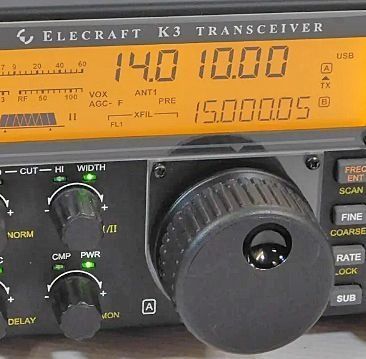
In 2007, the K3 was announced. It was a massive financial and technical risk for the company, requiring a "blood ritual" level of commitment to parts inventory. The risk paid off; the K3 became an instant classic, dominating the "high-end" transceiver market and being used by top contesters and DXpeditions worldwide.
Evolution into a Major Manufacturer (2010s)
By the 2010s, Elecraft had moved well beyond its "QRP kit" roots. While they continued to offer kits, they became a major manufacturer of factory-assembled "QRO" (high power) equipment, such as the KPA500 500-watt amplifier and the KX3 (a revolutionary portable SDR transceiver).
n the early 2010s, Elecraft transitioned from traditional analog designs to high-performance Software Defined Radio (SDR) architecture.
KX3 (2012): This was a watershed moment for portable radio. The KX3 brought the performance of the desktop K3 into a package the size of a paperback book. It featured a large display and a full set of knobs, contrasting with the "black box" SDRs of the time that required a PC to operate.
KX2 (2016): Responding to the "SOTA" (Summits on the Air) and backpacking communities, Elecraft released the KX2. It was essentially a "shrunken" KX3, designed to be held in one hand and fit in a coat pocket, yet it still offered 10 watts of power and a built-in microphone for handheld operation.
The K4 (2019–Present): Announced at the 2019 Dayton Hamvention, the K4 represents the current pinnacle of their lineup. It is a "Direct Sampling" SDR with a large color touch screen.
Development Challenges: Like many tech companies, the K4’s rollout was significantly impacted by the COVID-19 pandemic and global semiconductor shortages, delaying full production deliveries until 2021.
Hybrid Architecture: The K4 is designed to be modular. Users can start with a basic K4 and upgrade it to a K4D (adding a second set of filters/ADC for diversity reception) or a K4HD (adding a superhet front-end for extreme signal handling).
Recent Innovations and the "Flagship Twins"
The KPA1500: To complement the K4, Elecraft released the KPA1500, a full-legal-limit (1500-watt) solid-state amplifier. Together, the K4 and KPA1500 are often referred to as the "Elecraft Twins" because they share the same enclosure size and styling.
KH1 (2023): Their most recent handheld innovation is the KH1, a specialized 5-band "hand-portable" CW station specifically for ultra-minimalist trail operation.
Remote Operation: Elecraft has recently moved heavily into the "Remote Shack" market. The K4 features built-in Ethernet that allows it to be controlled by another K4 (or a dedicated remote panel called the K4/0) from anywhere in the world without needing a complicated middle-man computer setup.
Business Philosophy
Eric Swartz (WA6HHQ) attributes the company's longevity to several core principles:
1. Continuous Improvement: Designing products like the K3 that receive new features via firmware/hardware updates long after purchase.
2. Financial Stability: Maintaining zero debt and owning all inventory.
3. Community Engagement: Remaining personally accessible to customers and listening to their feedback daily.
From its start with a foam mockup in 1997, Elecraft evolved into a multi-million dollar company that remains one of the few high-end radio manufacturers based and built in the United States (California).
Key Milestones Summary
Year Milestone
1998 Company founded in Aptos, California.
1999 K2 released; sets new ARRL record for close-in dynamic range.
2007 K3 announced; becomes the "gold standard" for DXpeditions and contest stations.
2012 KX3 released; brings high-end SDR performance to the portable market.
2016 KX2 released; "shrunk" the HF radio into a pocket-sized form factor.
2019 K4 unveiled; flagship direct-sampling SDR.
2021 K4 full production begins despite global chip shortages.
2023 KH1 released; targeting the specialized ultra-portable CW market.