Note
Abstract
Radios by Hallicrafters by Chuck Dachis
Radios by Hallicrafters (Schiffer Publishing) is the definitive reference chronicle and collector's guide to the iconic consumer and military electronics produced by the Hallicrafters Company of Chicago from its founding in the early 1930s through its operational decline in the late 20th century. Authored by Chuck Dachis—widely recognized within the amateur radio and radio archiving communities as the "Hallicrafter Man"—the text represents over a decade of meticulous primary research and historical archiving.
The book traces the evolutionary arc of Hallicrafters' industrial design and electronic innovation, beginning with the depression-era shortwave craze that birthed the early Skyrider superheterodyne receivers, through the company's massive military wartime production (such as the legendary BC-610 transmitter), and concluding with the consumer electronics boom and amateur radio equipment of the post-war single-sideband (SSB) era.
Organized sequentially by product lines and model numbers, the work provides exhaustive technical descriptions for every known piece of Hallicrafters equipment. This includes:
– Commercial and consumer communication receivers (e.g., the S and SX series, from the ubiquitous entry-level S-38 to the ultra-premium SX-88)
– Amateur radio transmitters and transceivers (the HT and SR lines)
– Early television sets, citizen's band (CB) gear, marine transceivers, and specialized military communication kits
– Matching speakers, external frequency calibrators, test equipment, and promotional ephemera
Supplemented by over 800 high-resolution archival photographs, design variant listings, original introductory pricing, production timeline tables, and a specialized valuation framework for electronics preservation, this text functions as an essential, high-utility diagnostic and historical benchmark for technology historians, radio restorers, and electronics archivists alike.
-----------------------------
Abstract
The Hallicrafters Story, by William Orr, W6SAi
Published in Ham Radio magazine, Nov 1979
Founding and Early Struggles
The Vision: In 1931, during the Great Depression, amateur radio enthusiast Bill Halligan (W9WZE/W9AC) wanted to build high-quality ham radio equipment.
Licensing Hurdles: Founded in 1933, the company initially struggled because it could not afford a patent license from RCA. To survive, Halligan had to design sets and pay a licensed competitor (Silver-Marshall Company) to manufacture them.
A New Partnership: After an empty factory acquisition in Indiana left him deep in debt, Halligan partnered with Ray Durst and Clem Wade of the Ecophone Company. Through cross-licensing and resolving legal battles, Hallicrafters finally secured its own manufacturing capabilities.
Pre-War Success and Innovation
Market Breakthrough: Hallicrafters entered the ham market rapidly in 1935 with the "Super Sky Rider" short-wave receiver. Using modern marketing and high-volume production, they made varied receiver models affordable for everyday consumers.
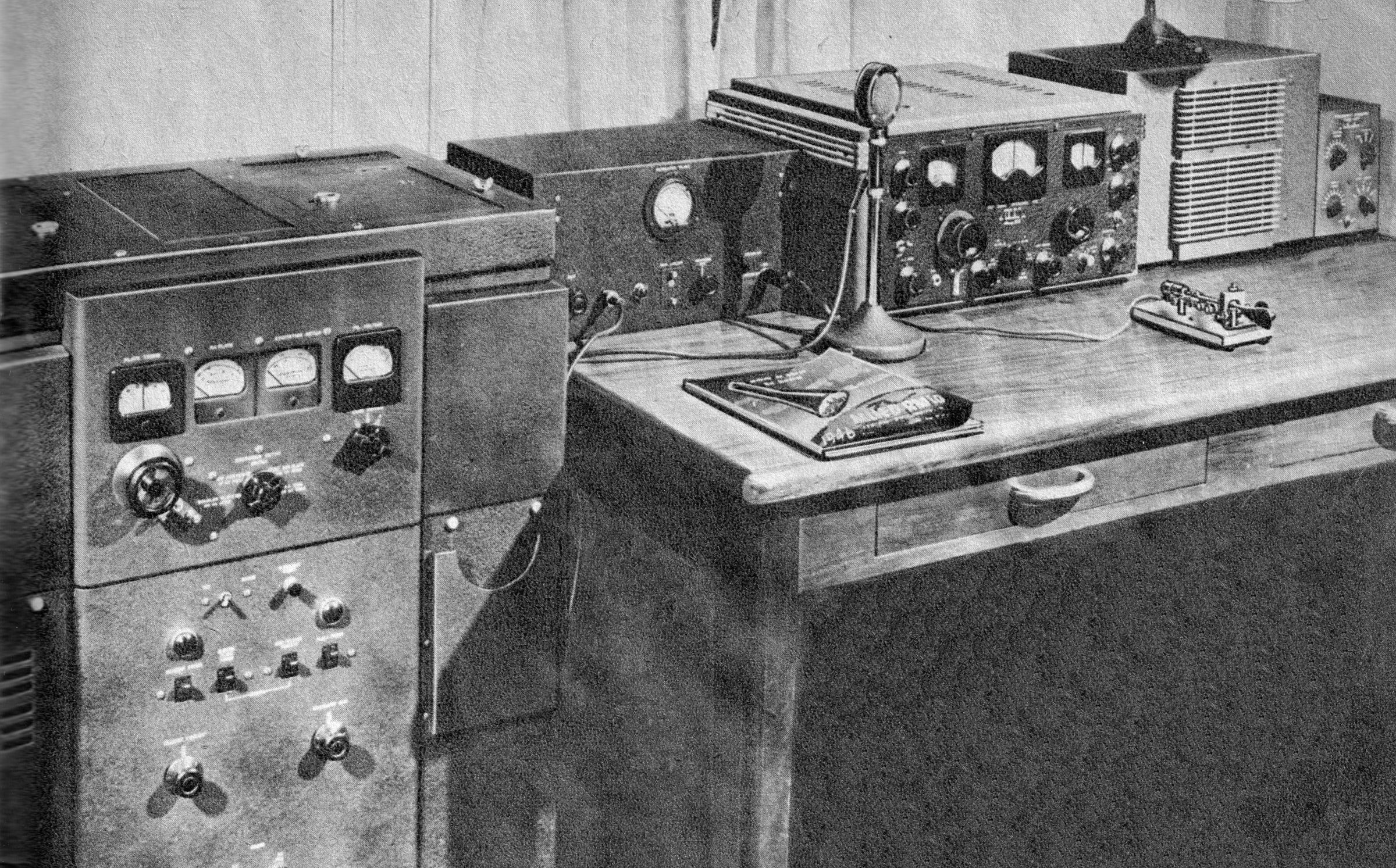
The HT-4 Transmitter: In 1938, engineers reduced the conventional massive, high-power transmitter design into the compact, 500-pound, 450-watt HT-4 phone and CW transmitter.
World War II and the SCR-299
Mass Production: Right before Pearl Harbor, British and French purchasing commissions ordered massive quantities of Hallicrafters gear. The factory pivoted to continuous three-shift operations.
The SCR-299 Van: The military selected the rugged HT-4 transmitter (labeled the BC-610) for the SCR-299 mobile communications truck. It was deployed across every Allied battlefront, from Guadalcanal to the D-Day invasion at Normandy.
Historical Impact: Hallicrafters equipment played crucial roles in history, including an FBI sting on Long Island that captured Nazi spies. Additionally, Bill Halligan’s personal HT-4 transmitter was flown to Pearl Harbor and served as the sole active communications link to the U.S. mainland during the December 7, 1941 attack. The company won five Army-Navy "E" awards for production excellence.
Post-War Transition and Decline
Peacetime Expansion: After the war, surplus military markets flooded the industry with cheap BC-610 transmitters. Hallicrafters consolidated its multiple plants and pivoted to new consumer gear, building the SX-42 receiver, televisions, hi-fi equipment, and organs.
Financial Turbulence: The consumer electronics market proved fiercely competitive. Frustrated by the cutthroat nature of the industry, Halligan sold the company to Penn-Texas Company in 1957 but bought it back a year later after managing it under them proved unsatisfactory. He then passed management to his son, Bob Halligan.
Legacy and Industry Firsts
Over its lifespan, Hallicrafters introduced numerous innovations to amateur radio and commercial electronics, including:
– Silk-screened panels (replacing expensive engraving).
– The calibrated S-meter.
– Automatic noise limiters and dual AVC systems.
– Temperature-compensated high-frequency oscillators.