Note
Abstract
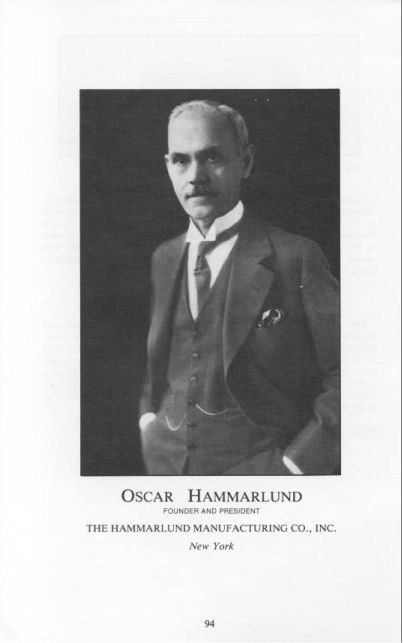
This paper traces the comprehensive history of the Hammarlund Manufacturing Company, from its founding in 1910 by Swedish-born engineer Oscar Hammarlund (1861–1945) to its acquisition and eventual dissolution in the late 1960s. Initially established in New York City as a specialized tool and novelty workshop, the company transitioned into a premier manufacturer of precision electrical components, pioneering the variable air capacitor in 1916 and the industry-standard "mid-line" capacitor in 1925.
Hammarlund's notable legacy rests on its landmark contributions to shortwave and amateur radio technology. Key achievements detailed include:
– The production of the highly successful Hammarlund-Roberts receiver kits in the mid-1920s.
– The introduction of the Comet Pro in 1932, recognized as the first commercially produced superheterodyne shortwave receiver.
– The legendary Super-Pro line (1936) and the postwar HQ-120/129 and HQ-170/180 series, which set standards for selectivity, noise-limiting, and calibrated amateur bandspread.
– Enormous wartime production of the high-frequency "APC" variable capacitor, which served as a critical component in 90% of Allied military electronics during early WWII.
The narrative also documents the company’s mid-20th-century diversification into land-mobile two-way radio (the "Outercom" line), single-sideband (SSB) transmitters, and early citizens' band (CB) transceivers, alongside its physical relocation to a 100,000-square-foot manufacturing plant in Mars Hill, North Carolina. Ultimately, the paper provides a behind-the-scenes look at the firm's transition from a tight-knit, family-run business to its eventual phase-out under corporate conglomerates, cementing Hammarlund's status as a cornerstone of the golden age of electronic communications.