Note
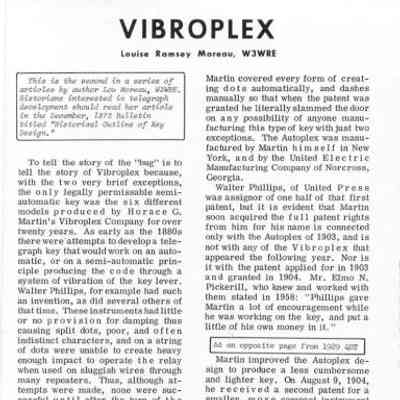
Synopsis of the "Vibroplex" by Louise Ramsey Moreau, W3WRE
The history of the semi-automatic telegraph key, popularly known as the "bug," is fundamentally tied to Horace G. Martin and his Vibroplex Company. Prior to Martin's innovations in the early 1900s, 1880s-era attempts at automatic or semi-automatic vibrating keys failed because they lacked proper damping, which caused distinct transmission issues on sluggish telegraph wires.
Key Technological Developments
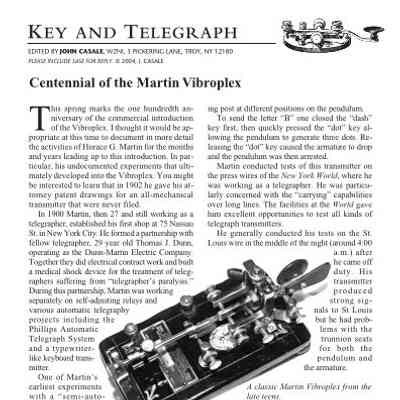
The Autoplex (1903): Invented by Horace G. Martin, this was the first key to use manually made dashes and automatic dots. Powered by dry cell batteries, its sweeping patent specifications effectively blocked competitors from manufacturing similar keys. Walter Phillips of the United Press initially co-owned half the patent and financially backed the concept before Martin acquired full rights.
The Vibroplex (1904): Martin improved upon the bulky Autoplex to create a smaller, lighter, self-activating instrument, marking the first appearance of the "Vibroplex" nameplate. These keys were custom-built to order and quickly gained official acceptance by major telegraph companies and press associations.
Design Variations (1911–1934): Martin continually adapted the Vibroplex to meet industry demands:
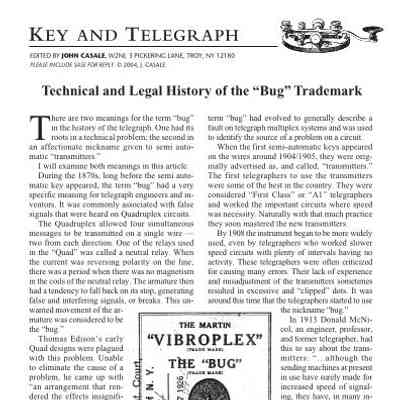
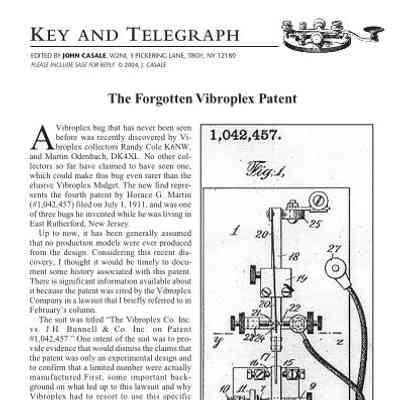
– 1911: Introduced a dual-lever model to eliminate split dots, and officially registered the Vibroplex trademark.
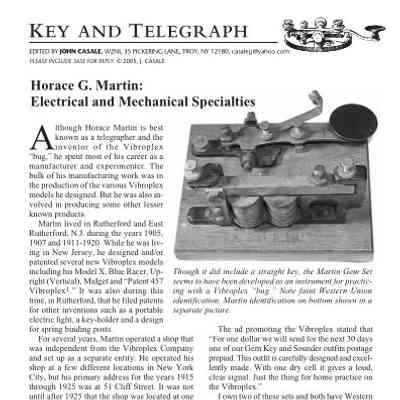
– 1912: Released the "Model X," utilizing a single contact for both dots and dashes.
– 1914: Produced the Vibroplex #4, a 3/4-sized portable model.
– 1917: Designed the "Vertical Bug" (Upright Model) for crowded spaces like wire chiefs' desks.
– 1923: Launched the highly popular Vibroplex #6, also known as the "Lightning Bug".
– 1934: Created the "Martin Junior" featuring larger contacts tailored for amateur radio.
Patent Monopolies and the "Bastard Bug"
Due to Martin's strict patent hold, only two early competitors successfully navigated legal loopholes before eventually being absorbed by Vibroplex:
– The Hulitt Transmitter (1909): A clockwork, spring-driven key.
– The Mecograph (1906–1914): A right-angle bug operating on a released spring tension principle.
Other manufacturers created exact clones, resulting in aggressive patent infringement lawsuits from Vibroplex. Because operators loved using these high-quality "bootleg" keys, a ban threatened to trigger an industry strike. A compromise was reached via the J.E. Albright Company (the sole agent for Vibroplex): operators could pay a $2.00 fee to secure a special brass license plate allowing the legal use of their non-Vibroplex keys. Telegraphers nicknamed these licensed clones "The Bastard Bug".
Post-Martin Era and Market Evolution
Martin left the company in the 1930s and passed away in 1939 after selling his final patents to the J.H. Bunnell Company. The expiration of the original Vibroplex patents in the mid-1930s opened the commercial market to other manufacturers.
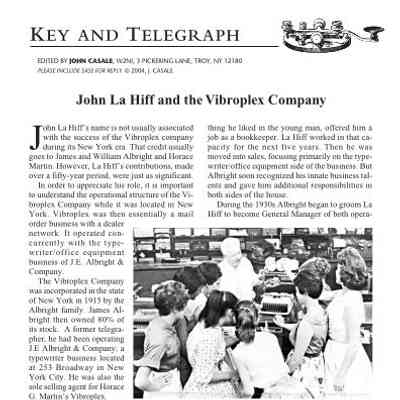
In 1940, John La Hiff took over Vibroplex, introducing a patented "jewel movement" to deluxe models like the "Original," "Blue Racer," and "Zephyr". Vibroplex later introduced the gold-plated "Presentation" model in 1941 and eventually pivoted to the electronic age by manufacturing the "Vibrokeyer" to interface with electronic keyers.
-------------------------------
Abstract of the attached three-part AWA series on Horace Martin.
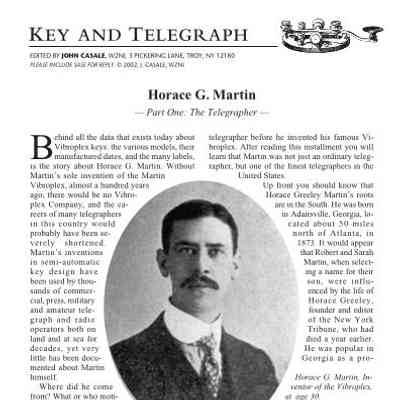
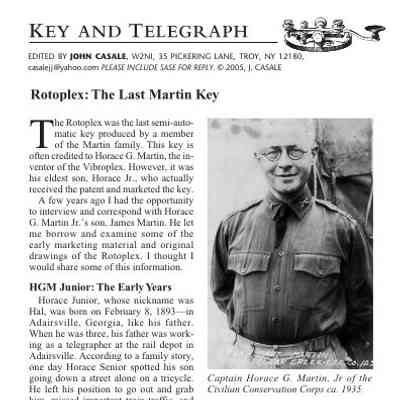
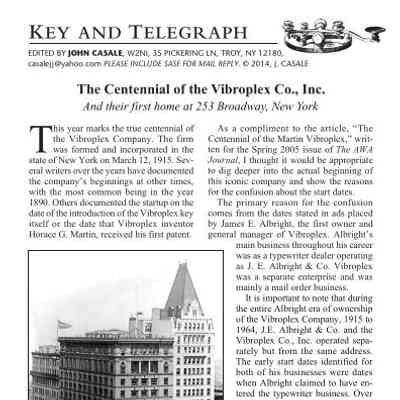
This three-part biographical series by John Casale chronicles the early life, career, and enduring innovations of Horace Greeley Martin (b. 1873), one of America's finest press telegraphers and the inventor of the revolutionary Vibroplex semi-automatic telegraph key.
Part One: The Telegrapher explores Martin’s upbringing in Georgia, his early career with the Associated Press and Western Union, and his standout performance at the 1898 Grand National Telegraph Tournament at Madison Square Garden. Despite turning in a flawless typewritten copy, a administrative oversight cost him the official championship. By this time, the physical strain of manual transmission left Martin suffering from "telegrapher’s paralysis," prompting him to experiment with mechanical alternatives to the standard straight Morse key.
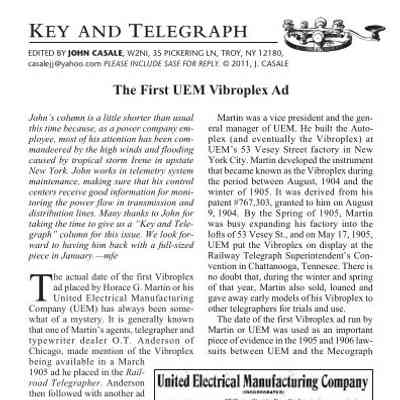
Part Two: The Phillips System and the Autoplex focuses on Martin’s transitional years in the early 1900s. Collaborating with Walter P. Phillips, Martin lent his mechanical talents to developing the Phillips Morse Automatic Telegraph System. Concurrently, Martin engineered and patented his first successful transmitter, the Autoplex (1902)—an electro-magnetic device that automated dots via a horizontal lever system to relieve operator fatigue while preserving traditional character emphasis. This design laid the foundation for the United Electrical Manufacturing Company (UEM) in 1904.
Part Three: A Vibroplex in Every Telegraph Office details Martin’s subsequent shift toward an entirely mechanical, battery-free design, culminating in the invention and 1906 patenting of the "original" Vibroplex. Utilizing a unique one-piece vibrating pendulum, the device gained immense popularity among high-volume "Bonus Men". Despite stiff industry competition, rigorous corporate evaluations, and an aggressive price war that limited his personal profits, Martin successfully achieved his ultimate goal: establishing a Vibroplex in virtually every telegraph office across North America to safeguard the careers and physical longevity of his fellow operators.
> Note: By late 1938, at least 100,000 Vibroplex bugs had been sold, according to an ad in the 1939 ARRL Radio Amateur's Handbook (p. 548 catalog section).