Note
Radio News, Apr 1939, back cover.
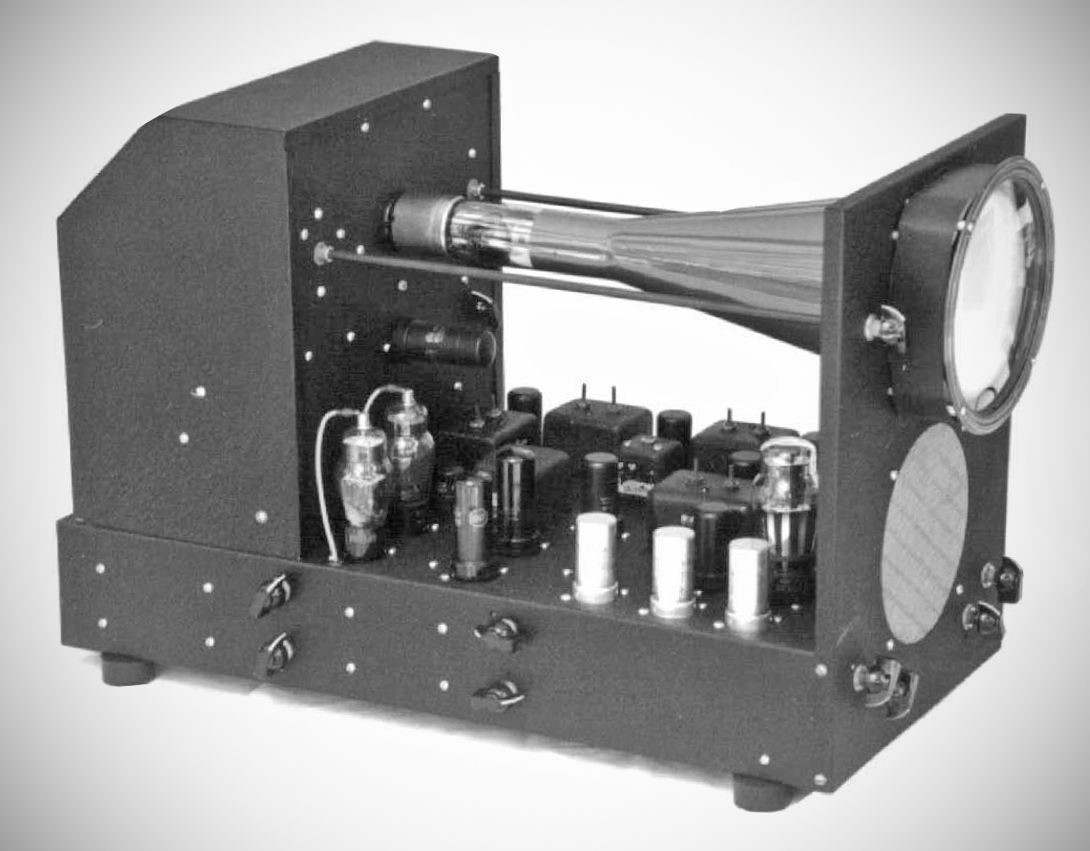
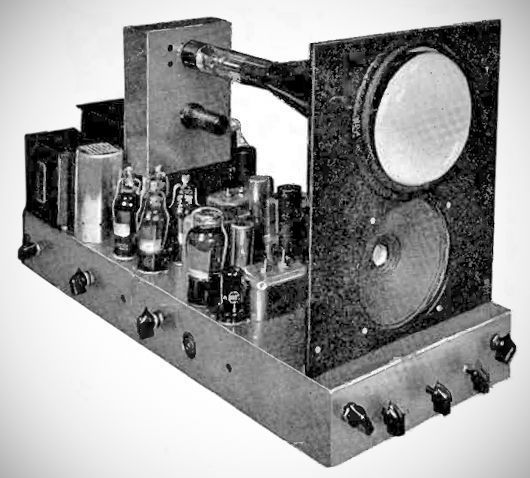
The Meissner Model 10-1153 is a 5-inch television set sold in kit form circa 1939.
It features a highly mechanistic "open frame" design that closely resembles an open frame oscilloscope with an added speaker. It was deliberately styled with engineers and hobbyists in mind, prioritizing utility over the lavish, decorative wood finishes of its contemporary competitors.
Unlike some competitors that used custom-designed tube masks, the front of the picture tube on the Meissner is supported by strong rubber bands wrapped around posts projecting from the front panel. It includes a pressed brass surround and an escutcheon similar to a radio dial glass, intended for an optional cabinet installation.
The set utilizes a four-channel VHF tuner incorporating a 6J5 local oscillator and an 1852 mixer tube.
Meissner leveraged its expertise in coil design to equip the kit with superior, adjustable, twin-tuned intermediate frequency (IF) transformers featuring high-Q ferromagnetic ("ferrocart") cores. This design achieved an overall band-pass characteristic of about 2.5 to 3 MHz, outperforming air-cored variations in gain.
The kit uses a 5BP4 (or 1802-P4) cathode-ray tube, which is a variant of the 5BP1 radar/oscilloscope tube. Running on a 2000V anode potential, its longer neck and narrower deflection angle provide excellent deflection sensitivity and even focus across the faceplate.
The documentation contains minor historical discrepancies regarding the video output tube; the circuit diagram and parts list specify an 1852 pentode, the text/brochures refer to a 6F6, and the physical socket wiring supports either a 6AC7 or a 6AG7 (with a 6AG7 often found installed).
The sound system was originally designed for AM reproduction on an 8.25 MHz audio IF, though it can successfully demodulate FM transmissions via slope detection.
The power supplies use 5V4 and 879 tubes, while the scanning system relies on 6N7 scan oscillators and 6F8 scan amplifiers. The line and frame rate controls possess enough flexibility to be adjusted to different regional scanning standards.
References
Technical description. Radio News, May 1939, p. 12.