Note
QST, Feb 1981, p. 116.
QST, Jan 1982, p, 117.
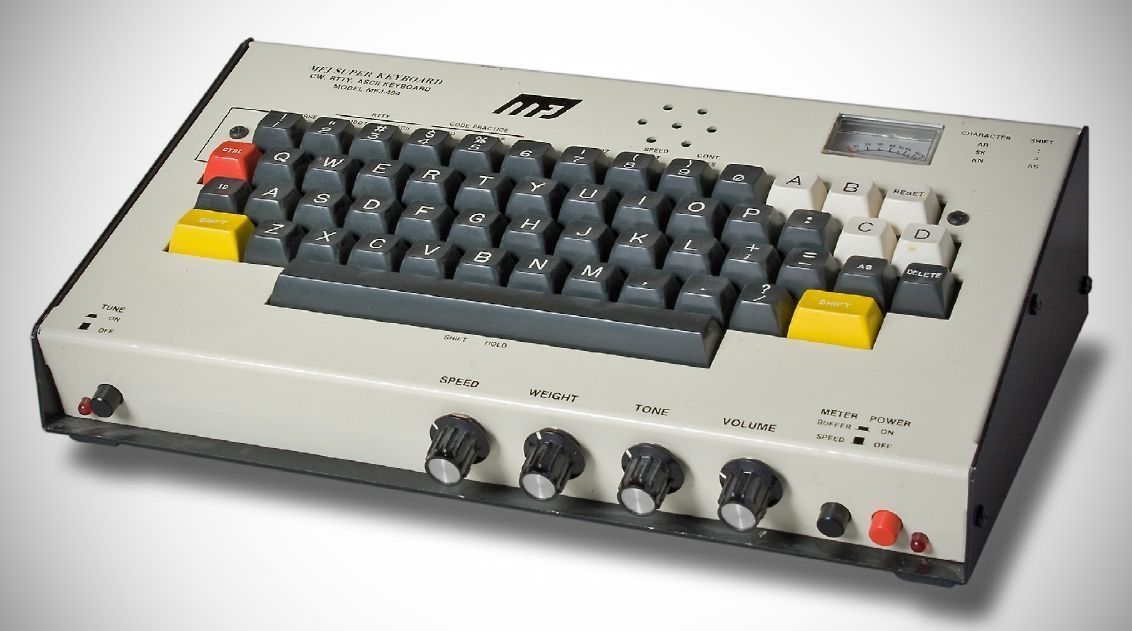
MFJ offered two models of its 5-mode Super Keyboards designed to enhance CW and RTTY operations:
MFJ-496 ($339.95): The fully featured model includes a larger memory capacity, automatic serial numbering, a repeat/delay function, and support for an optional clock module. Text Buffer: 256 characters. Message Memory: 256 characters total (split across 4 programmable message memories)
MFJ-494 ($279.95): A lower-cost version with a smaller buffer and memory capacity, lacking the sequential numbering, repeat/delay functions, and clock options. Text Buffer: 50 characters. Message Memory: 30 characters total (split across 2 programmable message memories)
Both keyboards feature five distinct operating modes:
1. CW Mode
– Text Buffer: The MFJ-496 has a 256-character text buffer, while the MFJ-494 has a 50-character buffer. This allows users to "preload" text and transmit it smoothly.
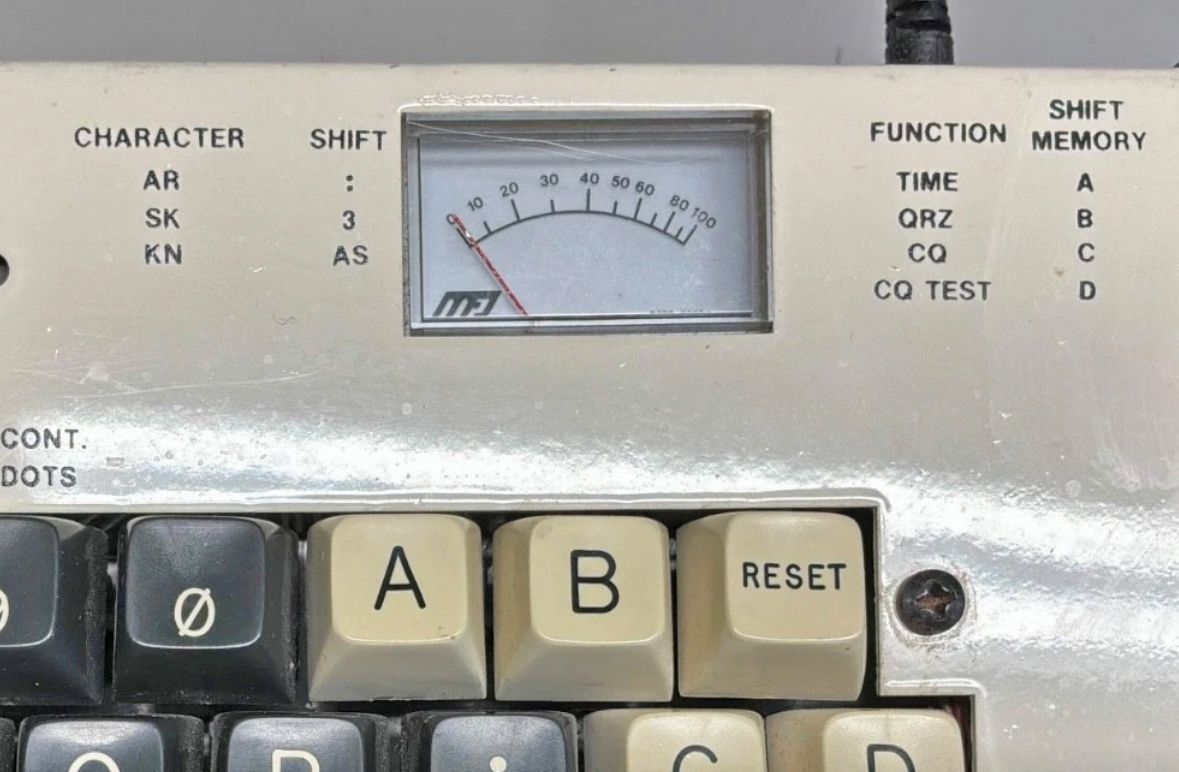
– Buffer Control: Includes a meter to track speed or remaining buffer space. The meter lights up red and the sidetone pitch changes when the buffer is within two characters of being full. Transmission can be paused for break-in comments via key paddles and then resumed.
– Message Memories: The MFJ-496 has 4 programmable memories (256 characters total), while the MFJ-494 features 2 memories (30 characters total). Errors can be deleted seamlessly by backspacing.
– Automatic Messages & Special Keys: Pre-programmed buttons automatically send standard sequences like `CQ CQ DE [callsign]`, `CQ TEST DE`, `DE`, and `QRZ`. Dedicated keys are also provided for common prosigns: KN, SK, BT, AS, AA, and AR.
2. Baudot (RTTY) Mode
– Transmits 5-level Baudot at 60 WPM.
– Automatically inserts a carriage return, line feed, and "LTRS" shift on the first space after 63 characters to prevent broken words. If no space occurs, it forces the function at 70 characters.
– Features automatic up and down shifting, executing a downshift on every space to clear up garbled reception.
– Includes RTTY and CW ID, buffer features, backspace deletion, and PTT (push-to-talk) control.
3. ASCII Mode
– Includes all the automated features of the Baudot mode but transmits at a speed of 110 baud.
– Generates both upper and lower case characters.
4. Memory Keyer Mode
– Allows the user to plug in a paddle to use the device as a full-featured iambic memory keyer, retaining the dot-dash memories, automatic/programmable memories, and CW mode configurations.
5. Morse Code Practice Mode
Offers two separate training styles to aid in character recognition:
Mode 1: Sends random length groups of entirely random characters
Mode 2: Sends pseudo-random 5-character groups across 8 repeatable lists, complete with answers.
Controls
Users can insert extra spacing between characters and groups to practice high-speed character recognition at a slower overall pace, select between alphabetic or alphanumeric/punctuation sets, and pause/resume sessions.
Hardware & Design Features
– Designed for ease of use, executing any command with a maximum of a one or two-key sequence. Controls are logically positioned and clearly labeled.
– Analog Knobs: Uses physical potentiometers for adjusting speed, volume, tone, and weight. Pots are used because they retain their settings when the power is turned off and are more intuitive than keystroke programming.
– Power & Indicators: Features a red power indicator LED and runs on 9–12 VDC or 110 VAC using an optional adapter.
Transmitter Keying & Interface:
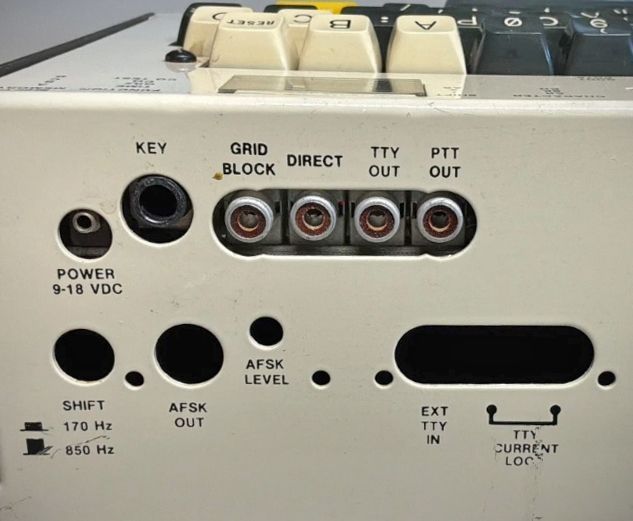
– Provides solid-state keying for CW (grid block, cathode, or solid-state transmitters up to +300V max).
– Includes a tune switch with an LED that keys the transmitter continuously to save finals during tuning.
– Features a built-in sidetone and speaker.
– Provides TTL and open-collector outputs for RTTY and ASCII modes.
Model-Specific Features & Plug-In Options
– Automatic Serial Numbering (MFJ-496 only): Automatically increments contest serial numbers from 0 to 999, which can be dropped directly into the text buffer or message memories.
– Repeat Function (MFJ-496 only): Automatically repeats a message memory with a customizable delay of 1 to 99 seconds (ideal for repeating a CQ call until answered).
Options
– MFJ-61 Clock Module ($29.95, MFJ-496 only): A plug-in module that sends the current time in a 24-hour format via CW, Baudot, or ASCII at the press of a key.
– MFJ-53 AFSK Module ($39.95): Provides 170 and 850 Hz shift options, plugging into a microphone or phone patch jack for FSK on SSB rigs, or AFSK on FM/AM rigs.
– MFJ-54 Loop Keying Module ($29.95): Features an opto-isolated 300V, 60 ma loop keying circuit to drive a RTTY printer, alongside a TTL input allowing a computer to drive the printer.
References
Review. QST, Jul 1982, p. 41.