Note
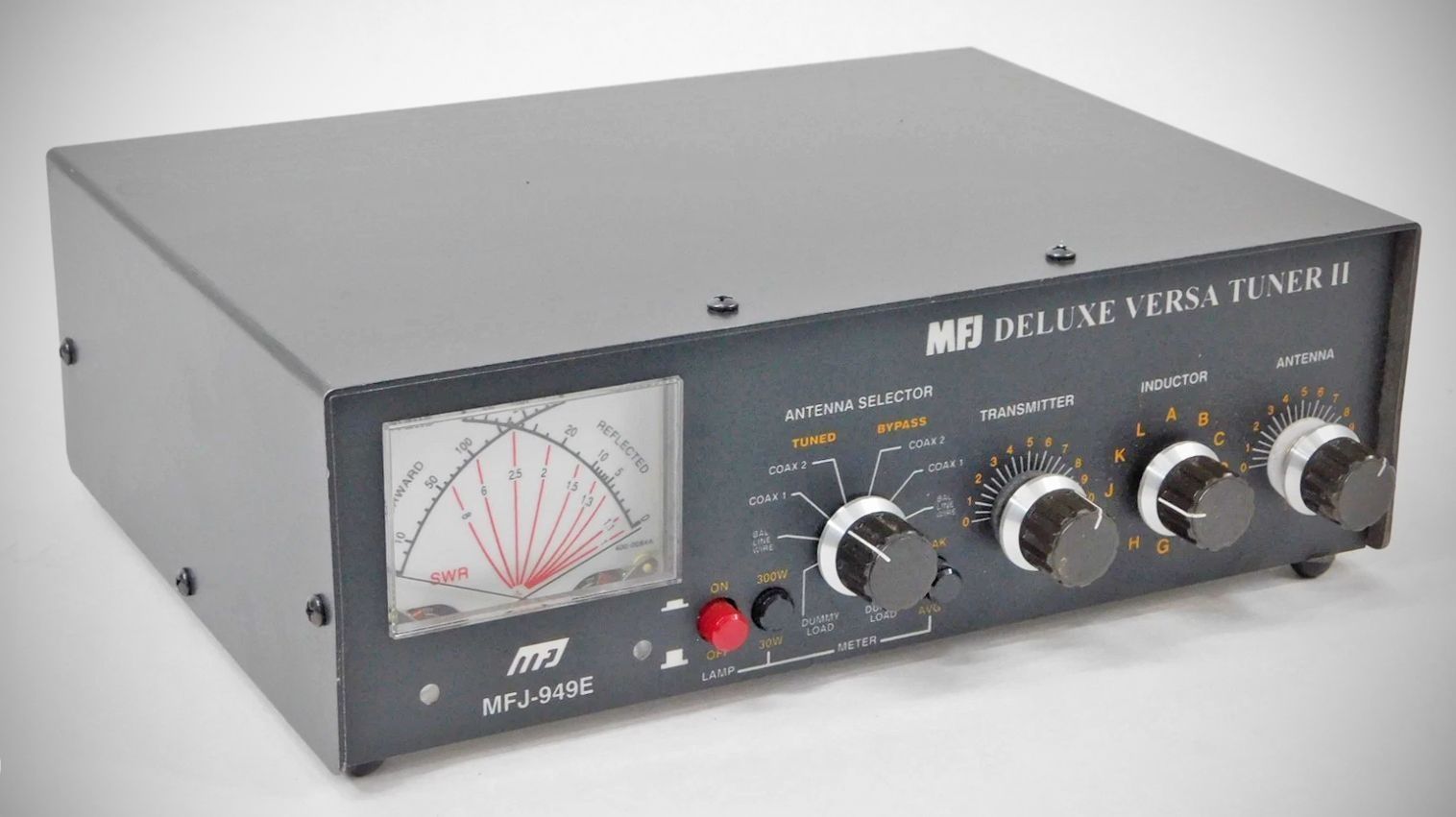
The MFJ-949E is a 300 watt RF output power antenna tuner that will match any transmitter or transceiver to virtually any antenna. Peak or average forward and reflected power and SWR can be read on the illuminated cross-needle meter.
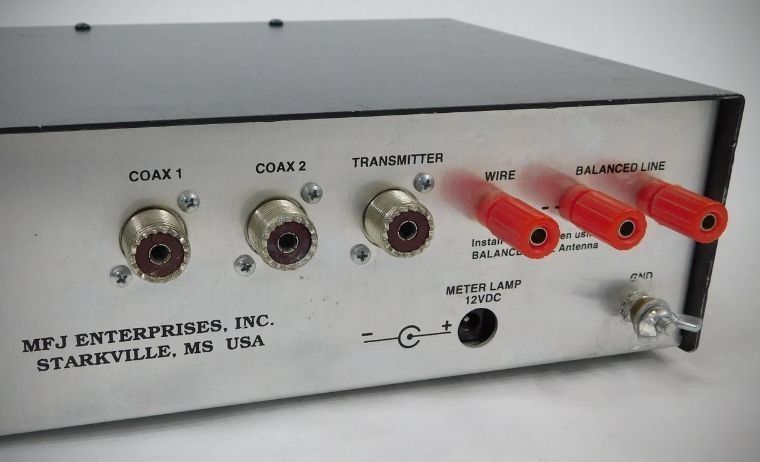
The tuner uses a "T" matching network and covers all bands between 160 and 10 meters. This network will tune dipoles, inverted-vees, verticals, mobile whips, beams, random wires, and many other antennas. The MFJ-949E has rear panel connectors for coaxial, single wire or two wire feedlines.
A built-in 4:1 balun allows the use of balanced open wire, twinlead, or twin-axial feedlines.
An internal eight position antenna-selector switch selects a built-in 50 ohm dummy load, two separate coaxial line outputs, or a single wire line-balanced line output.
All of these functions can be selected in tuned (with tuner's "T" network in line) or bypassed (no tuning circuit) configurations.
The illuminated cross-needle meter measures the peak or average FORWARD power, REFLECTED power, and SWR. The wattmeter is active in all the ANTENNA SELECTOR positions. To use the wattmeter without the tuning circuit select one of the ANTENNA SELECTOR positions under BYPASS.
The meter's full scale forward and reflected power range is controlled by the left METER switch that selects 300W or 30W. If your transmitter runs more than 30 watts of output power, set this switch to 300W (in position). If your transmitter has less than 30 watts of output, set this switch to the 30W switch position (out).
Peak envelope power (PEP) is measured when the PEAK or AVERAGE METER push button (right-hand side) in placed in the PEAK (in) position. Peak power and average power values are equal with steady unmodulated carriers, FSK, or FM. The PEP power is twice the average power with SSB two tone test modulation, and may be any amount larger than the average power with SSB voice signals.
Forward power is displayed on the left-hand FORWARD meter scale. This scale is calibrated from 0 to 300 watts and is read directly in the 300 watt position. Each picket (scale mark) represents 25 watts between 300 and 100 watts, 10 watts between 100 and 10 watts, and has a single 5 watt picket below 10.
In the 30W position the forward power scale must be divided by 10. Each picket represents 1/2 watt below 1 watt, 1 watt from 1 to 10 watts, and 2.5 watts from 10 to 30 watts.
The reflected power is read on the right-hand REFLECTED meter scale. This scale indicates 60 watts full scale when the 300W power sensitivity is selected, and 6 watts full scale when the 30W power scale is selected. This scale has a picket every 5 watts above 10 watts and at each watt below 10 watts. This scale is also divided by 10 when using the 30W switch position.
When trying to measure power with a less than perfect match, the reflected power should be subtracted from the forward power readings. The most accurate peak power readings are obtained only with a sustained carrier, voice or two tone test modulation.
During normal voice modulation the wattmeter will typically indicate 70% of the true peak power.
The SWR is read directly from eleven red SWR curves that range from 1:1 to infinity. SWR is measured by observing the point where the forward and reflected power needles cross. The SWR is indicated by the red curve closest to the needle crossing point. No cumbersome or time consuming SWR sensitivity adjustments are required with this meter.
The wattmeter has an internal lamp that backlights the meter scale. The lamp circuit requires power from an external 12 Vdc source, such as the optional MFJ-1312C power supply. The rear panel jack accepts a 2.5 mm coaxial plug with a positive center pin polarity. The METER LAMP ON / OFF switch turns the meter lamp off and on.