Note
QST, Nov 1981, p. 220.
QST, Jan 1982 p. 195.
Kit or wired.
Kit, $169.95
Wired, $249.95
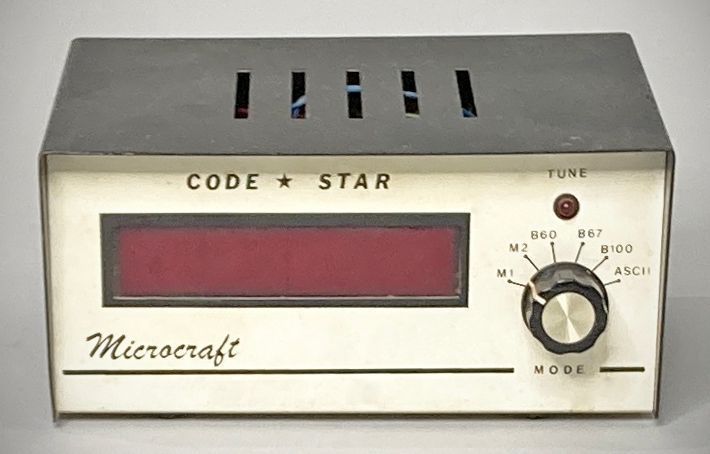
The CODE STAR is an all-mode code reader manufactured by the Microcraft Corporation of Thiensville, Wisconsin. It is designed to decode and read multiple types of data transmissions directly from a radio receiver or from a connected telegraph key for practice.
Hardware & Circuitry: The unit relies on a custom-designed 40-pin microcomputer integrated circuit alongside specialized analog circuitry.
Signal Conditioning: To maximize readability under poor signal conditions, it implements a highly selective internal bandpass filter centered at 800 Hz to reject noise and interference, as well as an automatic gain control with 16 dB of range to counter signal fading.
Digital Filtering: The microcomputer runs a proprietary tracking program that provides digital filtering and automatic speed tracking specifically optimized for Morse code.
Specifications
The CODE STAR features a 6-position front-panel rotary switch to select between various operating modes:
Mode M1 (Morse): Decodes Morse code from 3 to 33 words per minute (WPM). It uses heavy digital filtering tailored for high-noise or heavy QRM environments and automatically tracks speed changes.
Mode M2 (Morse): Decodes high-speed Morse code from 3 to 70 WPM utilizing light digital filtering.
Mode B60 (Baudot RTTY): Decodes 5-level Radio Teletype at 60 WPM (commonly used by amateur radio operators).
Mode B67 (Baudot RTTY): Decodes 5-level Radio Teletype at 67 WPM (commonly used by commercial stations).
Mode B100 (Baudot RTTY): Decodes 5-level Radio Teletype at 100 WPM (used by both amateurs and commercial operations).
Mode ASCII: Decodes standard 8-level ASCII computer code at 110 Baud.
Visual Display & Character Set
Alphanumeric Readout: Received messages are scrolled across an 8-character display made of 14-segment alphanumeric IEE 3785R LEDs behind a red plastic front-panel bezel.
Decoded Text: For RTTY, it decodes upper-case letters, numbers, and punctuation. For Morse code, it handles letters, numbers, standard punctuation (comma, period, question mark, slant bar), and special prosigns such as SK, KN, AS, BT, and AR.
Tuning Indicator: A front-panel "TUNE" LED illuminates to assist the user in zeroing in on an incoming signal's 800 Hz mark frequency.
Receiver Input: Uses an RCA jack requiring a minimum 50mV signal, designed to connect to a receiver's headphone jack, external speaker jack, or speaker lines.
Key Input: Includes an RCA jack labeled "KEY" on the rear panel, grounding the terminal activates an internal oscillator to output code practice tones through its integrated speaker.
Power Requirements: Operates on 12 VDC at 250 mA via a 3.5mm power jack, typically powered via a provided 120 VAC to 12/13 VDC wall adapter.
Expansion: Features a designated "OPTION-01" section on the PC board for an optional ASCII serial/parallel output port, enabling the reader to directly drive an ASR33 teleprinter or home computer at 110 Baud.
The CODE STAR was distributed both as a commercial factory-wired unit and as a build-it-yourself kit intended for intermediate to advanced electronics hobbyists.
Optional ASCII output port, $69.95