Note
Ham Radio, Feb 1971, p. 74.
73, Oct 1971, p. 27, (reference to model 601)
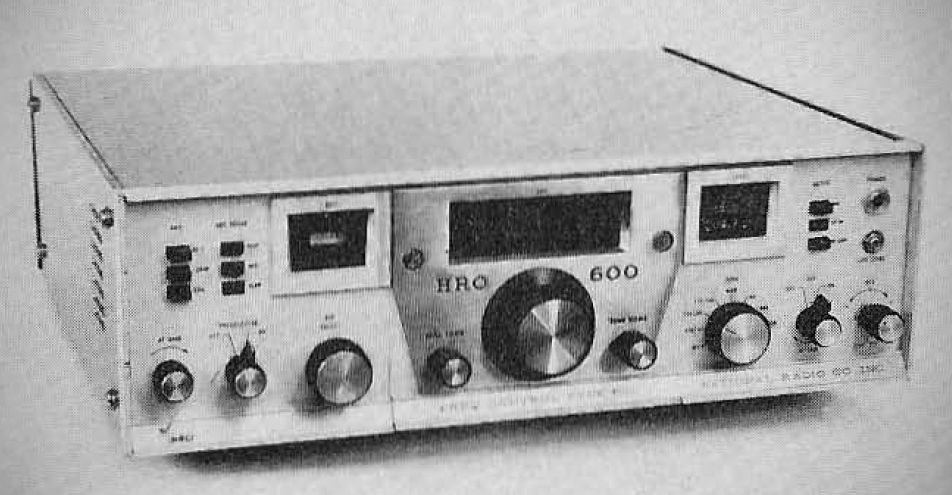
The HRO-600 was the final, legendary receiver produced in National's famous HRO line. Released in the late 1960s and produced into the late 1970s, it bypassed the traditional amateur radio market in favor of the high-end military and commercial markets, commanding a staggering price tag of $5,600 by 1979.
Abandoning the classic look and iconic PW dial of its predecessor (the HRO-500), the HRO-600 features a squat, wide, low-profile cabinet.
The interior resembles a mini-computer more than a traditional radio. It utilizes a highly modular layout where individual circuit assemblies plug directly into a central main frame. And unlike previous models, it includes a small self-contained internal speaker.
The HRO-600 covers continuous coverage from 16 kHz to 30 MHz split into 30 distinct 1-MHz bands. It requires no outboard preselector to tune below 500 kHz. The receiver operates as a single-conversion superheterodyne for signals below 1 MHz, and switches to a double-conversion setup for signals above 1 MHz via internal relays.
Functioning essentially as a frequency standard, its VFO/VCO is locked to an oven-controlled crystal frequency standard.
Despite looking like a modern processor-controlled rig, it has no internal microprocessor. The first injection-frequency synthesizer's ROM is uniquely programmed using actual discrete diodes, the display circuits use individual IC logic elements, and frequency-determining circuits are mechanically operated by motor-driven switches.
Features a 1-MHz frequency counter that reads out the selected frequency via four digital Nixie readout tubes. It displays a simple + or – symbol if the tuned range exceeds the counter's capability.
Operation is straightforward—a Collins-style MHz knob selects the main 1-MHz band, while a secondary kHz VFO knob fine-tunes the frequency.
The entire standard VFO assembly (the 601 Scanning Unit) can be pulled out and replaced with either the 602 Synthesizer (thumbwheel frequency selection) or the 603 Fixed Channel Unit (providing 12 crystal-controlled channels).
Selectivity is handled by a passive preselector (which can be bypassed for an extra 2 to 4 dB of gain) and multiple crystal filters.
Rotating the primary "Mode" control powers the unit and automatically assigns detection and selectivity. Selectivity is fixed at 2.4 kHz for USB/LSB, and ranges from wide (8–10 kHz) down to very narrow (300–400 Hz) for AM and CW.
When tuning sideband, the BFO is fixed at 5 MHz, the appropriate sideband filter is engaged, and the product detector automatically switches in.
It lacks a rejection/notch filter to eliminate interfering heterodynes, and features no passband tuning for any mode.
Modes include AM CW, SSB, FSK and FAX. FSK operation requires an accessory plug-in FSK converter or external audio equipment. FAX reception requires external audio equipment.
Other accessories available for the HRO-600 include a noise blanker, diversity combiner, remote-control system, DC power supply, VLF/MF/HF preselector, and independent sideband adapter.
Power requirements: 115–230 VAC, 47–420 Hz
References
Brief description. Ham Radio, Feb 1971, p. 74.
Brief description. 73, Jul 1971. Upfront news section.