Note
QST, Aug 1947, inside back cover.
Concord catalog 9-47, p. 160.
Allied catalog 1948, p. 155.
Lafayette catalog number 89, p 175.
See National's Notes: QST, May 1949, p. 59.
Lafayette-Concord (1949 #949), p. 144.
QST, Sep 1951, p. 117. ("while they last"}
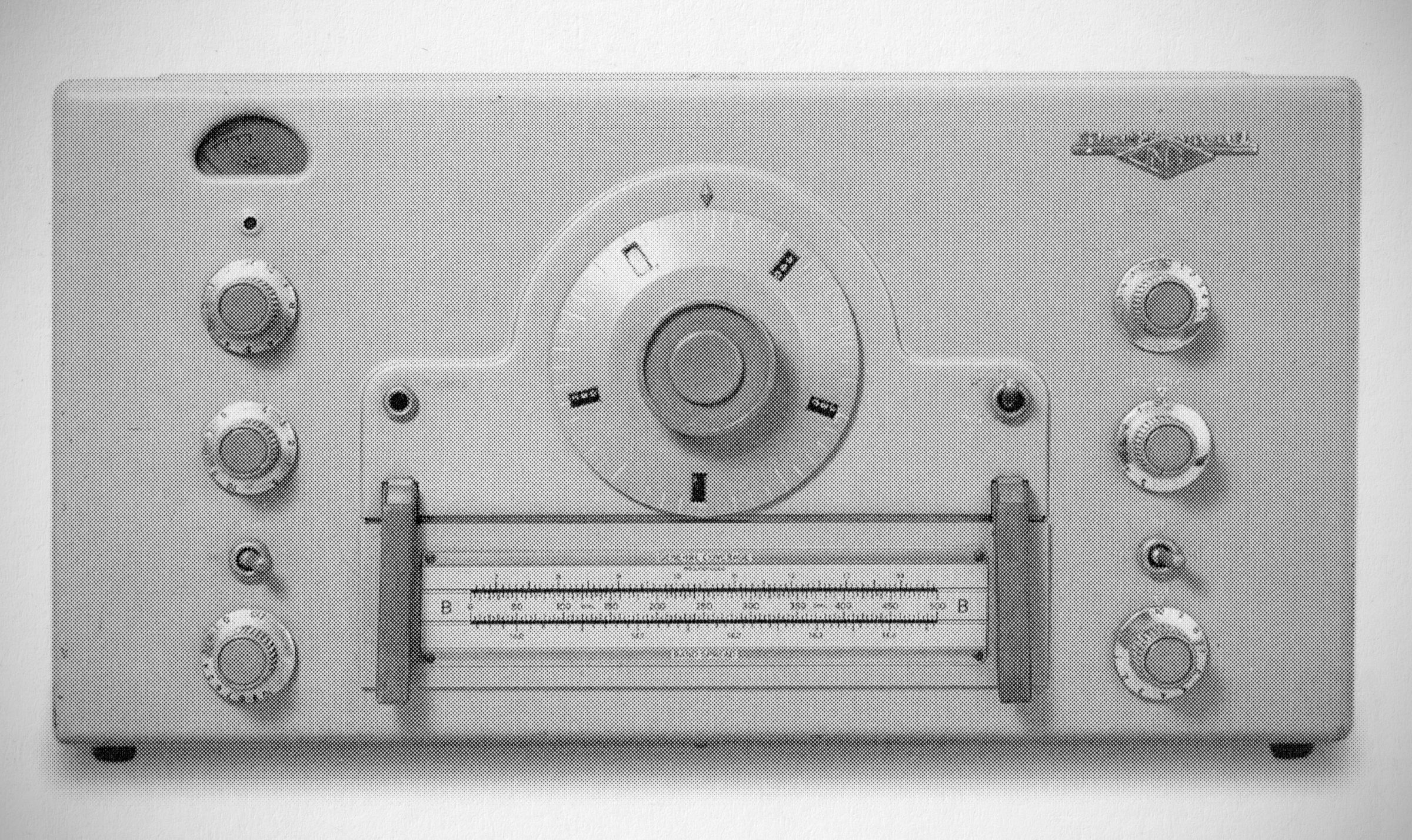
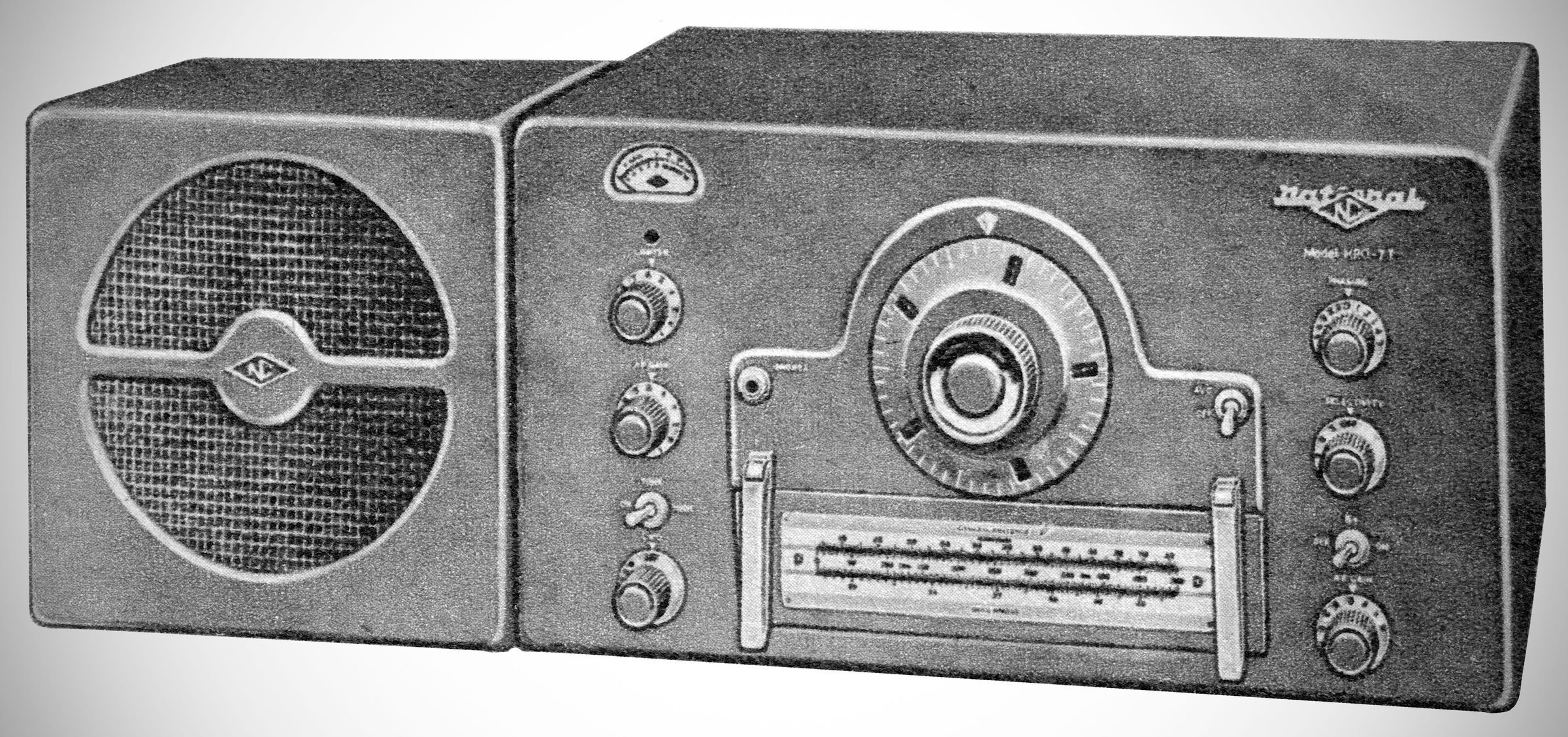
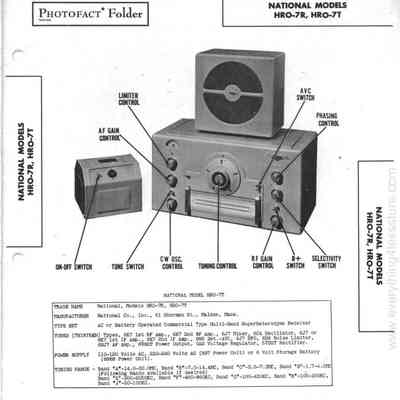
Even though the HR0-7 shed the basic black livery of its predecessors and acquired a sleeker cabinet, inside it was still cast in the mold of earlier HROs. It had plug-in coils, and frequency readout was interpolated from the PW dial and a scale attached to each coil. Standard HRO practice was also followed with the external power supply. Nine sets of coils covered 50 to 430 kHz and 480 kHz to 35 MHz. The 12-tube HR0-7 improved upon previous HRO designs with the addition of a voltage regulator tube for the HF oscillator B+ and a more effective noise limiter.
Introduced by the National Company in August 1947, the HRO-7 was a short-run, post-WWII upgrade designed to modernize the company's famous HRO receiver line in the face of new competition. Today, it is a highly sought-after collectible due to its distinctive appearance and unique place in the HRO lineage.
The receiver was produced in two primary configurations:
– HRO-7T: The standard tabletop model.
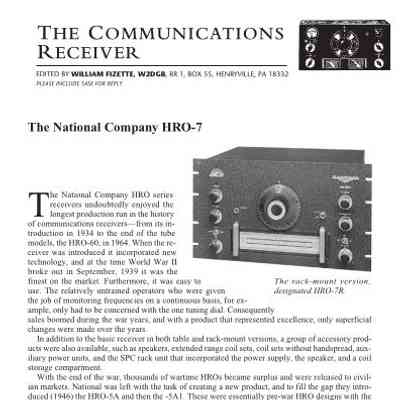
– HRO-7R: The rack-mount version, which was designated as the HRO-7C when paired with a matching SPC-type rack assembly (which housed the power supply, speaker, and coil storage).
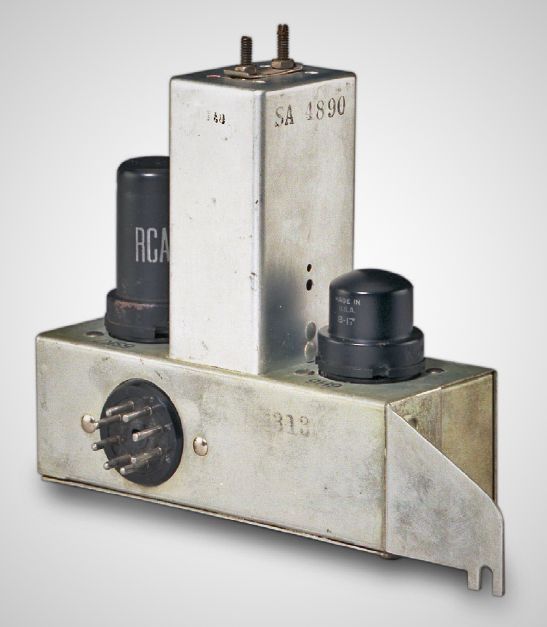
The HRO-7 retained a strong physical and internal layout resemblance to pre-war models, continuing to use several double-ended, grid-cap tubes (such as the 6K7 and 6J7) in its RF and IF stages.
Cosmetically, it shifted away from older styling with a brand-new cabinet design, an updated paint scheme, and redesigned knobs.
The HRO-7 boasted a sensitivity of 1 microvolt or better across its entire operating frequency range, and to remedy stability issues, National incorporated a 6C4 oscillator paired with an 0A2 voltage regulator to stabilize the high-frequency oscillator.
The receiver featured a 6-position switch for its crystal filter and a radio-phono switch located on the rear of the chassis, and introduced a new automatic noise limiter with a variable threshold. Moreover, the design included built-in provisions for adding a narrow-band FM (NBFM) discriminator and a crystal calibrator.
True to the HRO lineage, the receiver utilized plug-in coil sets to change bands, relying on a single, high-precision main "PW" tuning dial. However, the HRO-7 introduced critical quality-of-life updates to this mechanism: The coil sets were updated with lever-action handles and latches to make swapping bands significantly easier, and each coil set featured a vastly clearer, easier-to-read calibration chart.
Note for Collectors: The fiber rods used for the lever-action coil handles are a known design weakness; they are frequently found broken at the ends due to rough handling over the decades.
The matching external speaker featured an output transformer mounted directly inside its own cabinet. The circuitry was cleverly wired so that unplugging the speaker automatically disconnected the B+ voltage from the plate and screen of the 6V6 audio output tube, protecting it from burning out.
For emergency or field operations, operators could unplug the 6V6 tube entirely to conserve power, run the receiver off a 6-volt DC battery source using a 686S vibrator power pack, and monitor signals using headphones plugged into the first-stage audio circuit.