Note
QST, Oct 1961, p. 193.
QST, Mar 1964, p. 159.
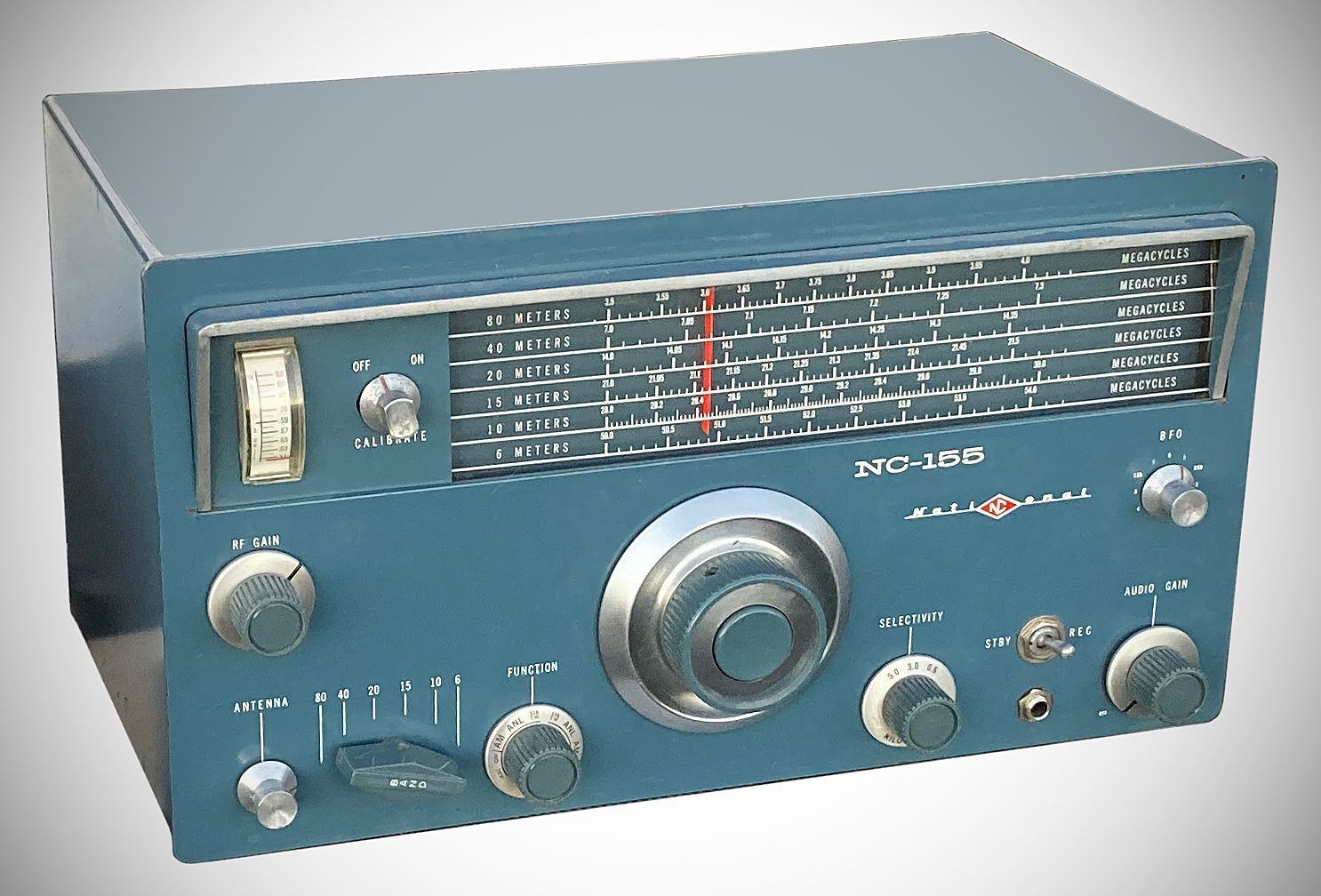
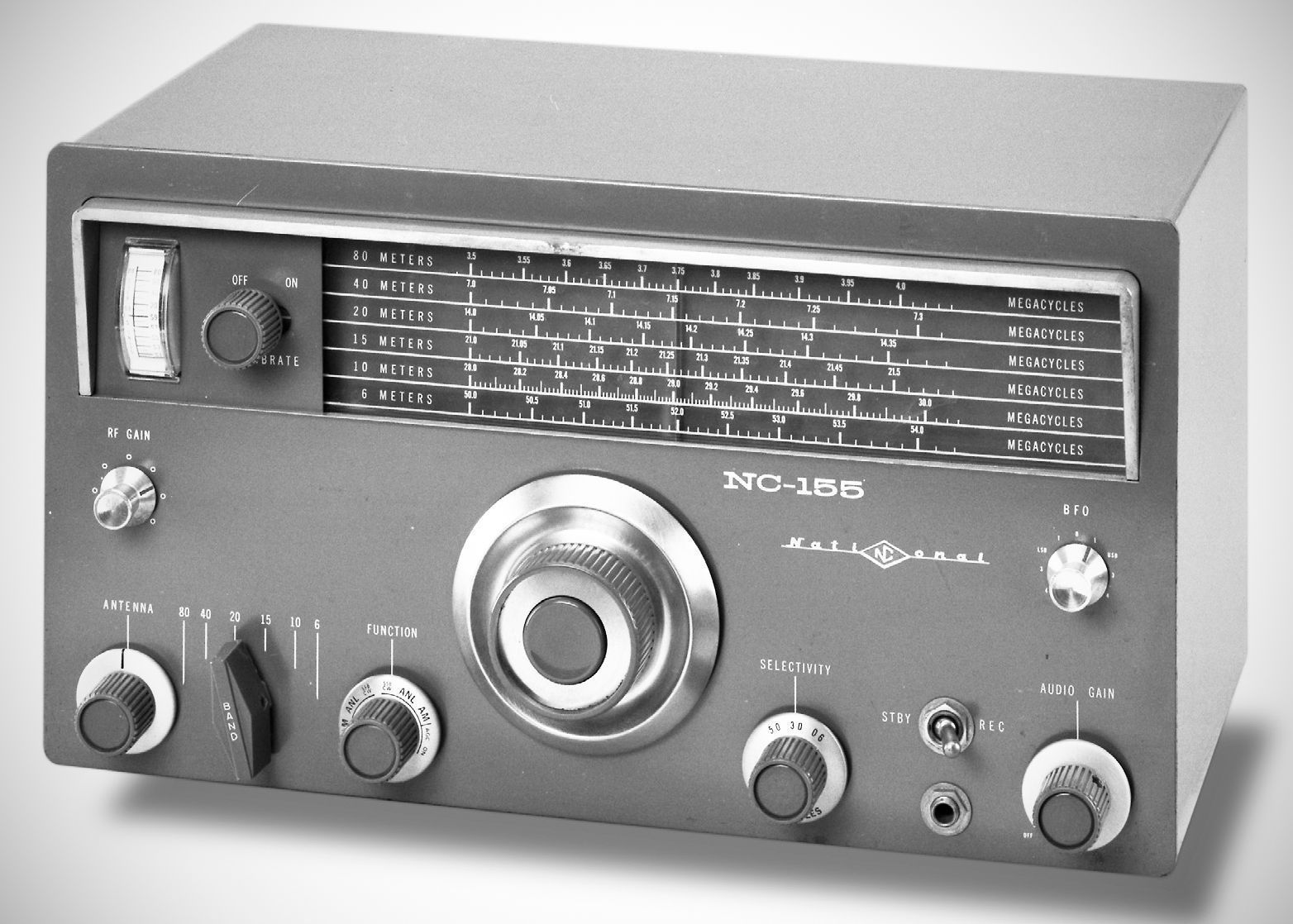
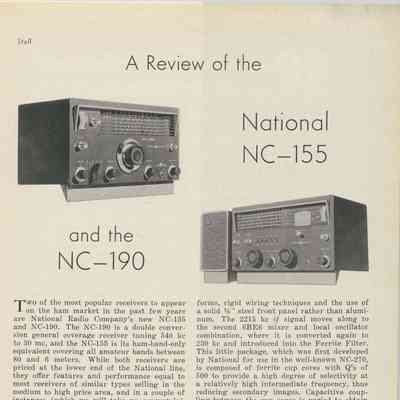
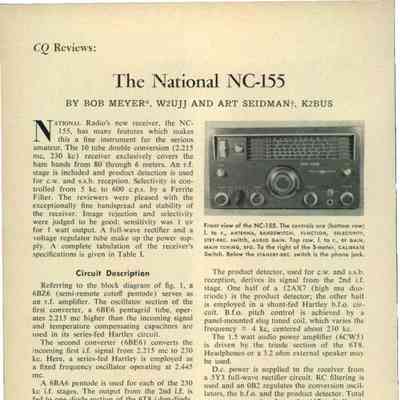
The National Radio Company NC-155 is an amateur band communications receiver designed as a double-conversion superheterodyne system. It provides dedicated coverage across six major amateur radio bands, with a frequency layout optimized for the 80, 40, 20, 15, 10, and 6-meter bands. This is another in National's "Cosmic Blue" series.
Uses National’s proprietary "Ferrite Filter," a high-Q circuit designed to yield steep selectivity curves. This filter provides three selectable bandwidth positions:
– 600 Hz: CW
– 3.0 kHz: SSB
– 5.0 kHz: AM.
Reception Modes and Controls
The NC-155 supports AM, SSB, and CW signals with dedicated detection paths. For standard AM, it features a conventional diode detector alongside a self-adjusting Automatic Noise Limiter (ANL) designed to suppress sharp electrical interference spikes. For CW and SSB, a separate triode heterodyne product detector is utilized. A panel-controlled Beat Frequency Oscillator (BFO) includes dedicated markings for Upper Sideband (USB) and Lower Sideband (LSB) to easily position the carrier injection along the slope of the IF passband.
The front panel function control permits the selection of these modes with the Automatic Gain Control (AGC) either active or completely disabled. When the AGC is switched on, an integrated signal strength meter becomes operational. This S-meter is connected between the plates of the two IF amplifier stages and is calibrated from S-1 to S-9 (with S-9 set at approximately 50 microvolts of input signal), reading up to 60 decibels over S-9.
The tuning mechanism uses a high-reduction 60:1 pinch-type drive combined with a 5:1 panel vernier for smooth, high-inertia flywheel tuning. The dial layout is a slide-rule style that includes an exclusive lateral dial adjustment knob, allowing the operator to shift the entire dial scale slightly for precise alignment against external references.
The rear apron features an unbalanced 50-to-70 ohm antenna terminal strip, speaker terminals matching a 3.2-ohm load, remote standby/receive control lines, and an accessory socket designed to interface with the optional XCU-109 1 MHz crystal calibrator.
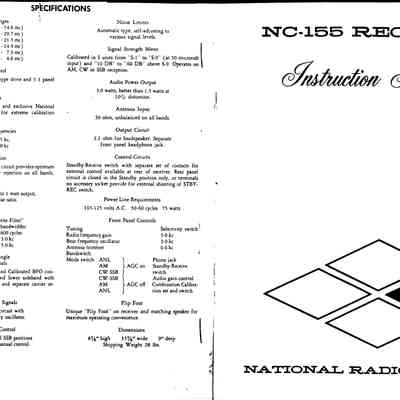
Specifications
– Frequency Coverage
6 m: 50.0–54.0 MHz
10 m: 28.0–29.7 MHz
15 m: 21.0–21.5 MHz
20 m: 14.0–14.4 MHz
40 m: 7.0–7.3 MHz
80 m: 3.5–4.0 MHz
– Tuning: 60:1 step down ratio with pinch type drive and 5:1 panel vernier for smooth inertia tuning.
– Intermediate Frequencies
1st IF: 2215 kHz
2nd IF: 230 kHz
– Sensitivity
Better than 1.0 uV for 1 watt output, 10 db signal to noise ratio.
– AGC: Operates in AM, CW and SSB positions or may be disabled for manual control.
– ANL: Automatic type, self-adjusting to various signal levels.
– Audio Power Output: 3.0 watts, better than 1.5 watts at 10% distortion.
– Antenna Input: 50 ohm, unbalanced on all bands.
Audio output: 3.2 ohm for speaker. Separate front panel headphone jack.
Tube Complement
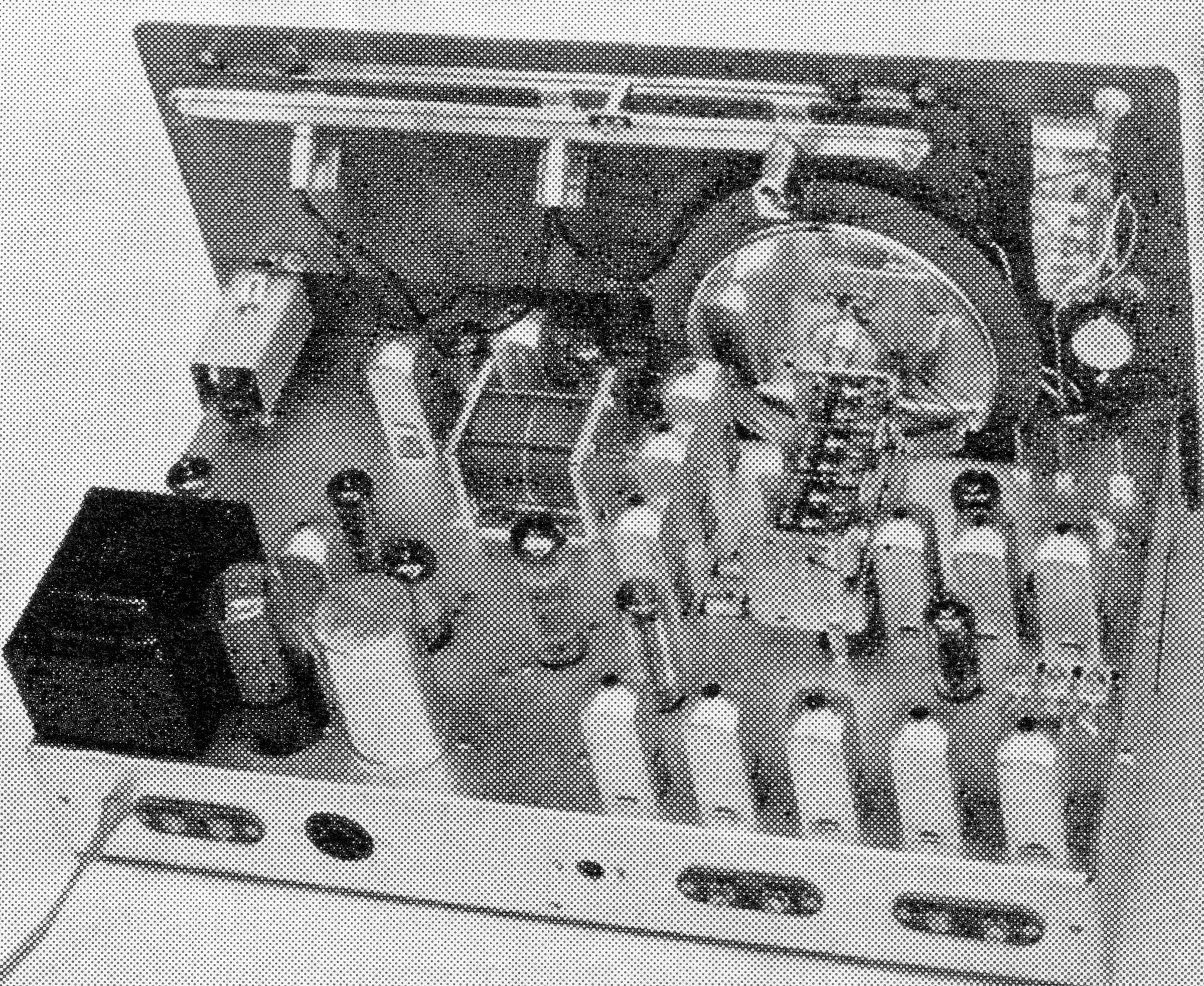
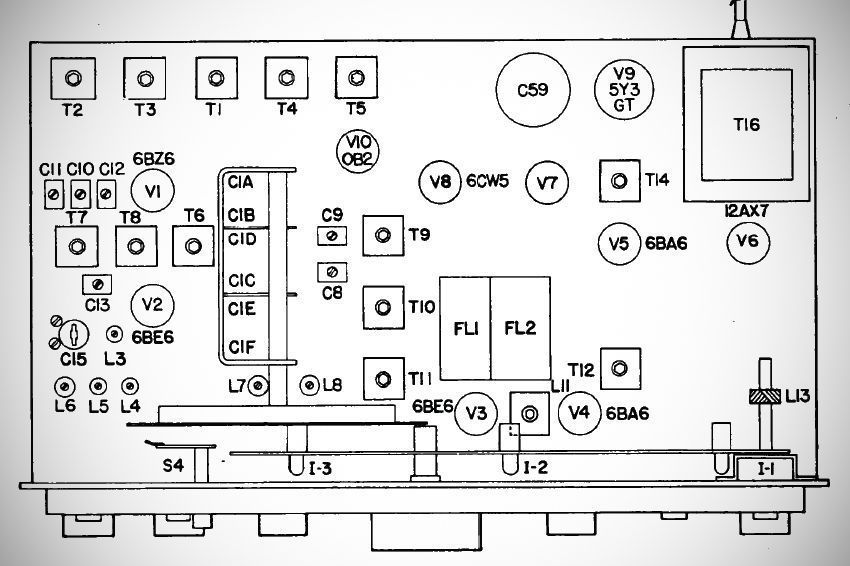
The NC-155 relies on a ten-tube architecture to handle RF, IF, audio, and power functions. The line-up includes:
– 6BZ6 RF amplifier
– 6BE6: 1st IF
– 6BE6: 2nd IF
– 6BA6: 1st IF amp
– 6BA6: 2nd IF amp
– 12AX7: BFO / product detector
– 6T8: AM detector, audio preamplifier, and ANL
– 6CW5: Audio amp
– 5Y3GT: Power supply rectifier
– OB2: Voltage regulator
Power Requirements: 105–125 VAC. 50/60 Hz, 75 watts.
References
Review: QST, Jul 1962, p. 47.
Review: CQ, Jan 1963, p. 38.