Note
QST, Jul 1961, p. 161.
Allied Radio catalog 1962 (copyright 1961), p. 277.
CQ, Aug 1961, inside back cover.
QST, Jan 1963, inside back cover.
QST, Dec 1963, inside back cover.
QST, Jan 1964, inside back cover.
Allied Radio catalog 1965 (copyright 1964), p. 328.
Allied Radio catalog 1966 (copyright 1965), p. 362.
Closely related to the NC-140. See discussion below.
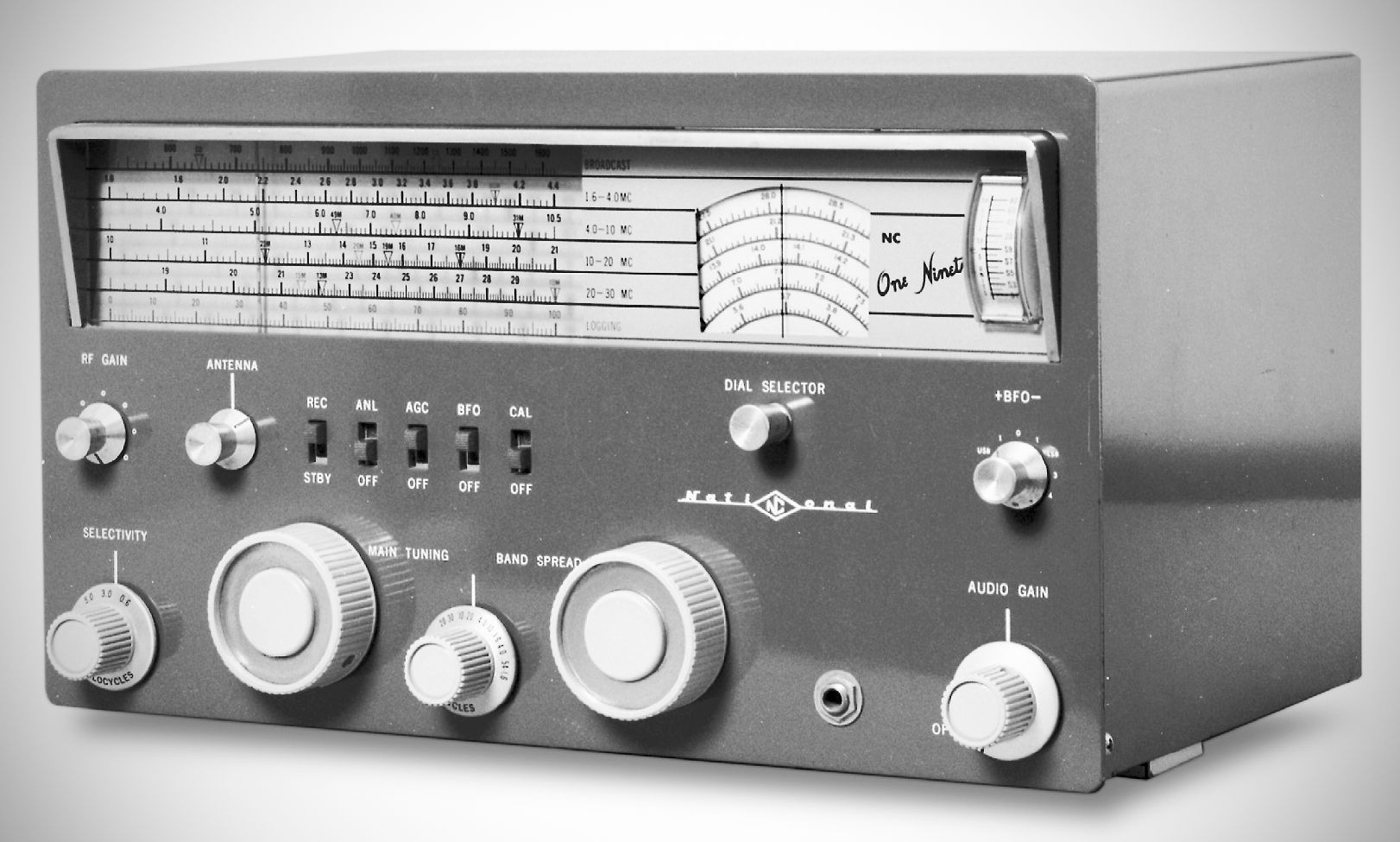
The NC-190 featured National’s “Cosmic Blue” finish.The 10-tube, double-conversion receiver had selectable ham or SWL band-spread dials. It tuned from .54–30 MHz and had IFs at 2215 and 230 kHz. The second IF incorporated National’s Ferrite Filter. Two separate band spread dials available with a front panel selector.
The National NC-190 is highly capable under crowded band conditions and serves as a general coverage or ham-band receiver, or as a tunable IF for use with VHF converters. It combines exceptional SSB, AM, and CW performance with an exclusive, patented Dial Selector mechanism that provides dedicated bandspread calibration for both shortwave/foreign broadcast and amateur bands.
Tuning & Frequency Coverage
– Main Tuning Ranges: Covers 540 KC to 30 MC across five main tuning bands.
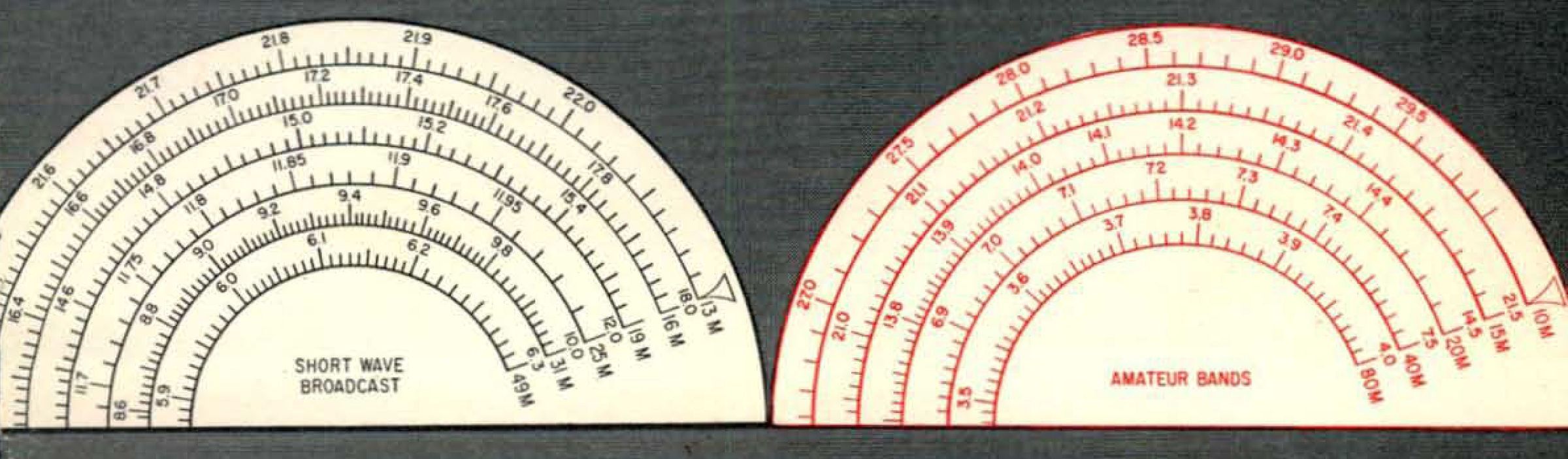
– Amateur Bandspread: Calibrated scales are provided for 80, 40, 20, 15, and 10 meters.
– International Broadcast Bandspread: Calibrated scales cover the 49, 31, 25, 19, 16, and 13 meter foreign broadcast bands.
– Tuning Mechanism: Features a 60:1 bandspread ratio utilizing a built-in National Velvet Vernier planetary tuning mechanism, providing exceptional ease of tuning.
Features
– Double conversion receiver (above 4 MC) utilizing a 6BZ6 RF stage for image rejection (1st IF is 2215 KC; 2nd IF is 230 KC).
– Sensitivity: Better than 1.0 uV for a 10 dB signal-to-noise ratio.
– Selectivity: True variable IF selectivity yielding:
600 Hz bandwidth for CW,
3 kHz for SSB, and
5 kHz for AM at the 6 dB points).
– Detectors & AGC: Includes a triode-type product detector for SSB/CW alongside a separate diode detector for AM. Automatic Gain Control (AGC) is fully operative on both AM and SSB/CW modes.
– Noise Limiters: Equipped with an automatic series gate for AM and IF limiting for SSB/CW signals.
– Audio Output: Front panel headphone jack and a 3.2-ohm speaker output delivering more than 1 watt at 10% distortion.
– Antenna Input: Coaxial antenna input.
Tube lineup (10 total)
– 6BZ6: RF Amplifier
– 12BE6: HF Converter
– 12BE6: 2nd Converter
– 12BA6: IF Amplifier
– 12BA6: IF Amplifier
– 12AX7A: Product Detector / BFO
– 6T8: AM Detector, Automatic Noise Limiter (ANL), Automatic Gain Control (AGC), and Audio Amplifier
– 6CW5: Audio Output
– 5Y3GT: Power Rectifier
– 0B2: Voltage Regulator
Accessories
NTS-3B matching speaker
XCU-109 crystal calibrator (which provides 100 kHz markers across the tuning range).
Power Requirements: 105–125 VAC, 50–60 cycles, 75 watts.
The NC-190X export model accommodates 115/220 VAC. 50/60 Hz.
Relationship to the NC-140
The NC-190 and NC-140 look like identical twins because, mechanically and structurally, they almost are. National introduced the NC-190 in 1961, and when they designed the lower-cost NC-140 in 1962, they directly reused the NC-190’s chassis, dial mechanisms, and "Cosmic Blue" cabinet.
However, if you look under the hood or try to align them, the electrical differences become very clear.
1. Selectivity Control (Potentiometer vs. Rotary Switch)
NC-190: Features a discrete 3-position rotary switch for selectivity, providing fixed bandpass widths of 0.6 kHz, 3.0 kHz, and 5.0 kHz.
NC-140: Uses a continuously variable potentiometer on the front panel. It controls feedback on a single regenerative IF stage (acting like a Q-multiplier), giving you infinitely adjustable selectivity from 0.5 kHz to 5.0 kHz.
2. IF Stage Complexity
NC-190: A more robust design featuring two dedicated IF amplifier stages.
NC-140: A simplified, budget-conscious design that has only one IF amplifier stage. To make up for the loss of gain and to keep selectivity sharp, National made this single stage highly regenerative.
3. Tube Layout & The Parts Bin Swap
Both radios utilize a somewhat odd mix of 6 and 12 volt tubes. National originally bought these 12 volt tubes in massive quantities for their incredibly popular NCX-3 transceiver. To save money, they designed the NC-140 to use them, requiring a unique power transformer with multiple filament windings.
Because the NC-140 sold poorly and was cancelled after about a year, National ended up with a large surplus of NC-140 power transformers. To burn through the inventory, late-production NC-190s were built using the NC-140's chassis and power transformers, leading to a lot of confusion for restorers when their NC-190 doesn't match the early 6V-only schematics.
References
Review. Popular Electronics, Sep 1961, p. 64.