Note
QST, Jul 1955, inside back cover. "Coming soon!"
QST, Oct 1955, p. 160. "Available now" / specs.
QST, Nov 1955, inside back cover. (lots of detail)
Allied Radio catalog 1958 (copyright 1957), p. 266.
QST, Feb 1960, p. 141.
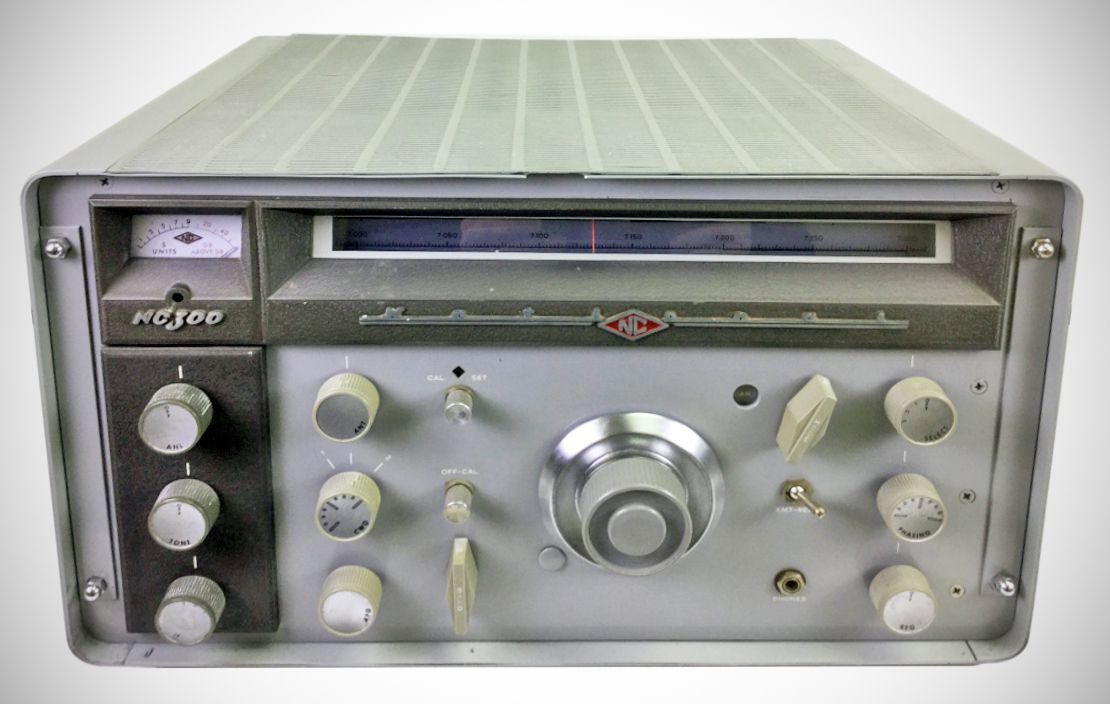
National's NC-300 was double-conversion with IFs at 2215 and 80 kHz. It had a crystal filter in the 1st IF. It covered the 160–10 meter bands and had a band at 30–35 MHz that served as a tunable IF for VHF converters. It was calibrated for 6, 2, and 1-1/4 meters. The 13-tube NC-300 had a product detector, and its AVC could be used on CW and SSB.
Circuit Design: It features a double-conversion superheterodyne circuit.
Tuning Mechanism: Uses a heavily weighted tuning knob coupled to a free-moving gear train to provide a smooth 40-to-1 tuning ratio with zero backlash.
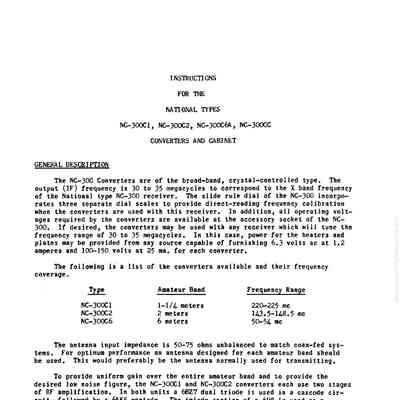
The NC-300 covers all standard amateur bands from 160 through 10 meters, plus a special 30–35 MHz band designated as the "X" band. The "X" band functions as a tunable IF range for external broadband crystal converters to listen to 6, and 2 meters, and 220 MHz.
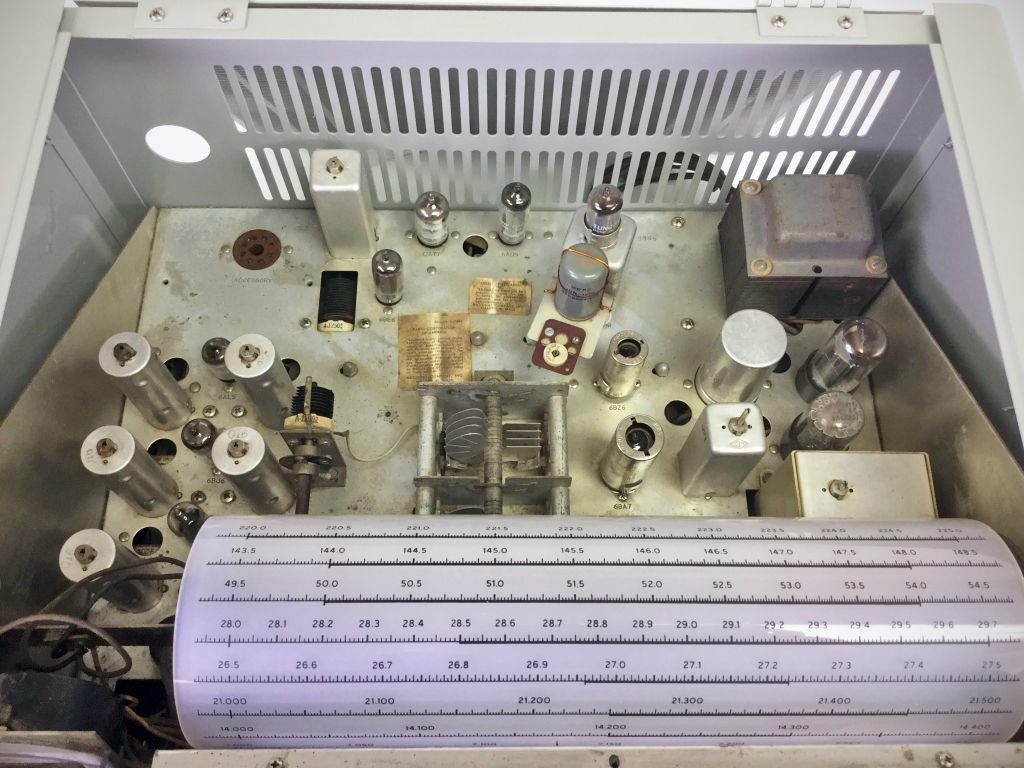
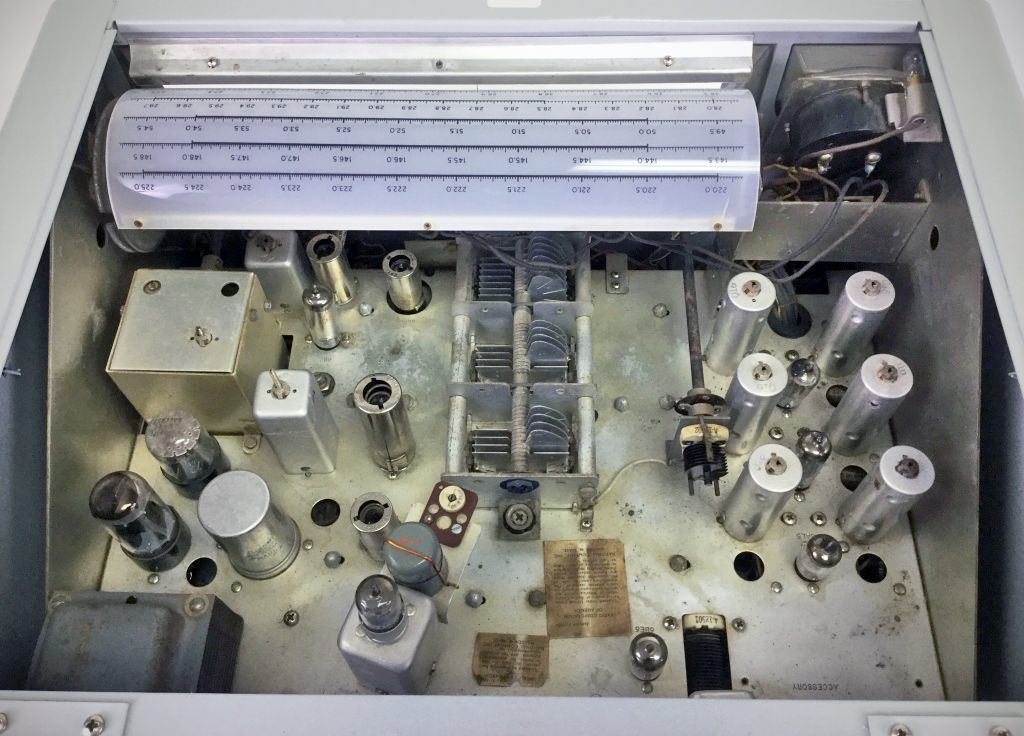
The direct-reading slide-rule dial functions via a rotating drum mechanically coupled to the band switch. To prevent visual clutter, only the calibrated scale for the specific band in use is visible in the dial window.
The tuned bands and their ranges are:
160 Meters: 1.8 – 2.0 MHz
80 Meters: 3.5 – 4.0 MHz
40 Meters: 7.0 – 7.3 MHz
20 Meters: 14.0 – 14.4 MHz
15 Meters: 21.0 – 21.5 MHz
11 Meters: 26.5 – 27.5 MHz
10 Meters: 28.0 – 29.7 MHz
X Band: 30.0 – 35.0 MHz (used with external converters to tune 6m, 2m, and 220 MHz
– Selectivity: 0.5, 3.5, and 8 kHz
– Crystal Filter: Works in tandem with the IF circuitry, offering three degrees of crystal selectivity and a Phasing control to inject a precise nulling notch to slice out nearby interfering signals. (Note: The crystal filter cannot be used when the IF switch is set to the sharpest 500 Hz position).
– Two-Way RF Gain Control: An integral switch on the Audio Gain control allows the user to remove the RF gain control from the RF amplifier stage entirely. This lets the front-end run at maximum gain while overall gain is managed strictly through the IF stages.
– SSB and CW Detection: Features a highly stable, low 80-kHz second IF and a stable CW oscillator utilizing the heterodyne detection principle for proper carrier re-insertion voltage during SSB copy.
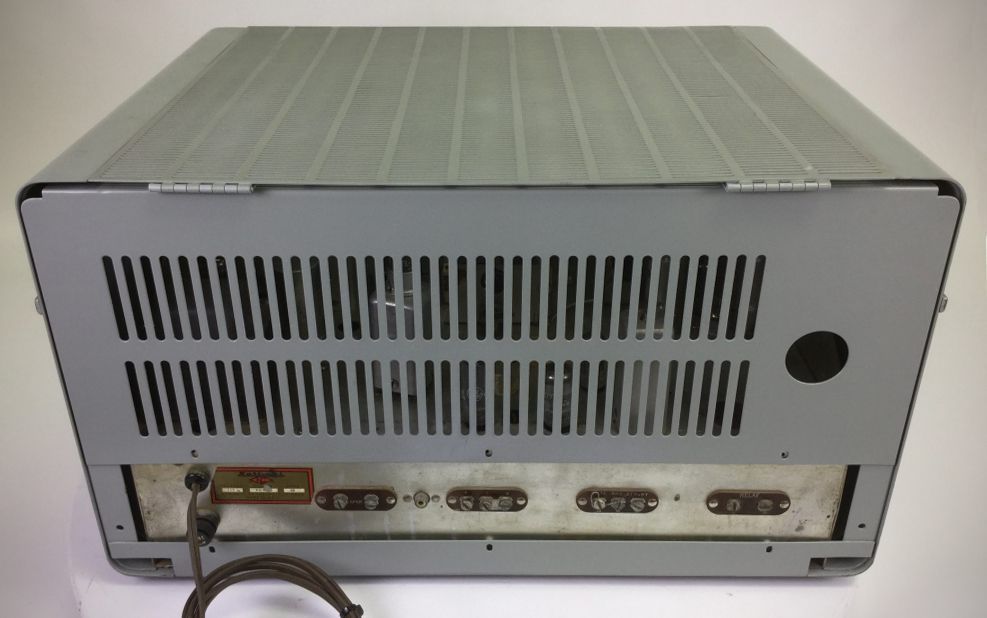
– Muting & Station Integration: Includes a built-in muting circuit that cuts off the audio amplifier during transmission without needing extra relays. It requires a negative 22 to 50V supply from the transmitter. Additionally, rear Relay terminals short together when the front panel switch is flipped to "XMT", acting as a master station changeover for external antenna or plate relays.
– S-Meter: An illuminated meter provides relative signal strength readings calibrated in S-units from 0 to 9 and decibels up to 40 db over S-9. The circuitry is designed to prevent the needle from pegging on signals over 60 db.
– Expandability: The chassis includes a dedicated factory-wired socket to drop in the National XCU-300 Crystal Calibrator unit alongside an accessory socket that provides B+, heater voltage, AVC, and receiver IF output for external accessories or converters.
Features:
– Tuning Ratio: 40-to-1 tuning mechanism with a heavily weighted flywheel gear train.
– Ten dial scales for coverage of 160 meters to 220 MHz meters with converter provision and receiver scales calibrated for 50, 144, and 220 MHz using a special 30–35 MHz tunable IF band.
– Dial Type: Rotating drum-style slide-rule dial (exposes only the active band scale to view).
– Slide-rule dial is more than a foot long. Easily readable to 2 kHz without interpolation up to 21.5 MHz.
– Hi-speed, smooth inertia tuning dial with 40 to 1 ratio.
– Three-position IF selector—0.5, 3.5, and 8 kHz
– Separate linear detector for SSB decreases distortion by allowing AVC "on" with single sideband. Will not block with RF gain full open.
– Muting for CW break-in operation.
– Calibration reset adjustable from front panel to provide exact frequency setting.
– Crystal filter with phasing control and three-position bandwidth control.
– Wide range tone control, for control of both low frequency and high frequency end of response curve.
– Socket for crystal calibrator plus accessory socket for powering converters and future accessories.
Specifications
– Circuit Type: Double-conversion superheterodyne.
– Intermediate Frequencies (IF):
1st IF: 2215 kHz.
2nd IF: 80 kHz
– Sensitivity: better than 1.5 µV
– Selectivity:
500 cycles (CW)
3.5 kHz (Phone/SSB under interference)
8.0 kHz (Broad/VHF converters)
Inputs, Outputs & Interfacing
– Antenna Input: Terminals for balanced or unbalanced transmission lines.
– Audio Output Impedance: 3.2 ohms (for external speaker or headphones).
– Muting Interface: Requires an external negative bias voltage (-22V to -50V DC) from a companion transmitter.
– Relay Terminals: SPST internal switch contacts (closed in "Xmt" position) for master station control.
– Accessory Sockets:
Dedicated internal plug-in socket for the XCU-300 Crystal Calibrator.
Octal accessory socket providing B+, filament voltage, AVC line access, and 2nd IF output.
Tube Complement (10 tubes + 3 regulation/rectification):
6BA6 (RF Amplifier)
6BE6 (1st Mixer)
6C4 (1st High-Frequency Oscillator)
6BA6 (6-MHz 1st IF Amplifier)
6BE6 (2nd Mixer)
6BA6 (80-kHz 2nd IF Amplifier)
6AL5 (Detector, AVC, and Limiter)
6U8 (Audio Amp and CWO)
6AQ5 (Audio Output)
5Y3GT (High-Voltage Rectifier)
0B2 (Voltage Regulator)
4H4-C (Current Stabilizer / Ballast Tube)
References
Technical description. Radio News, Oct 1955, p. 96.
Adding WWV. CQ, Feb 1959, p. 39.
Revisions. CQ, May 1959, p. 41.
Ballast replacement. 73, Feb 1963, p. 38.
Improving SSB. 73, Apr 1966, p. 94.
Improving SSB. 73, Sep 1969, p. 52.