Note
QST, Apr 1959, inside back cover.
Allied Radio catalog 1960 (copyright 1959), p. 391.
QST, Dec 1963, inside back cover.
QST, Jan 1964, inside back cover.
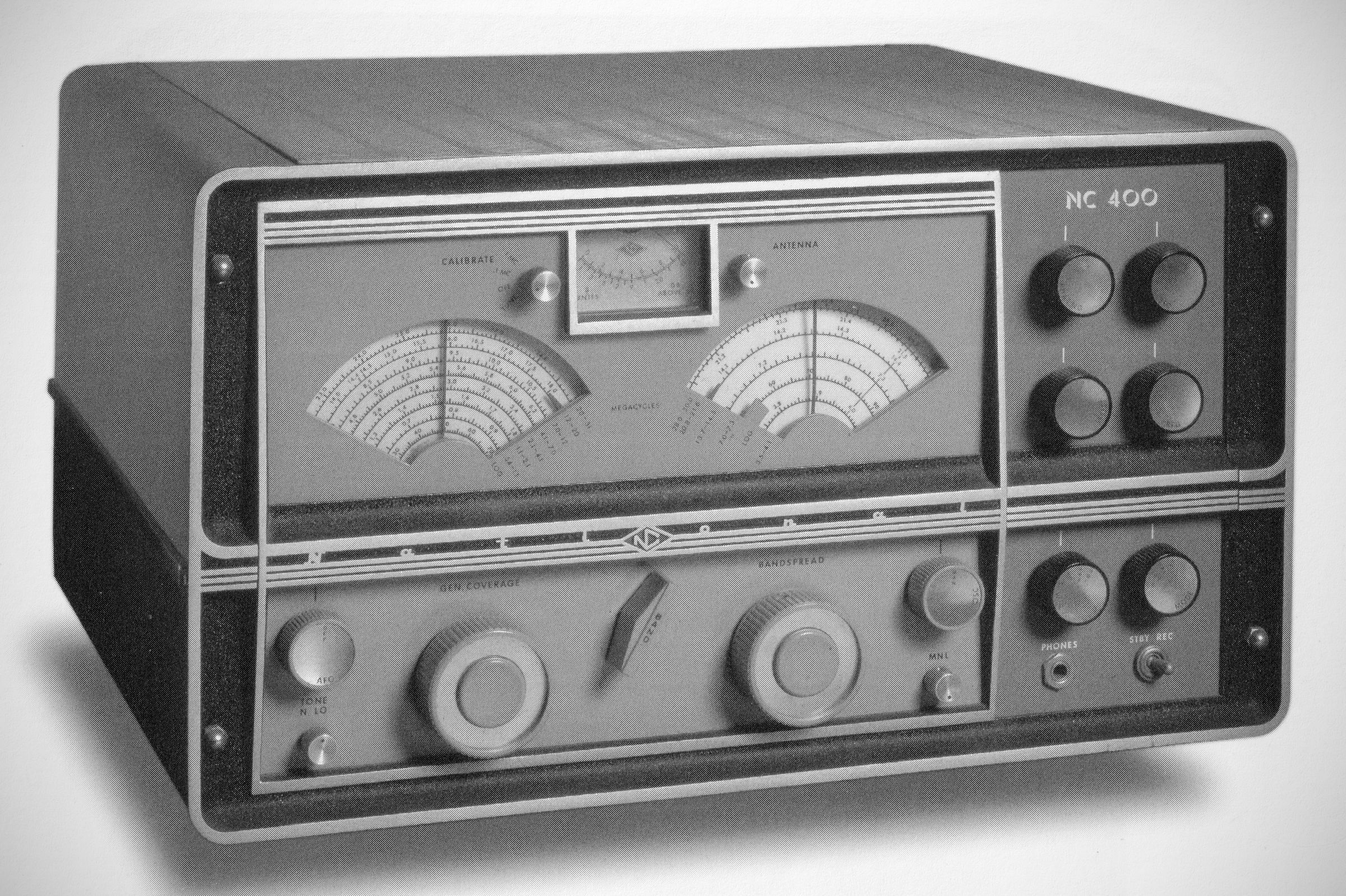
The National NC-400 represents a fascinating, if highly flawed, milestone in amateur radio history. Introduced around 1957 as National’s "flagship," it was the company's final attempt to market a top-tier vacuum tube communications receiver for the amateur and commercial markets, positioning itself to compete against legends like the Hammarlund SP-600 and the Collins R-390A.
The NC-400 is a narrative of exceptional, highly advanced RF concepting coupled with unfortunate gaps in mechanical implementation and ergonomics.
The "No Champion" Paradox: The NC-400 suffers from a lack of cohesive engineering leadership. Unlike Collins gear, which benefited from Arthur Collins' singular vision, the NC-400’s design teams seemingly worked in isolation. Features feel pulled from existing designs or tacked on as afterthoughts, likely due to shifting corporate goals or conflicting demands between commercial and amateur users.
Production Rarity: National built only about 500 units. Roughly 200 went to private amateur operators, while the remainder were sold to the FBI as rack-mounted units without outer cabinets.
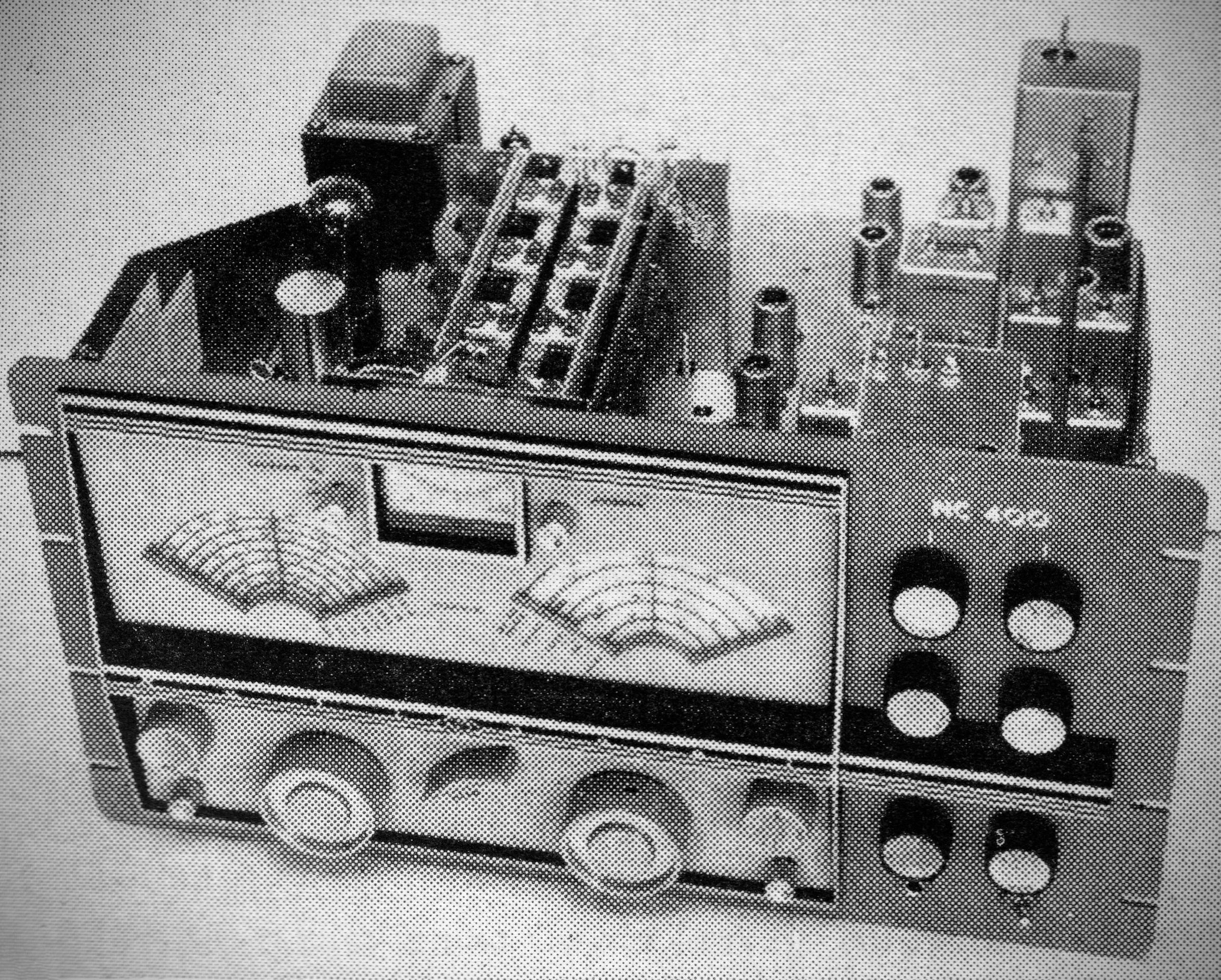
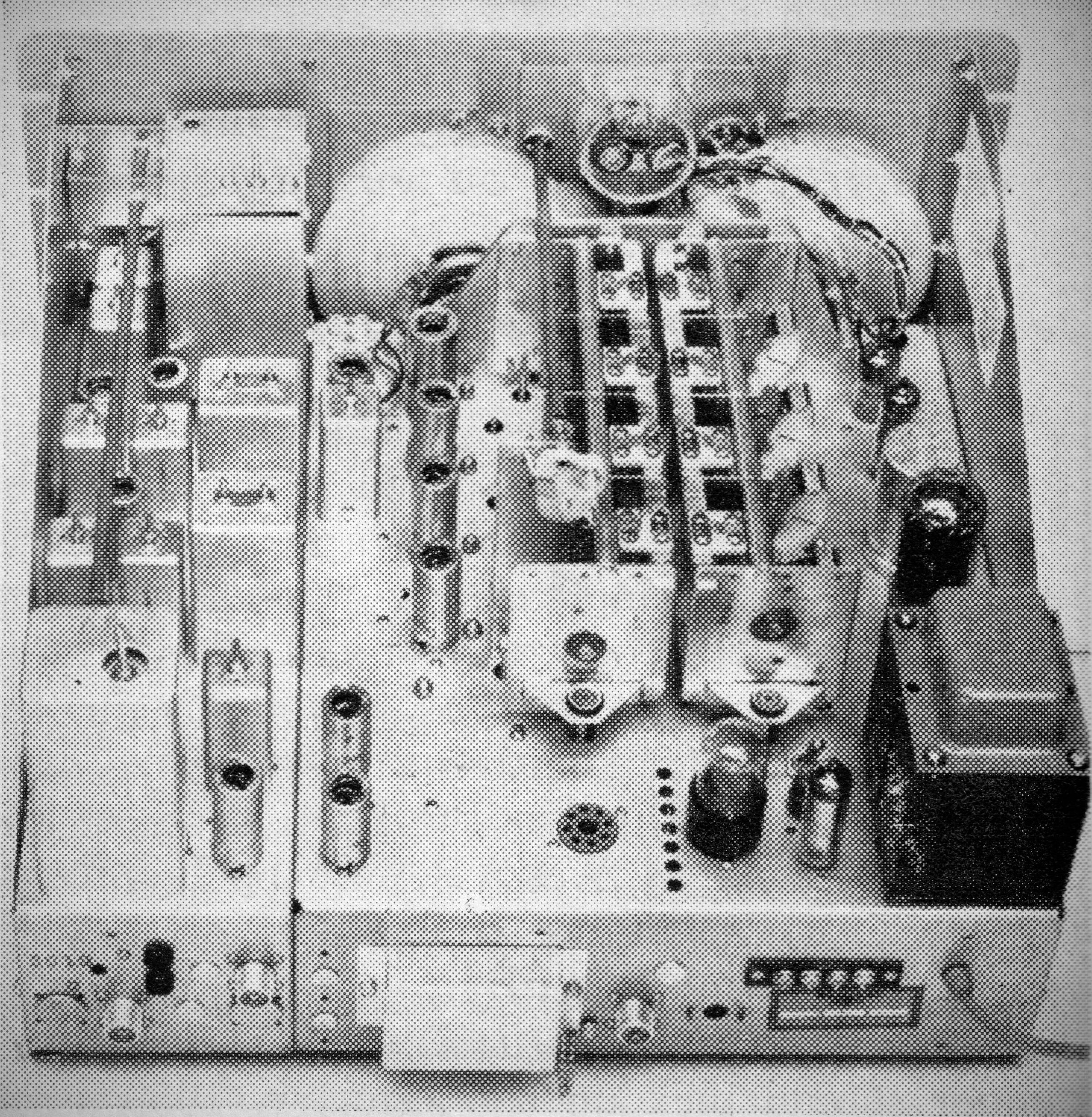
RF and Mixing Structure: The receiver covers 540 kHz to 31 MHz across seven bands. It features dual RF stages utilizing high-$\mu$ television pentodes, with three tuned circuits at the signal frequency. It uses dual conversion on the top three bands (first IF at 1.720 MHz, converting down to 455 kHz) and single conversion on the lower four bands (direct to 455 kHz).
The 14-Circuit IF Strip: To achieve narrow bandwidth, the standard receiver features an IF strip packing 14 tuned circuits centered at 455 kHz, delivering a 6/60 dB shape factor of roughly 3-to-1.
Quirky Sideband Selection: Instead of shifting the BFO frequency—the industry standard that keeps the passband stable—National chose to switch internal padding capacitors in and out of all 14 IF tuned circuits to move the entire center frequency. Because of this, the sideband settings are labeled SB1 and SB2 rather than USB and LSB. Component drift over the decades makes aligning this system a notorious challenge today.
Selectivity Options: The standard unit includes a single-crystal filter module (reminiscent of the late-model HROs) offering five selectivity steps and a phasing control. A later-adapted optional Collins mechanical filter holder could replace this module to host three mechanical filters, bypassing much of the standard IF strip.
The Calibrator Switch From Hell: The optional crystal calibrator features a tiny-diameter front-panel knob that is physically painful to turn. Worse, turning it past the "Off" position to the far-left "Tune" detent switches the local oscillator architecture entirely, causing the radio to behave erratically until the operator realizes the mistake.
String-and-Pulley Tuning: Despite its premium original retail price of $895, National bypassed its famous, heavy-duty HRO gear-drive tuning mechanism. Instead, they implemented a cheap layout of strings, springs, pulleys, and plastic knobs borrowed from lower-tier dual-dial receivers. The left dial handles coarse tuning, while the right handles bandspread. Repeatability was limited to roughly 5 to 10 kHz.
Physical Instability: The radio is a massive beast, weighing roughly 80 pounds and measuring nearly two feet square. Despite this heavy footprint, it lacks structural rigidity; bumping the operating desk or snapping a heavy front-panel switch can instantly jar the receiver's frequency by several kHz.
Though the FBI famously discarded their NC-400s in favor of R-390s as quickly as possible, the radio's native performance wasn't explicitly terrible. In fact, the NC-400 holds one distinct honor over its contemporary rivals: it is the only receiver of the trio (NC-400, SP-600, R-390A) capable of cleanly demodulating an SSB signal out of the box using its built-in product detector without requiring a cumbersome external adapter.
Today, its value to collectors is driven entirely by its immense rarity and striking, mid-century aesthetics rather than its real-world utility on the air.
Here are the specifications and tube lineup for the National NC-400 communications receiver, written out in clear text lists:
Specifications
– Modes: AM, SSB, and CW.
– Sensitivity: Approximately 1 microvolt for a 10 dB signal-to-noise ratio.
– Frequency Stability: Long-term drift of 0.0025% after warm-up.
– RF Input: Single-ended coaxial, 52 ohms, featuring an antenna trimmer.
– Audio Output: Outputs for 3.2 and 600 ohms impedance, providing 1 watt of power with distortion under 10%.
Power Requirements: 115 or 230 volts AC, 60 cycles, 138 watts.
Frequency Range by Band
– Band 1: 0.54 to 1.1 Mc.
– Band 2: 1.1 to 2.1 Mc.
– Band 3: 2.1 to 4.1 Mc.
– Band 4: 4.1 to 7.0 Mc.
– Band 5: 6.9 to 12.2 Mc.
– Band 6: 11.8 to 20.4 Mc.
– Band 7: 19.6 to 31.0 Mc.
Image Rejection by Band
– Band 1: 100 dB or more.
– Band 2: 100 dB.
– Band 3: 85 dB.
– Band 4: 65 dB.
– Band 5: 95 dB.
– Band 6: 90 dB.
– Band 7: 80 dB.
Intermediate Frequency (IF) Selectivity
– Overall Range: 16 kc down to 150 cycles when utilizing the crystal filter.
– Broad Setting: 16 kc bandwidth.
– Medium Setting: 8 kc bandwidth.
– Sharp Setting: 4 kc bandwidth.
– Very Sharp Setting: Variable from 3.5 kc down to 150 cycles via the crystal filter.
– SSB Setting: 3.5 kc bandwidth at 6 dB down, and 10.0 kc bandwidth at 60 dB down.
Available Accessories
– Crystal Calibrator: A plug-in unit (XCU-400) providing 100 kc and 1 Mc marker frequencies, selectable via a front panel switch.
– Diversity Modification Kit: Enables dual-receiver diversity setups.
– Mechanical Filter Housing: A plug-in option replacing the standard crystal filter to accept mechanical filters.
– Fixed-Channel Crystals: Up to 5 plug-in crystals for fixed-channel operation of the high-frequency oscillator.
– BFO Control Crystal: A plug-in crystal option for fixed BFO operation.
– Speaker: A matching external speaker was also available.
Tube Lineup
The receiver uses an 18-tube complement consisting of the following stages:
– 6BZ6: 1st RF amplifier.
– 6BZ6: 2nd RF amplifier.
– 6BE6: 1st Mixer (for the 455 kc conversion).
– 6BE6: 1st Mixer (for the 1720 kc conversion).
– 6BE6: 2nd Converter / Oscillator.
– 6BZ7: High-Frequency Oscillator.
– 6BA6: 1st IF amplifier.
– 6BA6: 2nd IF amplifier.
– 6BA6: 3rd IF amplifier.
– 6AL5: AM Detector and Automatic Noise Limiter (ANL).
– 6BE6: Heterodyne Detector.
– 6AL5: Manual Noise Limiter (MNL).
– 6U8: Beat Frequency Oscillator (BFO).
– 12AT7: 1st Audio Amplifier and S-Meter Amplifier.
– 6AQ5: Audio Output stage.
– 4H4C: Filament Current Regulator.
– 0B2: Voltage Regulator.
– 5U4GB: Full-wave Rectifier.
References
Brief description. Radio News, Apr 1959, p. 151.
Review: CQ, Apr 1960, p. 60.