Note
QST, Sep 1937, back cover.
Radio News, May 1941, p. 51. (clearance)
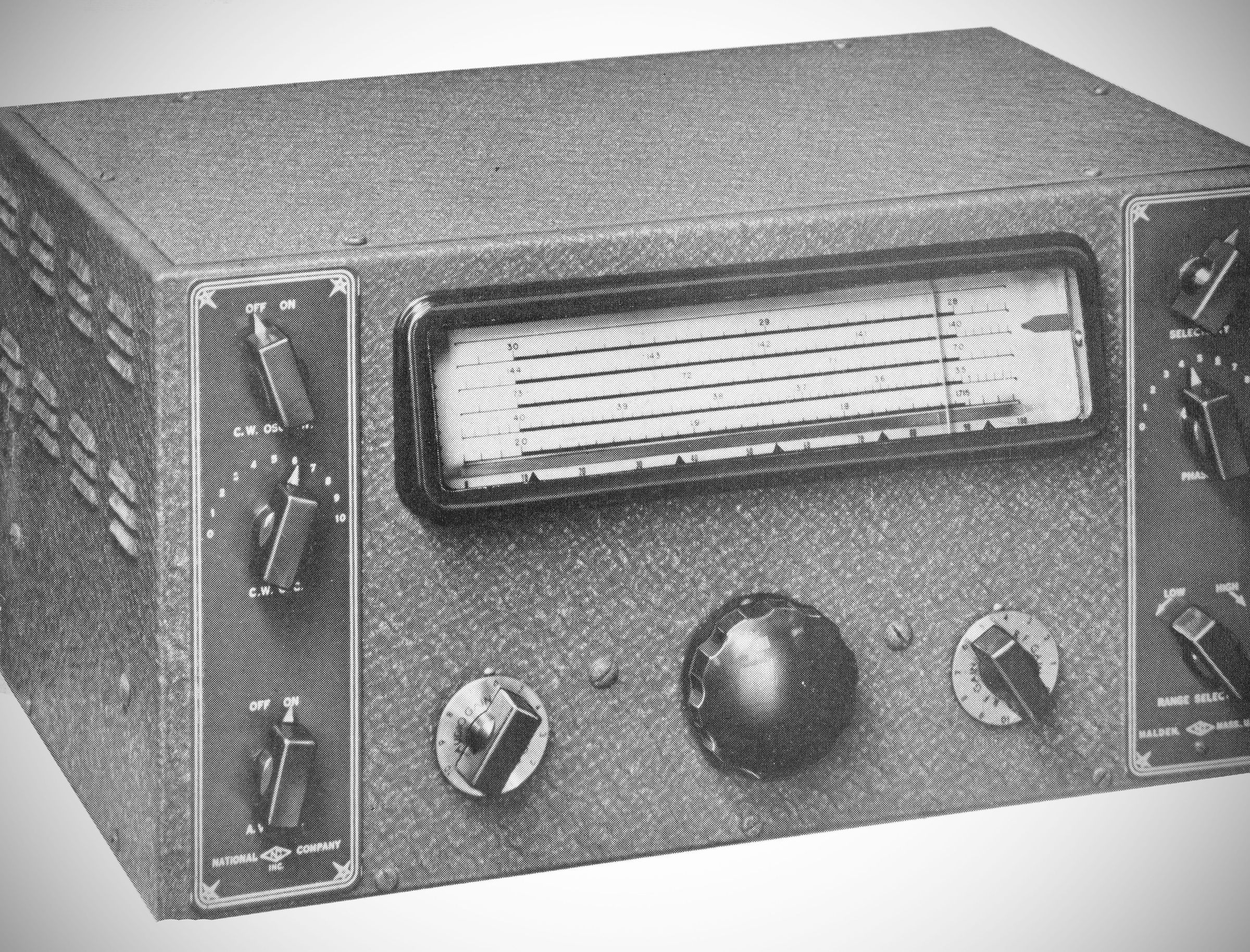
This is the ham-band-only version of the general coverage NC-80X.
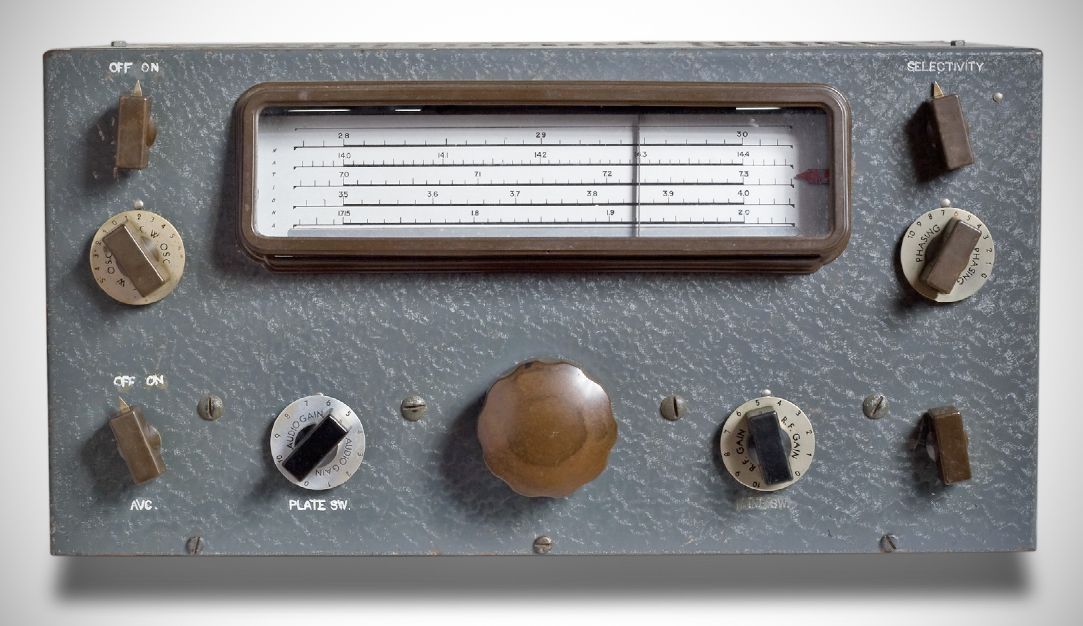
The National NC-81X is a 10-tube amateur-band communications receiver introduced by the National Company in September 1937 . Designed by James Millen and Dana Bacon, it was developed as a high-performance, low-cost successor to the obsolete FB-7, aiming to provide cash-strapped amateurs during the Great Depression with a high-quality radio for an amateur net price of $88.00. The AC/DC powered set used 10 tubes and had a crystal filter.
In one of his National Company ad “chats” in QST, James Millen related how the company had tried to lower the NC-81X’s price by employing consumer broadcast set-quality components. The resulting receiver failed to meet the company’s standards and National’s own PW tuning capacitors were used to replace the cheaper units in the first production run.
Design & Cost-Cutting Measures
To keep the receiver budget-friendly, several standard amenities found on premium National models (like the HRO or NC-100 series) were omitted or simplified :
– No Power Transformer: It was originally designed around an AC-DC circuit to eliminate transformer costs, heat, and hum, though it required extra manufacturing costs to completely insulate the chassis from the outer cabinet .
– No R.F. Stage or S-Meter: These were excluded entirely from the factory configuration .
– Simplified Coil Tray: It utilized a simplified, 10-compartment cast aluminum sliding coil tray with a thin aluminum cover plate, adapted from the heavier NC-100 design .
– Slide-Rule Dial: The premium National PW micrometer dial and gear box were replaced with a more economical slide-rule dial . The dial featured a two-speed drive (16:1 for quick tuning and 80 to 1 for precise bandspread tuning) alongside a mirror strip and knife-edge pointer to eliminate parallax errors .
Specifications
– Frequency Coverage: Specifically tailored for the five amateur radio bands of its era . True to National's precision design, each band was meticulously aligned to span precisely from 10 to 90 on the dial scale .
– High-Frequency I.F.: It utilized a high-frequency IF (1560 kHz) to eliminate image frequencies .
– Crystal Filter: Features a built-in, wide-range crystal filter that is continuously variable from 300 Hz to 7 kHz . Because of the high IF design, the filter could be left active in the circuit at all times .
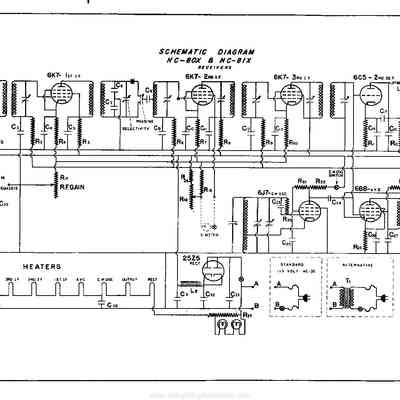
Tube Lineup & Audio: The design used a new beam-power amplifier tube (25L6G) that delivered 2 watts of audio output even at low plate voltages . The full tube lineup included :
6J7: First Detector, High-Frequency Oscillator (HFO), and CW Oscillator
6K7: Three separate I.F. stages
6C5: Second Detector
6B8: Automatic Volume Control (AVC)
25L6G: Audio Output
25Z5: Rectifier
Power Variations:
⚠️ While standard production models were built as 115V AC-DC "hot-chassis" units, National offered a factory-installed isolation transformer option for a few dollars more, transforming the set into a strictly 115V AC model . Both variations required removing screwed-on top and bottom plates to access the chassis safely .
Speaker: The $88.00 price tag included an open speaker "chassis" (the frame and cone).
The NC-81X offered remarkable performance for its price point—particularly on the 10-meter band due to its highly stable, well-regulated power supply . The model was produced until mid-1939 when James Millen departed the company, after which it was replaced by cheaper, entry-level lines like the NC-44 .
References
Brief description. Radio News, Nov 1937, p. 279
A few notes: QST, Dec 1937, p. 61.
Brief review: Radio, Jan 1938, p. 100.
Lafayette catalog number 78, p. 147.
NC-81