Note
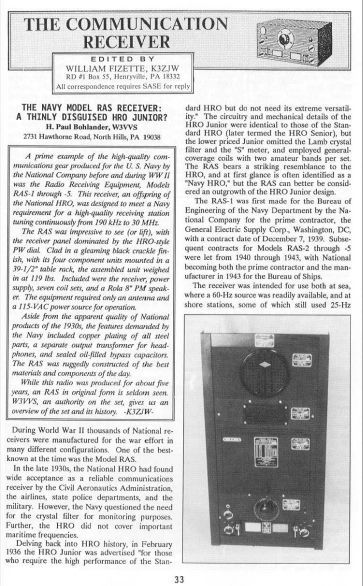
The National RAS-1 through -5 were high-quality, rugged communications receivers manufactured for the U.S. Navy by the National Company before and during World War II.
While often mistaken for a "Navy HRO" due to its similar appearance and PW dial, the RAS was actually an outgrowth of the lower-priced HRO Junior design. The Navy bypassed the HRO's standard crystal filter and "S" meter for monitoring purposes, opting for a design that could cover vital maritime frequencies.
Production spanned roughly five years. The RAS-1 contract began on December 7, 1939, via prime contractor General Electric Supply Corp. By 1943, National became the prime contractor for later models (RAS-2 through -5) for the Bureau of Ships.
Built for military environments, features included copper-plated steel parts, sealed oil-filled bypass capacitors, a 6V6 output tube, a 6F8G dual triode detector, and a separate sealed output transformer for 600-ohm headphone audio. An optional Mission Bell noise limiter sub-chassis became available in the mid-1940s.
The receiver provided continuous tuning from 190 kHz to 30 MHz.
Unlike the conventional 456-kHz IF of the standard HRO, the RAS used a 175-kHz IF. This allowed it to tune through the 430–480 kHz range to receive maritime and aircraft frequencies without interference, placing spurious responses safely outside critical bands. Because of this, RAS and HRO coils are not interchangeable.
Designed for both sea and shore stations, the equipment could run on 60-Hz power, 25-Hz power packs, or 180-volt batteries.
During and after WWII, the RAS was heavily utilized for:
– Monitoring strike frequencies during naval operations.
– Listening to air-sea rescue channels.
– Operating as control-tower monitors where the Army Airways Communications System (AACS) was unavailable.
– Providing entertainment for land-based aircraft squadrons, Carrier Aircraft Service Units (CASUs), and Marine Air Groups (MAGs), who used them to tune into Armed Forces Radio and continental U.S. broadcast stations.
References
See notes in QST, Feb 1946, p. 79.